





Cash flow forecasting for small businesses is one of those topics many owners know they “should” care about, but often push down the list. We get it. You are busy selling, serving customers, and keeping the lights on. The trouble is, without a clear view of future cash, you are mostly guessing about hiring, inventory, marketing spend, and even your own salary.
When cash gets tight, the stress hits fast. Suppliers chase payment, payroll deadlines loom, and suddenly every decision feels risky. A solid cash flow forecast doesn’t remove uncertainty, but it gives you a clear map of what’s coming. That means fewer surprises and more control. In this article, we’re going to be taking a look at cash flow forecasting for small businesses, and how you can use it to make smarter decisions and sleep a little better at night. If you would like to find out more, feel free to read on.
Pic – CC0 License
Why cash flow forecasting matters more than profit
Profit is what you see on your income statement. Cash is what sits in your bank account. They are related, but not the same. You can be profitable on paper and still struggle to pay your bills if cash is slow to arrive.
For small businesses, cash flow forecasting helps you answer simple but important questions:
- Will we have enough money to pay salaries next month?
- When can we afford that new hire or equipment?
- How much can we safely spend on marketing?
- What happens if a big client pays late?
When you know your expected cash in and cash out, you can plan instead of react. That is the real power here.


The basics of a cash flow forecast
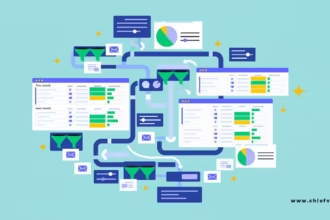
Cash Flow Forecasting for Small Businesses:A cash flow forecast is just a forward-looking schedule of money coming in and going out of your business over a set period. For most small businesses, a 13‑week (quarterly) weekly forecast is a good start.
At its core, your forecast tracks:
- Opening cash balance – how much is in the bank at the start of the period
- Cash inflows – customer payments, grants, loan drawdowns, other income
- Cash outflows – rent, salaries, supplier payments, loan repayments, tax, etc.
- Closing cash balance – how much is left after inflows and outflows
Repeat this weekly, and you have a simple but powerful view of your cash runway.
How to build a simple forecast that you’ll actually use
We are going to keep this practical and light on jargon. You can do this in a spreadsheet or basic accounting software.
- Decide your time frame
Start with 13 weeks. It is short enough to stay realistic, but long enough to spot trouble ahead. - List your expected inflows
Look at:- confirmed invoices and expected payment dates
- regular income (retainers, subscriptions)
- any planned grants or loan drawdowns
Use past payment behaviour to adjust dates. If a client usually pays 10 days late, reflect that.
- List your fixed outflows
These are the payments you know are coming:- rent and utilities
- salaries and CPF contributions (if you are in Singapore)
- loan repayments
- regular software and service subscriptions
- Add variable outflows
These depend on sales and operations:- inventory or raw materials
- marketing and ads
- freelance or contract work
Base these on realistic plans, not on best‑case hopes.
- Calculate weekly balances
For each week:- start with opening cash
- add inflows
- subtract outflows
- you now have the closing cash balance
That closing balance becomes next week’s opening cash. Once you set this up, updating it takes much less time than you might think.
Common mistakes small businesses make
Cash Flow Forecasting for Small Businesses:When we look at cash flow forecasting for small businesses, we often see the same issues:
- Over-optimistic inflows
Counting sales that are not confirmed, or assuming everyone pays on time. It is safer to be conservative with income. - Forgetting tax and annual costs
Tax, insurance, and annual software renewals can hit hard if they are not in the forecast. Add them in as soon as you know the timing. - Not updating the forecast
A forecast built once and ignored quickly becomes useless. Make it a weekly habit, like checking email. - Ignoring scenarios
Owners often plan for the best case only. What if a big client leaves? What if costs rise? Simple “what if” scenarios are very helpful.
Recognising these patterns is the first step to fixing them.

Turning your forecast into better decisions
A good forecast is not just a file sitting on your desktop. It should directly shape your decisions. Here are a few ways to use it:
- Timing investments
If your forecast shows a cash dip in two months, you may delay a big purchase or hire until after that point. - Negotiating payment terms
You might bring forward customer payments with better terms, or push out supplier payments where relationships allow. - Planning for funding
If your runway looks short, you can start talking to lenders or investors early, instead of waiting for a crisis. - Aligning your team
Sharing a simple version of the forecast with key staff can help everyone understand why certain decisions are being made.
The goal is to make your cash forecast part of your regular decision-making rhythm.
When you might need extra help from a finance expert
As your business grows, managing cash gets more complex. Multiple revenue streams, different currencies, and more staff all add layers. At that point, many founders start thinking about stronger financial leadership.
This is where the conversation about fractional CFO vs full time CFO for scaling companies comes into play. A fractional CFO can help you design better cash flow forecasting, build stronger reporting, and give you strategic guidance without the cost of a full-time executive. A full-time CFO makes more sense when your cash decisions are daily, high-stakes, and heavily linked to funding and expansion.
If you find that cash discussions are taking up too much of your time and you are still not confident in the numbers, that is a sign you might benefit from more senior support, even if only part-time at first.
Keeping cash flow forecasting practical and sustainable
The best forecast is the one you keep up to date. It does not need to be perfect or complex. It needs to be honest, simple, and regularly reviewed.
Set a weekly calendar reminder. Update last week’s actuals. Adjust inflows and outflows based on new information. Look at your closing cash over the next 13 weeks and ask yourself: do we like what we see, and if not, what can we change?
We hope that you have found this article enlightening in some way, and that cash flow forecasting for small businesses feels more like a straightforward tool you can use, rather than another accounting chore. If you build a simple forecast, keep it updated, and let it guide your decisions, you will reduce stress and gain more control over your growth. And when you reach the point where you are thinking about higher-level financial leadership, you will be in a stronger position to decide between a fractional CFO vs full time CFO for scaling companies.