





Multi-touch attribution analytics can sound like something only big tech companies use. In reality, it’s one of the most practical tools you can bring into your marketing and sales operation. If you’ve ever wondered which campaigns are actually driving revenue (not just clicks), you’re already thinking in the right direction.
Most businesses today use several channels at once—paid search, social media, organic content, email, events, partners, and more. The problem is, your customer’s journey cuts across all of them. Without a way to see the whole picture, you end up guessing where to invest. That’s where multi-touch attribution analytics steps in.
In this article, we’re going to be taking a look at multi-touch attribution analytics, and how you can use it to improve your marketing ROI, make smarter budget calls, and align with your sales and finance teams. If you would like to find out more, feel free to read on.
Pic – CC0 License
What is multi-touch attribution analytics?
Let’s keep this straightforward. Multi-touch attribution analytics is the process of tracking every meaningful interaction a prospect has with your business and then assigning shared credit for a conversion across those touchpoints.
Instead of saying, “This deal came from Facebook” or “This customer is from Google Ads,” you admit the truth: several touchpoints probably helped move that person from stranger to customer.
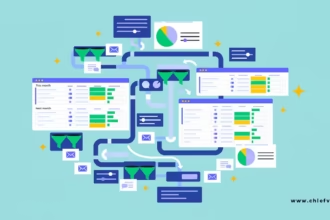


Those touchpoints might include:
- A LinkedIn ad viewed on mobile
- A blog post found via search
- A webinar registration from email
- A product page visit from retargeting
- A final “Book a demo” click from a branded search ad
Multi-touch attribution analytics uses data from your analytics tools, your marketing automation, and your CRM to show how these steps worked together. The result: you get a richer, more honest view of which channels, campaigns, and messages help close business.
Why multi-touch beats single-touch in modern marketing
Single-touch models, like “first touch” or “last touch,” are easy to understand. But they can be deeply misleading in real buying journeys.
Here’s why multi-touch attribution analytics is usually a better fit:
- It reflects how people actually buy
Your ideal customer doesn’t see one ad and convert on the spot. They research, compare, stall, return, and finally decide. Multi-touch analytics respects that reality. - It protects early-stage and mid-funnel marketing
Brand, content, and nurture campaigns often get ignored in last-touch models. Multi-touch attribution shows how those campaigns contribute, so they don’t get unfairly cut. - It supports more intelligent budget decisions
Instead of dumping budget into whatever got the last click, you can invest in the channels that consistently play a meaningful role at key stages in the journey. - It aligns marketing with sales and finance
When you can say, “This is how we assign credit across touchpoints,” it’s much easier to talk about ROI, pipeline, and forecasted impact.
If you’re already thinking about how CMO can measure marketing ROI with attribution modeling, multi-touch attribution analytics is the natural next step. It takes that core idea and gives you a more nuanced, comprehensive way to get there.
Common multi-touch attribution models (without the jargon)
Not all multi-touch models are the same. The good news is, you don’t need to know every formula under the sun. You just need to understand a few core patterns and pick what fits your business.
Here are some of the most common multi-touch attribution models:
- Linear model
Every tracked touchpoint in the journey gets equal credit. Simple, fair, but not always realistic if some steps clearly matter more than others. - Time-decay model
Touchpoints closer in time to the conversion receive more credit. Helpful when later-stage interactions, like retargeting ads or sales emails, are key to pushing deals over the line. - Position-based (U-shaped) model
A larger share of credit goes to the first and last touchpoints, with the remaining credit shared among the middle. This fits many B2B journeys where the first discovery and final conversion steps are especially important. - W-shaped and custom models
These give heavier weight to moments like lead creation, opportunity creation, and closed won, while still sharing credit with other touches. - Data-driven models
More advanced platforms use machine learning to infer the probability that each touchpoint contributed to a conversion, based on large volumes of data.
You can find clear explanations of these models in resources from Google Analytics, marketing platforms like HubSpot, and guides by analytics providers such as Adobe. The key is not chasing the fanciest model, but choosing one you can explain and apply consistently.
How multi-touch attribution analytics connects to ROI
At the end of the day, multi-touch attribution analytics should help you answer one big question: Which marketing activities are driving the most profitable growth?
Here’s how it connects directly to ROI:
- Track every touchpoint you reasonably can
Make sure your campaigns use proper UTM parameters, your website analytics is set up correctly, and your marketing automation platform is logging key actions. - Tie contacts and accounts to your CRM
When a deal is created and eventually closed, you want to know which marketing activities that person or company interacted with along the way. - Apply your chosen multi-touch model
Use your attribution software to assign fractional credit for each conversion across the touchpoints. - Roll it up by channel, campaign, and creative
Now you can see that, for example, organic search contributed 30% of closed-won revenue, paid social 20%, partner referrals 15%, and so on. - Compare attributed revenue to spend
For each channel or campaign, calculate:- Attributed revenue
- Total spend
- ROI and customer acquisition cost (CAC)
Once this is in place, conversations with leadership shift. You’re no longer just reporting on leads, impressions, or clicks. You’re talking about revenue contributions—and that’s exactly what decision-makers want.
Data and tools you’ll need to make it work
multi-touch attribution analytics doesn’t have to be complex, but it is impossible without some basic infrastructure in place.
We’d recommend focusing on:
- Analytics tracking (e.g., GA4)
Make sure events and conversions are configured correctly. Track form fills, sign-ups, purchases, demo bookings, and other key actions. - Marketing automation platform
This captures email opens, clicks, nurturing sequences, and sometimes website behavior. It fills in a lot of the mid-funnel story. - CRM with disciplined usage
If sales isn’t logging opportunities and closing deals in your CRM, your attribution will always be incomplete. - Attribution and reporting layer
Many modern tools offer multi-touch attribution out of the box, or integrate with BI tools so you can build your own reports.
If you operate in the USA, UK, AUS, Singapore, or Dubai, keep in mind local privacy rules and tracking consent. Work with legal or compliance where necessary so you’re capturing data in a responsible way.
Practical tips for getting started
If multi-touch attribution analytics feels like a big leap, here’s a simple way to start without overwhelming your team:
- Define your primary conversion
Is it a sale, a demo request, a free trial? Pick one main metric first. - Standardize your tracking
Use consistent UTM naming and make sure all key campaigns are tagged. - Pick one multi-touch model as your default
Many teams start with a position-based or time-decay model for balance and clarity. - Run it in parallel with your current reports
Don’t rip out your existing dashboards on day one. Instead, compare what multi-touch is telling you against your current view. - Use insights to test, not just to admire
When you see that certain channels or campaigns play a bigger role than expected, experiment with shifting budget or creative, and watch what happens.
As you get comfortable, you can layer in more advanced views, such as analysis by segment, industry, region, or deal size.
How this supports CMO-level decision-making
For CMOs and founders, multi-touch attribution analytics is more than a report—it’s a way of thinking. You’re training your organization to recognize that growth comes from a system of touches, not one magic campaign.
When you combine multi-touch analytics with a broader approach to attribution, you get a more strategic handle on how CMO can measure marketing ROI with attribution modeling across the entire funnel. You’ll be able to:
- Defend and grow budgets for high-impact activities
- Cut waste from underperforming channels
- Align marketing with sales and finance on what “good” looks like
- Plan multi-quarter growth strategies with confidence
Final thoughts
We hope that you have found this article enlightening in some way and that multi-touch attribution analytics now feels less like a buzzword and more like a practical tool you can use. When you start treating every touchpoint as part of the same story, your marketing decisions get sharper, your budget works harder, and your conversations with leadership become much easier.
If you put the basics in place—clean tracking, a consistent model, and regular reviews—you’ll start seeing patterns that were hidden before. That’s when you can really start steering your growth instead of just reacting to surface-level metrics.