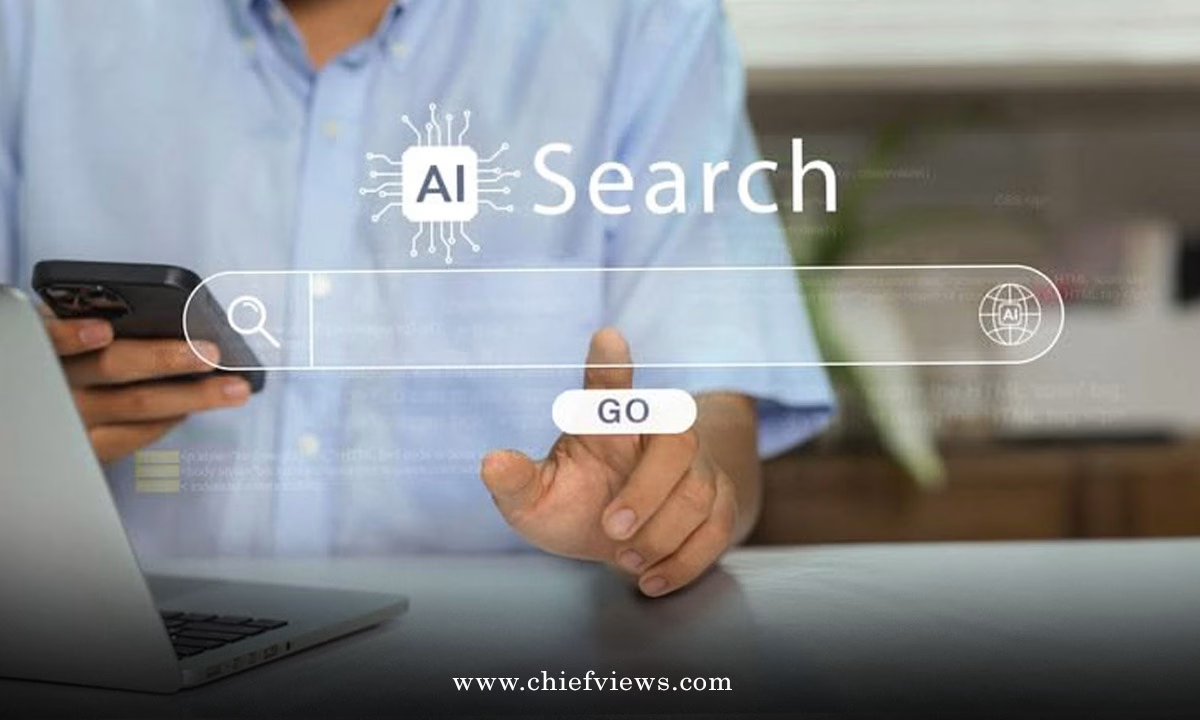






CMO guide to generative engine optimization for AI discovery starts with a simple problem: your customers are asking AI tools for recommendations, and your business may not be showing up. If you are a founder, marketing lead, or business owner, this matters because search is no longer just blue links on a results page. People are using AI answers, chat tools, and copilots to compare brands, shortlist vendors, and make buying decisions faster than before.
In this article, we’re going to be taking a look at CMO guide to generative engine optimization for AI discovery, and how you can make your business easier to find inside AI answers. If you would like to find out more, feel free to read on.
Pic – CC0 License
What generative engine optimization means
Generative engine optimization, or GEO, is the practice of making your brand easier for AI systems to understand, trust, and mention. That includes large language models, AI search features, and answer engines that pull from public web content, structured data, and brand signals.
For you, the goal is not to “game” the system. The goal is to make your company clear, credible, and easy to cite. If your site, content, and brand footprint are thin or confusing, AI tools have less reason to surface you.
A useful way to think about GEO is this: traditional SEO helps people find your pages, while GEO helps AI understand your expertise well enough to recommend you in an answer.


Why CMOs need to care now
Customers in the USA, UK, Australia, Singapore, and Dubai are already using AI to research products, services, and suppliers. That means your first impression may happen before anyone visits your website.
If AI tools describe your category without naming you, you are losing visibility at the exact point where buying intent is strongest. This is especially important for B2B services, high-consideration products, and local businesses that depend on trust.
It also changes how you measure marketing. Traffic still matters, but brand mentions, citations, and answer visibility matter too. The brands that adapt early will have an easier time building authority later.
CMO guide to generative engine optimization for AI discovery: the basics
If you want AI discovery to work in your favor, start with the fundamentals. AI systems look for signals that your business is real, useful, and consistent.
Focus on these areas:
- Clear positioning: say exactly what you do, who you help, and where you operate.
- Strong about pages: explain your company, leadership, expertise, and proof points in plain language.
- Helpful content: answer real customer questions, not just broad marketing topics.
- Consistent brand facts: keep your name, address, service list, and descriptions aligned everywhere.
- Third-party credibility: earn mentions from respected publications, associations, partners, and directories.
For a practical overview of how AI search is changing discovery, OpenAI’s help center on ChatGPT and browsing behavior is worth keeping on your radar, while Google’s search guidance on helpful content remains a strong baseline for quality. You should also watch the Microsoft Copilot documentation to understand how answer systems are evolving.
What your content should do
Your content should teach, explain, and prove. AI systems are more likely to surface content that answers a question cleanly and shows real-world expertise.
That means writing pages that feel useful to a customer who is comparing options. Think in terms of problems, outcomes, and next steps. If someone asks, “What is the best CRM for a small consultancy?” your content should help them decide, not just repeat keyword phrases.
We recommend building around:
- Service pages that explain exactly what each offer includes
- Comparison pages that show how your solution differs from alternatives
- FAQ pages that answer buyer questions in plain English
- Case studies that show measurable results
- Glossary pages that define the terms your market uses
Short, direct answers help. So do examples, numbers, and plain claims backed by proof.
CMO guide to generative engine optimization for AI discovery: build trust signals
AI systems are trained to look for credibility patterns. If your brand feels anonymous, inconsistent, or overly polished without proof, you will be easier to ignore.
A strong trust profile usually includes:
- Author names and bios on important articles
- References to real clients, markets, or use cases
- Reviews and testimonials on trusted platforms
- Mentions in industry media
- Company pages that show who runs the business
You should also make your expertise visible outside your own site. Guest articles, podcast appearances, speaking slots, and expert quotes all help AI systems connect your brand to a topic.
For entrepreneurs, this is where good marketing gets simple: be known for one clear thing, and repeat it everywhere with evidence.

Technical signals still matter
Even though GEO is about AI discovery, technical SEO still supports it. If a model or search system cannot access your content cleanly, it cannot use it well.
Make sure your site is easy to crawl, fast to load, and readable on mobile. Use clear headings, schema markup where appropriate, and simple page structures. Keep your URLs clean and your internal linking logical.
Structured data matters because it helps machines identify what your page is about. That can include organization details, FAQs, products, services, reviews, and articles. If your pages are messy, the machine has to guess. If they are organized, you make the job easier.
A simple 90-day action plan
You do not need to rebuild your marketing from scratch. Start with a focused plan.
- Weeks 1–2: audit your top pages for clarity, accuracy, and consistency
- Weeks 3–4: improve your homepage, about page, and core service pages
- Weeks 5–8: publish helpful FAQs, comparisons, and case studies
- Weeks 9–10: add author bios, proof points, and structured data
- Weeks 11–12: earn a few quality mentions through PR, partnerships, or guest content
The point is not volume. The point is signal strength. A few strong pages often do more for AI discovery than a large pile of weak ones.
What success looks like
Success in GEO is not just ranking higher. It is being named, cited, and recommended when AI tools answer a buyer’s question.
You may see more branded search, better-quality leads, stronger direct traffic, and more mentions in AI-generated summaries. Over time, your business becomes easier to recognize across search, chat, and discovery tools.
That is the real win: when a customer asks for help, your brand is already part of the answer.
We hope that you have found this article enlightening in some way, and that it gives you a clearer way to think about CMO guide to generative engine optimization for AI discovery. If you take one thing from it, make it this: help AI understand your business the same way a smart customer would, with clarity, proof, and consistency.