



How CFO can build agentic AI insights for financial strategy starts with a simple problem: your numbers are everywhere, but your decisions still feel too slow. If you run a business, you already know the pain of chasing reports, waiting on forecasts and trying to make sense of cash flow before it turns into a bigger issue.
Agentic AI changes that by helping finance teams move from passive reporting to active decision support. In this article, we’re going to be taking a look at how CFO can build agentic AI insights for financial strategy, and how you can make sharper decisions faster for your business. If you would like to find out more, feel free to read on.
Pic – CC0 License
Start with the decision, not the model
how CFO can build agentic AI insights for financial strategy works best when you begin with one business decision you want to improve. That might be pricing, spending, hiring, inventory, working capital or monthly forecasting.
Do not start by asking for “AI insights” in the abstract. Start by asking, “What decision do we make too late, too slowly or with too little confidence?” That gives the CFO a clear job to do and keeps the project tied to value.
A good first use case is one where the finance team already spends time gathering data from several systems. That could include accounting software, ERP data, CRM pipeline information and bank feeds. When agentic AI can connect those inputs and flag a likely cash gap or margin squeeze early, it becomes useful fast.

Build a clean data base first
Agentic AI is only as good as the data behind it. If your numbers are messy, duplicated or late, the output will be messy too.
This means the CFO should first standardize the basics: revenue definitions, chart of accounts, customer segments and reporting cadence. It also means choosing a small set of trusted data sources instead of feeding the system everything at once.
The goal is not perfect data. The goal is consistent data that the AI can use to spot patterns and explain what changed. If you want a broader view of why trust and governance matter in AI systems, the NIST AI Risk Management Framework is a useful reference for control and oversight. That kind of structure matters because finance decisions need repeatability, not guesses.
Give the AI a job with clear guardrails
Agentic AI is different from basic dashboards because it can take steps toward a goal, not just display numbers. That makes the CFO’s role even more important.
You need clear guardrails on what the AI can do, what it can recommend and what always needs human approval. For example, the AI might summarize monthly variance drivers, suggest scenario ranges or draft a treasury action plan, but the CFO should still approve any actual move.
This is where policy matters. The U.S. Federal Reserve’s work on AI and financial stability is a reminder that financial institutions and decision makers need strong oversight when models start influencing real-world actions. Even if you are not a bank, the principle is the same: make the system helpful, but never let it run without supervision.
Turn insights into financial strategy
The real value of how CFO can build agentic AI insights for financial strategy is not prediction alone. It is action.
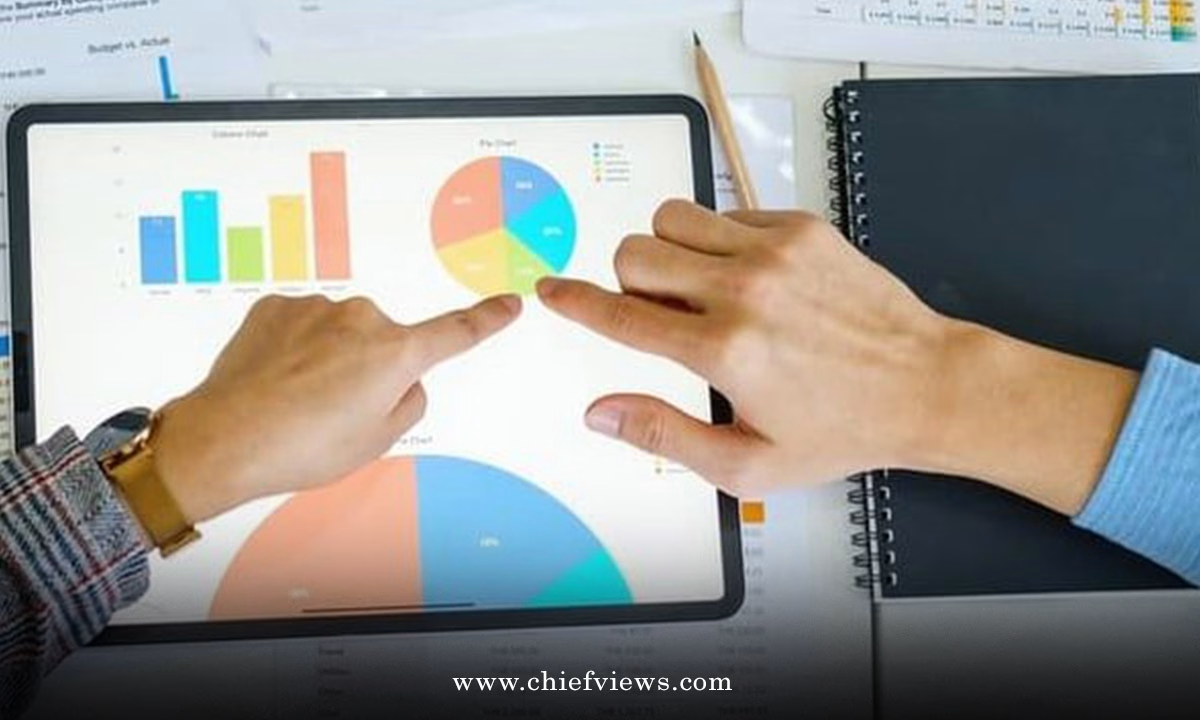
For example, the AI can compare current performance against budget, then test different scenarios for hiring, pricing or customer churn. It can show what happens if sales slow by 10%, if collections improve by two weeks or if supplier costs rise again. That gives the CFO a better base for planning.
This also helps you think in ranges instead of fixed numbers. In real businesses, exact forecasts are often false comfort. A good AI-backed finance process gives you a clearer view of risk, downside and upside, so you can move faster with less panic.

Make the output easy for non-finance leaders to use
Your finance insight is only useful if other leaders can understand it. That means the CFO should translate outputs into plain business language.
A founder does not need a wall of analysis. They need a short answer: what changed, why it changed and what to do next. The same goes for department heads who need to manage budgets, hiring or delivery.
This is where short, repeatable reporting works well. Think weekly cash updates, monthly scenario notes and simple alerts when a metric crosses a threshold. If you want teams to use the insights, keep them short and practical.
Start small, then expand
You do not need a huge AI program on day one. In fact, that usually slows everything down.
Start with one workflow, such as cash forecasting or expense anomaly detection. Prove that the insight is useful, check the accuracy and learn where human review is still needed. Then expand into areas like pricing, margin analysis, customer profitability or board reporting.
For a broader business view on how AI can be deployed responsibly, the OECD AI Policy Observatory is a strong source for policy, governance and adoption ideas. That kind of external benchmark helps CFOs think beyond hype and focus on what actually works.
Put controls around privacy, risk and accountability
If you are handling financial data in the USA, UK, Australia, Singapore or Dubai, you need to think about privacy, security and local rules from the start. That is not a side issue.
The CFO should work with legal, IT and operations to define who can see what, where data is stored and how model outputs are reviewed. You also need audit trails, so you can explain why the AI made a recommendation and who approved the final decision.
This matters even more when your business crosses borders. Different markets may have different expectations around data use, cloud storage and financial record keeping. Keep the system simple enough that you can explain it to a board, a banker or an auditor without a long technical lecture.
We hope that you have found this article enlightening in some way, because the real advantage here is not just speed. It is better judgment. When you build agentic AI insights around the decisions that matter most, you give your business a clearer financial picture and a faster path to action.