









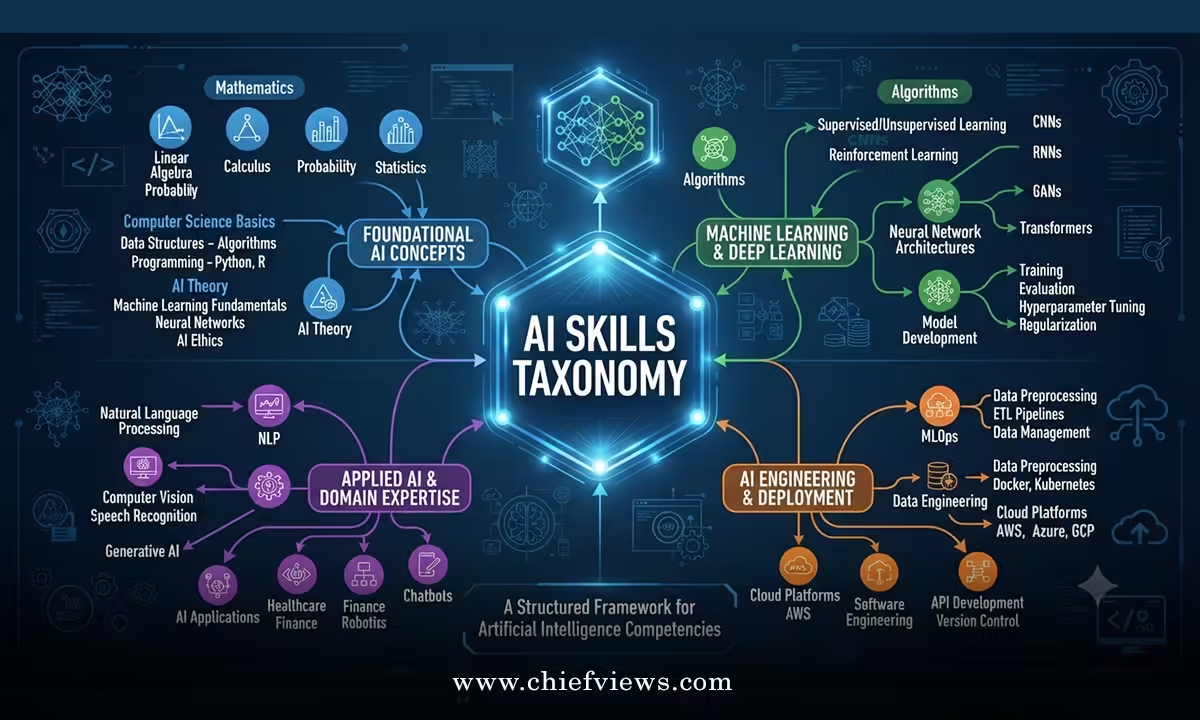
An AI skills taxonomy for workforce planning is the living map that shows which human capabilities still create outsized value once AI agents handle the routine load—and which new hybrid skills must be built, hired, or redeployed. Without it, workforce plans stay stuck in headcount math while the actual work changes underneath.
- It replaces static job descriptions with a dynamic inventory of human judgment, AI collaboration, oversight, and domain expertise.
- CHROs use it to forecast skill gaps 12–36 months out instead of reacting after roles break.
- It powers internal mobility, targeted reskilling, and accurate demand modeling when AI compresses some tasks and expands others.
- Organizations that treat the taxonomy as infrastructure—not a one-time project—move talent faster and convert AI capacity into growth.
- This is the practical foundation behind how CHRO can shape enterprise transformation with AI 2026.
Here’s the thing most companies miss. Building the taxonomy is not an HR housekeeping exercise. It is the control panel for every major talent decision in an AI-augmented enterprise.
What an AI Skills Taxonomy Actually Is
A traditional skills taxonomy lists competencies under roles. An AI-ready version does three extra jobs.
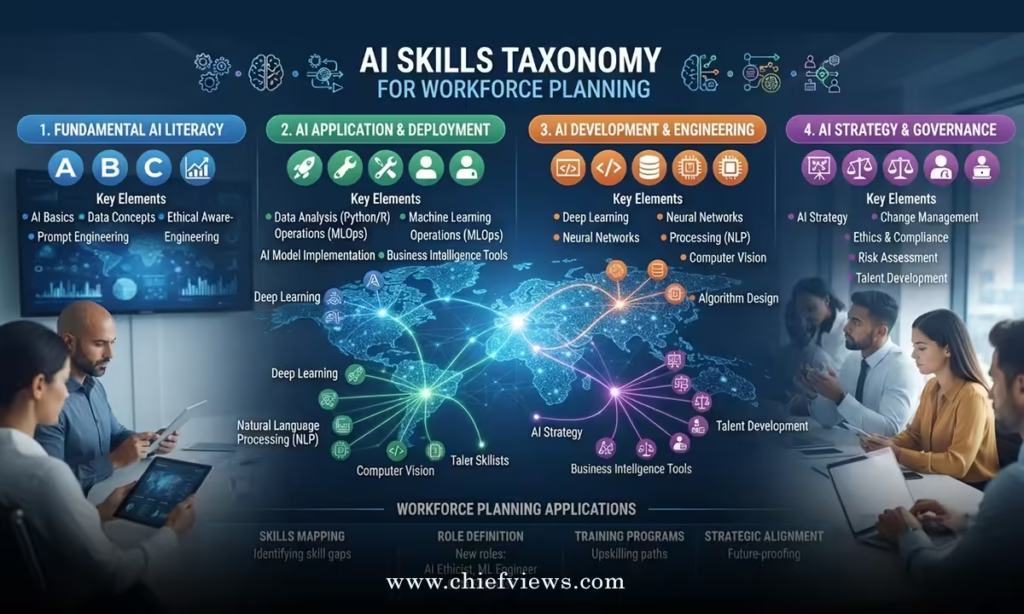
It distinguishes pure human skills (critical thinking, ethical judgment, stakeholder influence) from AI-collaboration skills (prompt design, output validation, agent orchestration) and from technical AI skills (model selection, data preparation, evaluation). It shows adjacency—how quickly someone strong in one skill can ramp into another. And it stays current by feeding real work signals instead of relying only on self-reported profiles.
In practice the taxonomy becomes a graph: skills connected to evidence, proficiency levels, roles, and AI agent capabilities. That graph lets workforce planners answer the only questions that matter in 2026: Which capabilities stay human-led? Which can be AI-assisted? Which should be AI-executed with human oversight?


Why Workforce Planning Breaks Without One
Most organizations still plan by job titles and headcount. AI does not respect titles. It rewrites tasks inside them.
When a company deploys agents that handle first-pass analysis, the demand for pure analysis skills drops while demand for judgment, exception handling, and process redesign rises. Without a taxonomy that captures that shift, planners keep hiring yesterday’s profile and wonder why productivity gains stall.
Data from multiple 2025–2026 studies show the pattern. Skills-based organizations that maintain a clear taxonomy place talent more effectively and retain high performers at markedly higher rates. The ones still running on instinct face the opposite: mis-hires, stalled internal mobility, and training budgets spent on the wrong capabilities.
The taxonomy also forces the hard conversations. Which decisions must remain human even when AI can generate the options? That clarity is exactly what separates companies that extract growth from AI from those that merely cut cost.
How to Build an AI Skills Taxonomy for Workforce Planning
Start small and make it operational. Here is the sequence that works.
- Anchor on critical value roles first. Identify the 30–50 roles that drive most of the enterprise value. Ignore the long tail until the core is solid.
- Inventory current skills with evidence, not surveys alone. Pull signals from project outcomes, learning records, performance notes, and work artifacts. Self-reports are noisy; observed evidence is cleaner.
- Layer in the AI dimension. For every skill ask three questions: Does AI already perform this better or faster? Does the human still need to validate or override? What new skill does collaboration with the agent require?
- Define proficiency levels that include AI fluency. Basic, intermediate, and advanced should describe both the human capability and the ability to direct and check AI output.
- Map adjacencies and transition paths. Show which existing skills make someone a fast learner for emerging hybrid skills. This turns the taxonomy into a mobility engine.
- Connect it to demand forecasting. Tie skills to business strategy scenarios. Model what happens if AI adoption accelerates in three key processes. Adjust hiring, internal moves, and learning investments accordingly.
- Refresh on a fixed cadence. Market skills shift every 12–18 months. Build a light governance process so the taxonomy does not become a static document within a year.
In my experience the companies that succeed treat the first version as a working prototype rather than a perfect encyclopedia. They validate it with business leaders in two or three pilot functions, then expand.
Sample Structure of an AI Skills Taxonomy
| Category | Example Skills | Human vs AI Role | Workforce Planning Use |
|---|---|---|---|
| Foundational Human | Critical thinking, ethical judgment, active listening | Human-led; AI can surface options | Protect and deepen these in high-stakes roles |
| AI Collaboration | Output validation, prompt refinement, agent orchestration | Human-AI partnership | Core for most knowledge roles by 2027 |
| Domain Expertise | Industry-specific process knowledge, regulatory nuance | Human-led with AI assistance | Priority for reskilling and internal mobility |
| Technical AI | Model evaluation, data preparation, RAG design | AI-executed with human oversight | Hire or develop selectively for builder roles |
| Adaptive | Learning agility, systems thinking, change leadership | Human-led | Leading indicator for future readiness |
This simple matrix already improves planning conversations. It forces clarity on where investment should go and where pure automation is realistic.
Common Mistakes and Practical Fixes
Building a 500-skill list from scratch that is obsolete before it launches.
Fix: Start with a vendor or open ontology and customize only the 10–15 percent that are truly company-specific.
Treating the taxonomy as an HR-only project.
Fix: Co-own it with the business and technology leaders who own the work redesign. That joint ownership is a core part of how CHRO can shape enterprise transformation with AI 2026.
Measuring success by number of skills catalogued.
Fix: Measure by decisions improved—time-to-fill for critical roles, internal fill rate, reduction in skill-related attrition, and accuracy of 18-month demand forecasts.
Ignoring evidence and relying only on self-ratings.
Fix: Weight observed performance and project outcomes higher than check-the-box self-assessments.
Turning the Taxonomy into Action
Once the structure exists, feed it into three systems immediately: talent acquisition (rewrite job architectures around skills, not titles), learning (build pathways that close the highest-value gaps first), and strategic workforce planning (model supply against multiple AI-adoption scenarios).
The CHRO who owns this taxonomy stops reacting to AI disruption and starts directing it. The same map that guides hiring also guides which workflows get redesigned and which human capabilities receive the heaviest investment. That is the practical link between a living skills taxonomy and broader enterprise transformation.
Key Takeaways
- An AI skills taxonomy is the operating system for workforce planning in an agent-augmented world.
- Focus first on critical roles and evidence-based skill signals rather than exhaustive lists.
- Separate pure human skills, collaboration skills, and technical AI skills so investment stays targeted.
- Refresh the taxonomy on a fixed cadence; market demand moves faster than most HR processes.
- Co-own it with business and technology leaders—the taxonomy only works when it drives real decisions.
- Use it to power mobility, reskilling, and demand forecasting instead of treating it as a static reference.
- This infrastructure is one of the clearest levers in how CHRO can shape enterprise transformation with AI 2026.
Build the map. Then run the enterprise on it. Everything else—hiring velocity, internal mobility, and the conversion of AI capacity into growth—gets sharper once the taxonomy is live and trusted.
FAQs
How detailed should an AI skills taxonomy be for mid-sized companies?
Keep it lean. Cover the top value-creating roles and the 100–150 skills that matter most. Over-building creates maintenance debt without improving decisions.
Can existing competency models be adapted into an AI skills taxonomy?
Yes, but they need a full AI layer. Add collaboration and oversight skills, redefine proficiency to include AI fluency, and reconnect everything to evidence rather than pure self-report.
How often should the taxonomy be updated in 2026?
Review high-priority skills quarterly and run a full refresh at least annually. Skills that touch generative AI and agent orchestration change fastest.
