




Enterprise architecture framework is the structural backbone that connects your business strategy to every technology decision you make. Get it wrong and every new initiative costs twice as much and takes twice as long. Get it right and your teams move fast, your data stays clean, and your CTO sleep improves dramatically.
Here is what this covers at a glance:
- An enterprise architecture framework is a structured method for describing and governing how business capabilities, applications, data, and technology fit together
- The most widely adopted option is TOGAF (The Open Group Architecture Framework), now in its 10th edition [1]
- No single framework wins outright — mature teams blend two or three depending on their needs
- Choosing the right framework is a prerequisite for successful modernizing enterprise architecture CTO initiatives
- Done right, it reduces technical debt, accelerates delivery, and gives leadership a single coherent view of how the business runs on technology
What Is an Enterprise Architecture Framework, Really?
Strip away the jargon. An enterprise architecture framework is a set of rules, patterns, and practices that tells your organization how to design, change, and govern its technology estate. It answers the question every CTO eventually asks out loud: “Why does every change feel harder than the last one?”
The framework does not do the work. People do. What the framework provides is structure so decisions get made consistently, tradeoffs get documented, and the same conversations do not happen over and over in every project kickoff.
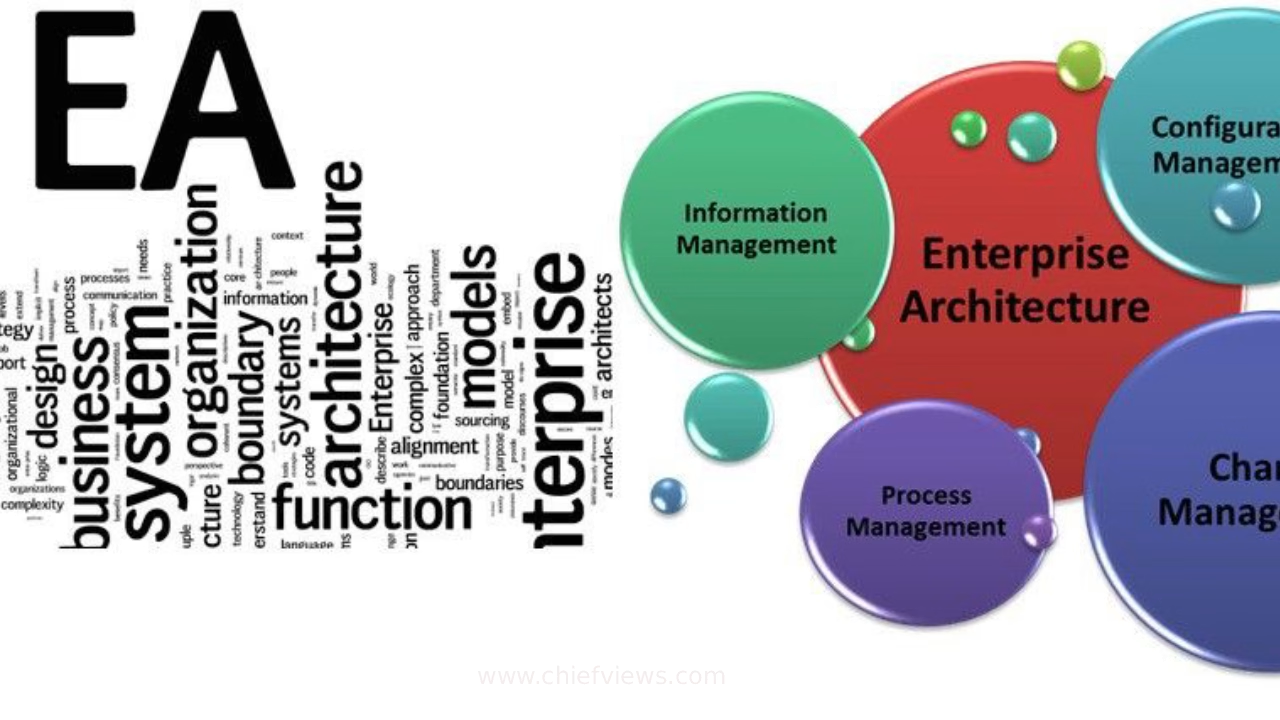
Four domains sit at the center of every serious enterprise architecture framework:
- Business architecture — capabilities, value streams, organizational structure
- Data architecture — how information flows, who owns it, and how it stays governed
- Application architecture — the software systems, their integrations, and boundaries
- Technology architecture — cloud, infrastructure, identity, networking, and observability [2]



The Main Frameworks — and What Each One Actually Does
Here is where most people get confused. The major enterprise architecture frameworks are not interchangeable. They are different types of tools.
| Framework | Type | Best Used For | Typical Audience | US Context |
|---|---|---|---|---|
| TOGAF 10 | Method + governance cycle | Governing change across multiple teams | Commercial enterprise, global orgs | Dominant in large enterprise |
| Zachman Framework | Classification matrix (6×6) | Organizing and stress-testing documentation | Architects, auditors | Used as a completeness check |
| FEAF | Business-driven standard | Reducing duplication, shared services | US federal government agencies | Effectively mandated in federal agencies |
| DoDAF | Viewpoint-heavy standard | Large defense, military, aerospace systems | US DoD, defense contractors | Required in DoD programs |
| Gartner EA Approach | Advisory/outcome-driven | Business strategy alignment, fast-moving orgs | Commercial CTO/CIO teams | Strong in agile commercial environments |
The short version? Zachman tells you what to document. TOGAF tells you how to do the work. They complement each other. Using both is the norm, not a compromise. [1]
How an Enterprise Architecture Framework Connects to Modernization
Here is the thing — no modernization initiative survives without a framework underneath it. That is not opinion. That is just what happens when you try to replatform, consolidate, or cloud-migrate without agreed-on architecture principles and governance.
When a CTO is serious about modernizing enterprise architecture CTO, the framework becomes the language everyone uses to describe where they are, where they are going, and what rules the journey follows. Without it, modernization becomes a collection of individual team decisions that never quite add up to a coherent system.
The enterprise architecture framework does three specific things in a modernization program:
- Provides the current-state map so teams stop guessing what they depend on
- Gives the target-state a structure that stakeholders can actually evaluate
- Creates governance so new work lands in the right place instead of adding new sprawl
Enterprise Architecture Framework: Step-by-Step for Beginners
No 200-page methodology required. Here is a practical path to standing up a working framework in your organization.
Step 1: Get a sponsor above the CTO level
Architecture without executive cover dies quietly. Secure a CFO or COO who sees the business case: faster delivery, reduced duplication, lower operational risk. That sponsorship is what keeps the framework alive when a major project pushes back against governance.
Step 2: Define your four domains and their owners
Assign clear ownership for business, data, application, and technology architecture. Not committees. Named people with accountability.
Step 3: Choose your framework blend
Answer these questions first:
- Do you need a repeatable governance process? Use TOGAF as the engine.
- Do you need to audit documentation completeness? Use Zachman as the checklist.
- Are you in a US federal agency? FEAF is likely non-negotiable.
- Does the board think in business capabilities? Add Gartner-style capability mapping.
Pick the minimum blend that solves your actual problem. Do not import an entire framework on day one. [1]
Step 4: Build a current-state inventory
Map your applications, data stores, integrations, and infrastructure. It does not need to be perfect. It needs to be honest enough to make decisions.
Step 5: Set five to seven architecture principles
Short, opinionated statements. Examples: “API before custom integration.” “No new data stores without a named owner.” “Cloud-smart, not cloud-first.” These principles do more governance work than a 40-slide deck.
Step 6: Create a lightweight Architecture Review Board (ARB)
Not a committee that blocks. A process that advises. Embed architecture reviews before funding approval, not after delivery is halfway done.
Step 7: Tie the roadmap to business priorities
Build a 12-month architecture roadmap. Line it up against what the business is actually trying to achieve this year. If an architecture initiative cannot be tied to a business outcome, it gets deprioritized — every time.
Step 8: Measure and report
Track lead time for change, deployment frequency, incidents per release, cloud spend efficiency, and data quality scores. These numbers make the framework visible at the executive level where it counts. [2]
Enterprise Architecture Framework: Common Mistakes and How to Fix Them
Mistake: Treating the framework as the goal
Fix: The framework is scaffolding. The real goal is faster, safer, cheaper change. If your framework only produces diagrams, it has already failed.
Mistake: Selecting TOGAF in full and running every phase
Fix: The complete TOGAF ADM cycle is overkill for most organizations. Simplify it to the phases that earn their keep and drop the rest. [1]
Mistake: No data ownership inside the architecture model
Fix: Assign data domains and stewards before you publish the architecture. Data without an owner becomes everyone’s mess and nobody’s priority.
Mistake: Framework governance that only slows delivery
Fix: If architecture reviews add weeks to delivery cycles, teams will route around them. Make ARB reviews fast, lightweight, and valuable to the teams asking for them.
Mistake: Skipping the business architecture layer
Fix: Most IT-led EA programs model applications and infrastructure but ignore business capabilities. That gap makes it impossible to communicate architecture value to leadership.
Mistake: Choosing a single framework dogmatically
Fix: Blend deliberately. TOGAF for process, Zachman for completeness, Gartner thinking for board conversations. Use each where it earns its keep and drop what does not. [1][2]
What a Good Enterprise Architecture Framework Looks Like in Practice
In my experience, the organizations that get real value from EA are not the ones with the most sophisticated frameworks. They are the ones with a current, honest register of what they run, a costed roadmap tied to strategy, and a set of architecture decisions that people actually follow.
That combination is rarer than it sounds.
The Federal Enterprise Architecture Framework (FEAF) from the US Office of Management and Budget is a good reference point for how governance-heavy architecture enables shared services and reduces duplication at scale — even if you are not in the public sector, the logic applies. [3]
For deeper guidance on TOGAF’s architecture development method and how mature teams apply it commercially, The Open Group’s TOGAF standard documentation remains the primary reference. [1] And for a 2026-focused view of how capability-based planning and business architecture converge in practice, Gartner’s enterprise architecture research offers a strong practitioner lens. [2]
Rhetorical gut-check for every CTO
Ask yourself this: if your best architect left tomorrow, could your organization still make consistent technology decisions? If the honest answer is no, the enterprise architecture framework is not embedded — it is just living in one person’s head.
That is the real test. Not the diagram quality. Not the framework brand. Whether the structure survives the individual.
Key Takeaways
- An enterprise architecture framework connects business strategy to technology decisions through agreed-on structure, principles, and governance
- No single framework wins — TOGAF, Zachman, FEAF, and Gartner each solve different problems; blend them deliberately
- TOGAF defines how to govern change; Zachman defines what to document — they are complementary, not competing
- US federal agencies operate under FEAF; commercial enterprises most often anchor to TOGAF + Gartner capability thinking
- Architecture principles (five to seven, max) do more governance work than most formal review boards
- The framework has no value without a current-state inventory, a business-aligned roadmap, and named data and domain owners
- Embedding the framework in delivery pipelines — not just in review meetings — is what separates working EA from diagram theater
- A strong enterprise architecture framework is the prerequisite for any serious modernizing enterprise architecture CTO program to actually deliver results
The clearest next step is this: do not pick a framework, build a committee, and run a discovery phase. Pick the most painful architecture problem your business faces right now — integration sprawl, data ownership gaps, cloud cost chaos, or delivery bottlenecks — and use the framework to govern the fix. Prove value in one domain first. Everything else gets easier from there
FAQs
What is the most widely used enterprise architecture framework in the USA?
TOGAF (The Open Group Architecture Framework) in its 10th edition is the dominant choice across commercial enterprises in the USA, while FEAF is effectively mandated across US federal government agencies. Most mature commercial teams blend TOGAF governance with Gartner’s capability-based planning for board-level communication. [1][3]
How does an enterprise architecture framework support modernizing enterprise architecture CTO work?
It gives modernization programs a shared language, a governance structure, and a current-state map to work from. Without a framework, modernizing enterprise architecture CTO efforts tend to produce isolated improvements that never add up to a coherent, scalable system — the framework is what makes individual decisions compound into durable progress.
How long does it take to implement an enterprise architecture framework?
A working foundation — inventory, principles, ARB, and a first roadmap — can be in place within 90 days. Full embedding into delivery cycles, funding governance, and product planning typically takes six to twelve months, depending on organizational complexity and executive sponsorship strength. [1][2]