




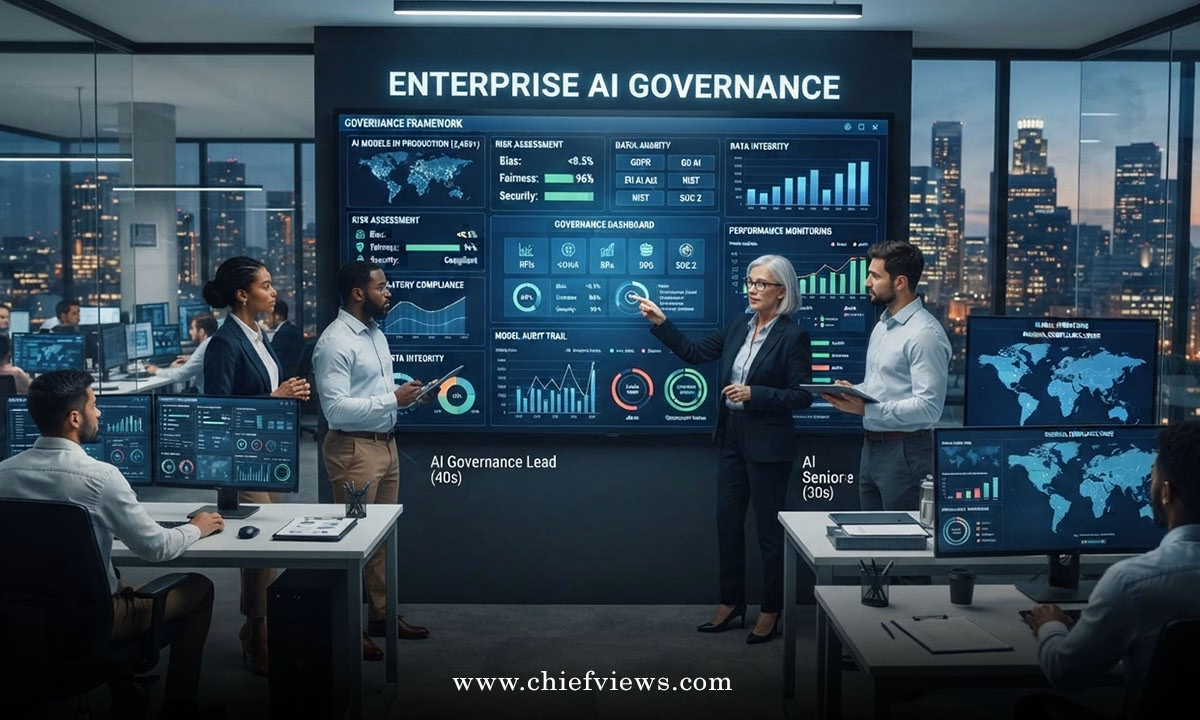
Enterprise AI governance framework isn’t a buzzword anymore — it’s the difference between shipping agentic AI that creates value and shipping agentic AI that creates headlines you don’t want. Companies with a mature governance framework put over 12x more AI projects into production than those flying without one, according to Databricks’ 2026 State of AI Agents report. Yet only 21% of organizations have a comprehensive AI security and governance structure in place (SANS Institute, 2026).
That gap is your opportunity — or your risk exposure. Pick one.
What you need to know at a glance:
- Only 21% of organizations have a comprehensive enterprise AI governance framework in place (SANS Institute, 2026)
- Mature governance correlates with a 27% improvement in AI efficiency directly attributable to governance practices (Hakkoda, 2026)
- 76% of organizations now have formal AI guidance — but only 12% have mature governance processes (HFS Research/Infosys, 2026)
- No single function owns governance: IT (25%), risk management (18%), and dedicated AI teams (10%) all hold fragmented pieces (Optro, 2026)
- Spending on AI governance platforms is projected to hit $492 million in 2026 (Gartner)
What Is an Enterprise AI Governance Framework — and Why Does It Matter Now?
Simple version: it’s the set of policies, controls, oversight mechanisms, and accountability structures that decide how AI systems operate inside your organization. What they can do. What they can’t. Who’s watching. What happens when something breaks.
That definition gets more loaded as you move from static AI tools to autonomous agents. A chatbot that gives a bad answer is an embarrassment. An agentic system that writes to your CRM, triggers a payment workflow, and sends a customer email without a human checkpoint — that’s a liability.
Here’s the thing — governance used to be a legal team’s job. In 2026, it’s an infrastructure problem. You need it baked into your deployment pipeline, not stapled on after the fact.



Think of it like building codes. Nobody argues against them once the house is standing. But nobody wants to add them after the walls are up either. Build governance in, not on.
The 5 Pillars Every Enterprise AI Governance Framework Needs
These aren’t theoretical. They’re the structural load-bearing walls of any framework that survives contact with production reality.
Pillar 1: Strategy and Accountability
Every AI system — every single one — needs a named owner. Not a team. A person. Someone who approves what the system can do, answers for it when it behaves unexpectedly, and has the authority to change its scope.
Without this, you have governance theater. Policies that exist in documents nobody reads and accountability that evaporates the moment something goes wrong.
Pillar 2: Risk Management
AI risk in 2026 comes in three flavors:
- Operational risk — what happens if the model fails, hallucinates, or acts outside its scope?
- Data risk — what sensitive information does the system access, process, or store?
- Third-party risk — which external APIs, models, or platforms does your system call out to?
Document all three before deployment. Not after.
Pillar 3: Data and Technology Controls
Least-privilege access isn’t optional. Scoped API keys over admin tokens. Temporary credentials over standing access. Granular logging that captures not just outputs but every action the system takes.
This matters especially for agentic systems. An agent that can read your entire data warehouse when its job is to summarize support tickets has a risk surface you haven’t fully mapped.
Pillar 4: Human Oversight and Operating Model
At what decision points does a human need to approve, review, or override the AI? This is the question most organizations either under-answer or answer too late.
Minimum human-in-the-loop requirements — at least until your system has a proven track record — should include:
- Financial transactions above a defined threshold
- Outbound communications to customers or partners
- Any modification to a system of record
- Decisions with legal, compliance, or HR implications
Pillar 5: Agentic-Specific Controls
Standard IT security wasn’t built for autonomous agents. You need additional infrastructure: agent identity management (each agent has a unique identity with documented permissions), behavioral monitoring (real-time anomaly detection, not just log review), rollback capability (the ability to reverse agent actions without a full incident response), and lifecycle management (formal processes for deploying, updating, and retiring agents).
If you’re currently navigating the broader challenge of autonomous AI at scale, the CTO guide to managing 33% agentic AI application adoption covers the deployment-side decisions that sit directly upstream of these governance pillars.
Enterprise AI Governance Framework: The Three Dominant Reference Standards in 2026
You don’t have to build from scratch. Three frameworks carry the weight for most U.S. enterprise governance programs.
| Framework | Best For | Core Strength | Limitation |
|---|---|---|---|
| NIST AI RMF 1.0 | U.S. enterprises across industries | Four-function structure (Govern, Map, Measure, Manage); widely recognized; maps to existing IT risk programs | Not prescriptive — requires internal customization |
| ISO/IEC 42001 | Global enterprises or those operating in regulated markets | International certification-ready; integrates with ISO 27001 | Compliance-oriented; heavy documentation overhead |
| EU AI Act (Risk-Based) | Orgs with EU market exposure | Legally enforceable risk tiers for AI systems; clear prohibited-use categories | Compliance deadline pressure; 78% of enterprises still unprepared (Vision Compliance, 2026) |
| McKinsey AI Trust Maturity Model | Strategic governance benchmarking | Five-dimension maturity scale; built for executive communication | Consulting framework, not a technical implementation guide |
Most enterprise teams end up layering two or three. NIST AI RMF as the technical backbone, ISO 42001 for international coverage, and the EU AI Act’s risk classification for anything customer-facing with European exposure.
The NIST AI Risk Management Framework is the logical starting point for U.S.-based organizations — it’s free, it’s authoritative, and it maps directly to existing enterprise risk management structures.
Enterprise AI Governance Framework: Step-by-Step Implementation for Beginners
If your org is starting from zero — or from a collection of disconnected policies that don’t actually govern anything — here’s the practical sequence.
Phase 1: Establish the Accountability Foundation (Weeks 1–4)
Before touching technology, fix the organizational structure.
- Name an AI governance lead or form a cross-functional AI review board (Legal, Security, Engineering, Business Owner, CISO minimum)
- Document every AI system currently in production or pilot — including shadow AI deployments
- Assign a named DRI to each system
- Define what “high-risk” means for your specific business context
Phase 2: Build the Risk and Policy Layer (Weeks 5–10)
- Develop a tiered risk classification system (low/moderate/high/critical — see the CTO action plan referenced above for a ready-made tiering model)
- Create acceptable-use policies that live in workflows, not in a document portal nobody opens
- Define human oversight thresholds for each risk tier
- Conduct initial data access audits for all production AI systems
Phase 3: Implement Technical Controls (Weeks 11–18)
- Deploy least-privilege access controls for all AI systems
- Implement centralized logging and behavioral monitoring
- Build rollback protocols for every agent in production
- Stand up a model inventory with ownership, access scope, and risk classification documented
Phase 4: Operationalize and Iterate (Ongoing)
Governance isn’t a project with a finish line. It’s an operational function.
- Monthly review of behavioral logs and anomaly reports
- Quarterly audit of agent permissions and access scope
- Annual framework review against evolving regulatory requirements

Common Mistakes in Enterprise AI Governance Frameworks (And How to Fix Them)
Mistake 1: Conflating policy with governance
Writing an AI acceptable-use policy is not the same as having a governance framework. One is documentation. The other is operational infrastructure. Fix: Governance lives in your deployment pipeline, your monitoring dashboards, and your incident playbooks — not just in a policy PDF.
Mistake 2: Fragmented ownership with no clear decision authority
No single function owns more than 25% of AI governance responsibility at most organizations (Optro, 2026). That fragmentation is a feature of early governance programs — and a dangerous one. Fix: Designate a cross-functional AI governance board with explicit decision authority, not just advisory input.
Mistake 3: Governance built for static AI applied to agentic systems
Your existing model risk management (MRM) policies were designed for predictive models — things that produce an output and stop. Agentic systems take sequences of actions. The controls are different. Fix: Audit every existing AI governance control against the question: “Does this still apply when the AI can act, not just respond?”
Mistake 4: Treating compliance as governance
Checking the EU AI Act compliance box or passing a SOC 2 audit is necessary. It’s not sufficient. Compliance is backward-looking; governance is forward-looking. Fix: Build governance for the AI systems you’ll have in 18 months, not just the ones you have today.
Mistake 5: No governance for third-party AI
85% of organizations have integrated AI into core operations (Optro, 2026), and most of that AI comes from vendors. Your governance framework needs to extend to every AI system touching your data or your workflows — including the ones you didn’t build. Fix: Add AI-specific vendor risk assessment criteria to your procurement process.
What Governance Maturity Actually Looks Like
The maturity scale runs from Level 1 (ad hoc — reactive, undocumented, inconsistent) to Level 5 (optimized — automated guardrails, continuous monitoring, governance invisible because it’s baked into every workflow).
Most organizations in 2026 sit at Level 2 or 3. Formal guidance exists. Some controls are in place. But execution is inconsistent, ownership is fuzzy, and agentic-specific controls are almost entirely absent.
What separates Level 4 and 5 organizations?
- Governance tooling deployed alongside AI tooling, not after it
- Audit logs reviewed systematically, not only after incidents
- Agents with defined identities, scoped permissions, and documented lifecycle processes
- Cross-functional review boards with real authority, not just advisory roles
- Executives who can articulate the org’s AI risk posture without prompting
For a deeper read on how governance connects to enterprise-wide AI deployment velocity, Deloitte’s State of AI in the Enterprise 2026 is the most comprehensive enterprise benchmark available this year.
And if you want the regulatory context that’s driving governance urgency for U.S. organizations operating internationally, the EU AI Act compliance resources via the European Commission lay out the risk-tier classification system that’s rapidly becoming a global reference standard.
Key Takeaways
- Only 21% of organizations have a comprehensive enterprise AI governance framework — making it a first-mover advantage, not a baseline expectation
- The 5 pillars — strategy/accountability, risk management, data/technology controls, human oversight, and agentic-specific controls — are non-negotiable for any framework that’ll survive production-scale deployment
- Governance increases production output dramatically: companies with mature governance put 12x more AI projects into production (Databricks, 2026)
- Policy ≠ governance: documentation without operational infrastructure is governance theater — useful for audits, useless for risk management
- Agentic AI breaks existing governance models — static AI controls were not designed for systems that act autonomously across multi-step workflows
- Fragmented ownership is the structural root cause of most governance failures — fix accountability first, technology second
- Phase your implementation: accountability → policy → technical controls → ongoing operations, in that sequence
- Governance is a product, not a project — it has owners, metrics, release cycles, and a roadmap
The enterprise AI governance framework isn’t the thing that slows your AI program down. Done right, it’s the thing that lets you move faster — because your legal team, your CISO, and your board all know the guardrails are in place.
Start with the accountability audit. Name an owner for every AI system in your environment today. That single action moves your org from Level 1 to Level 2 maturity and surfaces every governance gap that needs fixing next.
FAQs
Q1: What is an enterprise AI governance framework and what should it include?
An enterprise AI governance framework is the structured set of policies, accountability structures, technical controls, and oversight mechanisms that govern how AI systems operate within an organization. At minimum, it should include named ownership for every AI system, a tiered risk classification model, data access controls built on least-privilege principles, defined human oversight checkpoints, behavioral monitoring and logging, rollback protocols, and a formal lifecycle management process for deploying and retiring AI systems.
Q2: How does an enterprise AI governance framework connect to agentic AI management?
The connection is direct and load-bearing. Agentic AI systems — autonomous agents that take multi-step actions without a human in the loop at every decision point — require more granular governance controls than traditional AI tools. If you’re following a CTO guide to managing 33% agentic AI application adoption, your governance framework is the operational backbone that makes that adoption safe and auditable. Without it, agentic deployments stall in legal review, create untracked risk exposure, or produce incidents that roll back months of progress.
Q3: Which enterprise AI governance framework should a U.S.-based organization start with?
For most U.S. enterprises, the NIST AI Risk Management Framework (AI RMF 1.0) is the practical starting point. It’s free, widely recognized, and maps to existing enterprise risk management programs. Organizations with global operations or EU market exposure should layer ISO/IEC 42001 for international coverage and apply the EU AI Act’s risk-tier classification to any customer-facing system. The key is selecting a framework that integrates with your existing governance infrastructure — not one that requires a parallel bureaucracy to operate.