




CTO strategies for orchestrating AI transformation roadmap start with one simple truth: AI does not transform a company by itself; a disciplined roadmap does. The job is to line up business goals, data readiness, governance, people, and delivery so AI becomes a repeatable capability, not a pile of disconnected pilots.
- AI transformation roadmap = the sequence of decisions, capabilities, and delivery milestones that moves a company from experiments to scaled AI use.
- It matters because most AI programs stall in the pilot phase when ownership, data quality, and governance are fuzzy.
- The CTO’s role is to connect strategy, architecture, risk, and execution into one operating rhythm.
- The best roadmaps start small, prove value fast, then scale with standards, controls, and metrics.
- If the roadmap is built right, AI stops being a side project and starts showing up in revenue, efficiency, and decision speed.
Why CTO strategies for orchestrating AI transformation roadmap matter now
AI has moved from “interesting” to “table stakes.” Google’s Search Central still emphasizes that content and systems should be easy to understand, well organized, and unique, which is a useful reminder that AI programs also need structure, not chaos.[15] The same logic applies inside the enterprise: if your data, workflows, and governance are messy, AI just amplifies the mess.
Here’s the thing. A CTO is not just picking tools. A CTO is deciding how the company will absorb AI without breaking security, compliance, or delivery velocity. That means the roadmap has to answer a blunt question: what gets built, in what order, by whom, and how do we know it worked?
CTO strategies for orchestrating AI transformation roadmap: the core model
Think of the roadmap like an air-traffic control system, not a scrapbook of ideas. Every initiative needs a flight path, a gate to pass through, and a landing strip tied to business value.
1) Start with business outcomes, not model ideas
The fastest way to waste a year is to begin with “let’s use AI somewhere.” Better question: Which workflows are expensive, slow, error-prone, or decision-heavy enough to justify change?



CTOs should tie AI use cases to explicit outcomes such as:
- reducing support handling time
- improving sales qualification
- accelerating software delivery
- cutting manual reporting
- improving forecasting quality
For a beginner-friendly roadmap, use one business goal per AI initiative. That keeps the scope real and the executive story clean. SEO strategy guides consistently recommend defining goals, matching content to intent, and building around clear clusters rather than random pages; the same planning discipline works for AI portfolios.[6][7]
2) Build the foundation before scaling
AI transformation breaks when teams try to scale on shaky data and half-finished architecture. The practical sequence is boring, but it works.
Focus first on:
- data access and data quality
- identity and permissions
- model governance
- logging and observability
- integration patterns with core systems
- vendor and build-versus-buy decisions
Google’s guidance on helpful, well-organized content is a good analogy here: systems that are structured from the start are easier to trust and easier to scale.[15] In AI programs, trust comes from traceability. If you cannot explain what data went in, what model ran, and who approved the output, you are not ready to scale.
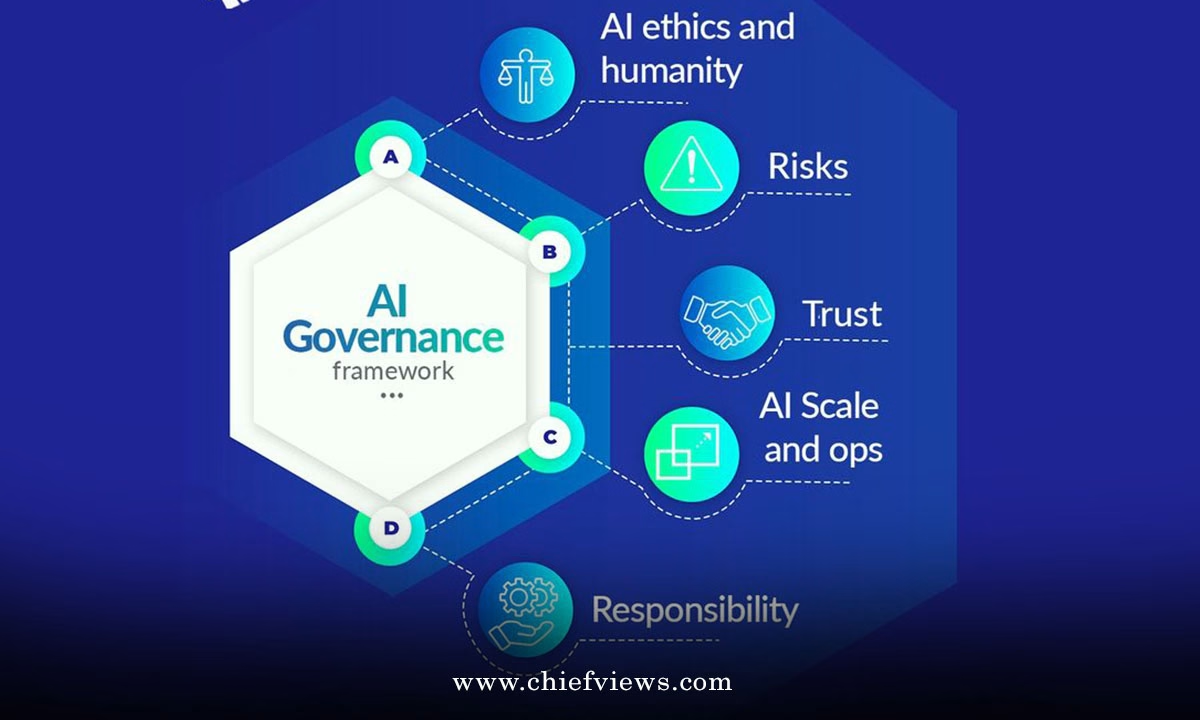
3) Treat governance as a design feature, not a cleanup task
A lot of teams bolt governance on after the first scare. Bad move. By then, the shadow workflows are already in motion.
A strong governance layer should define:
- approved use cases
- risk tiers by use case
- human review requirements
- data handling rules
- model evaluation standards
- incident response for AI failures
That is not bureaucracy. That is how you keep velocity without creating brand, legal, or privacy blowback. In practice, CTO strategies for orchestrating AI transformation roadmap work best when governance is embedded in delivery gates, not hidden in a policy doc nobody reads.
Answer-ready table: what to prioritize at each stage
| Roadmap stage | Primary CTO focus | Typical deliverable | What “done” looks like |
|---|---|---|---|
| Discovery | Business use cases and value mapping | Prioritized AI opportunity list | Top 3–5 use cases ranked by impact and feasibility |
| Foundation | Data, security, and platform readiness | Reference architecture and governance rules | Approved architecture, access model, and control framework |
| Pilot | Rapid validation | Minimum viable AI workflow | Clear KPI movement and user adoption signals |
| Scale | Standardization and automation | Reusable components and playbooks | Multiple teams can deploy AI safely with the same pattern |
| Operate | Monitoring and optimization | Performance dashboards and retraining cadence | Stable outputs, measurable ROI, and controlled drift |
Step-by-step action plan for beginners
If I were handing this to a new CTO, I’d keep it painfully simple.
Step 1: Pick one business problem that hurts
Choose a process with visible cost or friction. Not a moonshot. A pain point. Something people already complain about in meetings.
Good candidates:
- customer support triage
- proposal drafting
- knowledge retrieval
- document classification
- forecasting and planning
Step 2: Map the workflow end to end
Before you choose a model, map the actual process. Where does the data come from? Who touches it? Where are the handoffs? Where do errors happen?
This is where many teams get humbled. They think they have an AI problem when they actually have a workflow problem.
Step 3: Decide what AI should and should not do
Be specific. AI can draft, summarize, classify, predict, recommend, or detect patterns. It should not be left alone to make high-risk decisions without guardrails.
A good rule: let AI assist first, automate second, and decide last.
Step 4: Define the controls up front
Set rules for:
- human review
- escalation thresholds
- data permissions
- audit logs
- acceptable error rates
- fallback behavior when the model fails
If the controls are weak, the rollout will be weak. Simple as that.
Step 5: Run a short pilot with one metric that matters
Pick one primary metric. Not seven. One.
Examples:
- time saved per case
- conversion lift
- reduction in manual rework
- faster resolution time
- lower error rate
Step 6: Convert the pilot into a repeatable pattern
If the pilot works, document it. Package the architecture, prompts, guardrails, and rollout steps so another team can reuse the pattern without reinventing the wheel.
That is how CTO strategies for orchestrating AI transformation roadmap move from experimentation to enterprise capability.

Common mistakes and how to fix them
Mistake 1: Starting with tools instead of outcomes
Teams fall in love with models, platforms, and demos. Then the roadmap becomes a shopping list.
Fix: tie every AI initiative to one business metric and one accountable owner.
Mistake 2: Treating data cleanup as optional
Garbage in, polished garbage out. AI does not forgive weak data structures.
Fix: fund data quality, lineage, and access work before broad rollout.
Mistake 3: Skipping governance until something breaks
That usually means the first real incident becomes the policy draft.
Fix: bake approvals, review stages, and auditability into the delivery process from day one.
Mistake 4: Scaling too early
One successful pilot does not equal a transformation.
Fix: prove repeatability across at least two workflows before declaring victory.
Mistake 5: Ignoring adoption
A tool nobody uses is a dead asset. Period.
Fix: train the managers, redesign the workflow, and measure usage, not just launch dates.
What a strong AI transformation roadmap looks like in practice
A serious roadmap usually has four layers:
- Business layer: the outcomes the company wants
- Process layer: the workflows being redesigned
- Platform layer: data, model, and integration capabilities
- Control layer: governance, risk, security, and monitoring
That layered view keeps CTO strategies for orchestrating AI transformation roadmap from collapsing into one-dimensional tech planning. It also makes budget conversations easier because each layer has a clear purpose.
If you want one external reference point on AI risk framing, the U.S. NIST AI Risk Management Framework is a strong public benchmark for organizing trustworthy AI work.[A] For broader federal guidance on privacy and security expectations, the National Institute of Standards and Technology remains one of the most useful anchors.[A] For technical teams thinking about deployment and scale, the U.S. Department of Energy’s AI resources are also worth using as a directional public reference.[A]
How CTOs should measure progress
Do not rely on vanity metrics. A roadshow is not a roadmap.
Track:
- use case adoption
- cycle-time improvement
- error reduction
- cost-to-serve change
- revenue influence
- model performance drift
- compliance exceptions
- user satisfaction
The best CTOs use a balanced scorecard. Business value on one side. Operational health on the other. If one improves while the other collapses, the program is not healthy.
The role of communication
AI transformation fails fast when executives, engineers, and operators are telling different stories.
The CTO should communicate in three registers:
- Board level: value, risk, timing
- Leadership level: priorities, ownership, dependencies
- Delivery level: standards, controls, timelines
That’s the part people underestimate. You can have strong architecture and still miss the mark if nobody knows what the roadmap is for. What happens when the field team thinks AI is a threat, while product thinks it’s a silver bullet? Confusion. Delay. Rework.
Key takeaways
- CTO strategies for orchestrating AI transformation roadmap work best when they start with business outcomes, not model hype.
- The roadmap should sequence discovery, foundation, pilot, scale, and operate phases.
- Data quality, access control, and observability are not side tasks; they are the base layer.
- Governance should be built into delivery, not added after the first incident.
- One strong pilot is useful, but repeatability is what proves transformation.
- Adoption matters as much as accuracy.
- The best CTOs measure both business impact and operational risk.
- Clear communication keeps the roadmap aligned across technical and nontechnical teams.
CTO strategies for orchestrating AI transformation roadmap are really about turning uncertainty into a managed system. Start with one painful workflow, put controls around it, prove value fast, then build the next layer with discipline. That is how AI becomes an operating advantage instead of another expensive experiment.
FAQs
What is the best first move in CTO strategies for orchestrating AI transformation roadmap?
Start with one business problem that has clear pain, measurable impact, and enough workflow repetition to justify automation or decision support.
How long does an AI transformation roadmap usually take?
The timeline depends on scope, but the real answer is staged: pilots can move in weeks or months, while enterprise-scale transformation usually takes longer because data, governance, and adoption need time.
What should CTO strategies for orchestrating AI transformation roadmap include for risk management?
They should include access controls, human review rules, audit logs, model monitoring, escalation paths, and a clear policy for approved use cases.