





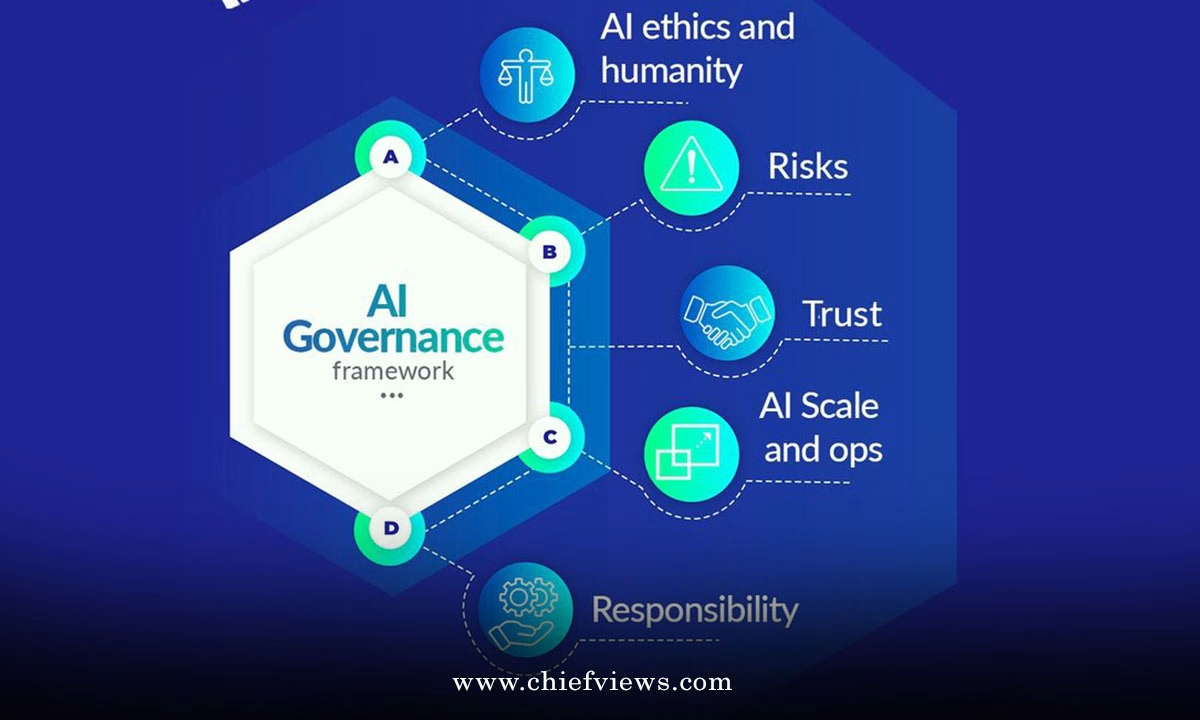
An AI Governance Framework is the operating system for responsible AI: the rules, roles, controls, and monitoring that keep AI useful, compliant, and safe across its lifecycle.[3][4] For teams building under the umbrella of CTO strategies for orchestrating AI transformation roadmap, it is the difference between scalable AI and a pile of unmanaged experiments.
- It defines who owns AI decisions, what risks are acceptable, and how controls are enforced.[3][11]
- It helps organizations move from scattered pilots to repeatable, audit-ready AI delivery.[13]
- It aligns AI work with security, privacy, compliance, and business value.[3][14]
- It usually covers the full lifecycle: inventory, policy, risk review, deployment, monitoring, and retirement.[1][13]
- For CTOs, it is not paperwork. It is how AI becomes operationally believable.
Why an AI Governance Framework matters
AI gets risky fast when teams scale without guardrails. A model can be accurate and still be a bad fit if the data is weak, the use case is high-risk, or nobody can explain who approved the deployment.[1][3] That is why leading guidance frames governance as a structured system of policies, processes, standards, and controls rather than a one-time checklist.[3][4]
Here’s the thing: most AI failures are not glamorous technical failures. They are ordinary management failures. No owner. No risk tier. No monitoring. No accountability.
That is exactly where a good framework earns its keep.
What an AI Governance Framework includes
A useful framework typically has four moving parts:



- Structure: decision rights, ownership, committees, and escalation paths.[3][11]
- Policy: acceptable use, privacy, security, fairness, and documentation rules.[1][4][14]
- Risk management: classification, evaluation, approval thresholds, and mitigation plans.[1][3][14]
- Operations: monitoring, audits, drift detection, incident response, and retirement controls.[1][13]
IBM’s implementation guidance adds a practical lens: establish scope, design the framework, create policies and standards, maintain a central system and data register, define risk management, and integrate governance directly into AI development.[1] That sequence is the backbone most organizations need.
AI Governance Framework and CTO strategies for orchestrating AI transformation roadmap
This is where the keyword bridge matters. A governance framework is not separate from CTO strategies for orchestrating AI transformation roadmap; it is one of the roadmap’s load-bearing beams.
A CTO using CTO strategies for orchestrating AI transformation roadmap should treat governance as a delivery capability, not a policy afterthought. That means the roadmap includes:
- a use-case inventory
- risk classification
- approval workflows
- reference architectures
- monitoring and audit trails
- lifecycle ownership from build to retirement
Snowflake’s framework summary is blunt about the point: AI governance defines who is responsible, how risks are mitigated, and what standards AI must meet throughout the lifecycle.[3] That is exactly the kind of operational clarity a CTO needs when turning AI strategy into execution.
Answer-ready comparison table
| Governance element | What it does | Why it matters | Common failure if missing |
|---|---|---|---|
| AI inventory | Lists all AI systems, use cases, and owners | Creates visibility and accountability | Shadow AI and duplicated effort |
| Risk classification | Sorts use cases by impact and sensitivity | Matches controls to risk level | Over-control of low-risk work or under-control of high-risk work |
| Policy set | Defines rules for data, privacy, security, and use | Keeps teams aligned and compliant | Inconsistent decisions and policy drift |
| Monitoring | Tracks performance, drift, and violations | Protects quality after deployment | Silent model degradation |
| Governance committee | Makes cross-functional decisions | Prevents one-team ownership blind spots | Legal, security, and business teams pulling in different directions |
Step-by-step: how to build an AI Governance Framework
1) Define scope first
Start by deciding what the framework covers. Is it all AI? Only customer-facing systems? Only generative AI? The scope must be explicit, or the framework will sprawl and stall.[1][14]
2) Build an AI inventory
Create a central register of AI use cases, models, datasets, owners, and deployment status.[1][4] This is the source of truth. Without it, nobody knows what exists.
3) Classify risk
Not all AI deserves the same controls. A low-risk internal summarization tool should not go through the same approval path as a model influencing employment, lending, or healthcare decisions.[3][14]
4) Write policies that people can actually use
Keep the rules practical:
- acceptable use
- data handling
- model documentation
- testing and validation
- human oversight
- incident escalation
- retirement criteria
The best policies read like instructions, not legal fog.
5) Assign clear ownership
A framework needs named humans. Governance committees, AI leads, data stewards, security, legal, compliance, and product owners all have a role.[3][9][11] If everyone is responsible, nobody is.
6) Put controls into the workflow
Do not rely on manual memory. Build review gates, logging, approval steps, and monitoring into the delivery pipeline.[1][13] Governance should travel with the work.
7) Monitor in production
Track drift, bias, performance changes, policy violations, and unusual outputs after deployment.[1][13] Deployment is the beginning of governance, not the end.
8) Review and refresh regularly
AI changes. Regulations change. Use cases change. Your governance framework should be reviewed on a schedule so it stays useful instead of fossilized.[14]

Common mistakes and how to fix them
Mistake 1: Treating governance like a compliance-only project
That leads to slow approvals and no business buy-in.
Fix: position the framework as a delivery accelerator that reduces rework, risk, and rollout friction.
Mistake 2: Building rules without an AI inventory
If you do not know what exists, you cannot govern it.
Fix: start with a central register of systems, owners, datasets, and use cases.[1][4]
Mistake 3: Using one-size-fits-all controls
Low-risk and high-risk use cases do not deserve identical treatment.
Fix: use risk tiers and apply controls proportionally.[3][14]
Mistake 4: Leaving monitoring until after launch
That is how problems go live unnoticed.
Fix: require logging, drift checks, and exception handling from day one.[1][13]
Mistake 5: Putting governance in one department
A single-team model creates blind spots.
Fix: use a cross-functional committee with business, legal, IT, security, and compliance representation.[3][11]
What a mature AI Governance Framework looks like
A mature framework is not just a policy binder. It is a working system that produces consistent decisions and audit-ready evidence.[13] In practice, that means:
- every AI system has an owner
- every use case has a risk tier
- every policy has a workflow
- every deployment has monitoring
- every incident has a response path
- every retirement has a traceable decision
IBM’s guidance is especially useful here because it ties governance to onboarding, evaluation, monitoring, and continuous oversight rather than a one-time approval event.[1] That is the real game. Control that holds up after launch.
How this supports CTO execution
If you are mapping AI transformation, the framework becomes the guardrail system for CTO strategies for orchestrating AI transformation roadmap. It helps the CTO do three things well:
- prioritize the right use cases
- reduce friction between teams
- scale AI without multiplying risk
That is the sweet spot. Fast enough to deliver value. Tight enough to stay defensible.
And yes, this is where a lot of teams get it wrong. They chase speed first, then spend months cleaning up what should have been governed from the start.
Key takeaways
- An AI Governance Framework defines the rules, roles, and controls that keep AI responsible and scalable.[3][4]
- It should cover inventory, risk classification, policy, ownership, monitoring, and retirement.[1][13]
- The framework is strongest when governance is built into the AI lifecycle, not added later.[1][14]
- Cross-functional ownership matters more than a single-team model.[3][11]
- Risk-based controls are better than blanket rules.[3][14]
- Continuous monitoring is non-negotiable if AI is live in production.[1][13]
- The framework directly supports CTO strategies for orchestrating AI transformation roadmap by making AI execution repeatable and safer.
A solid AI governance framework does one big thing well: it turns AI from an exciting liability into a managed capability. Start with inventory, define ownership, match controls to risk, and wire governance into delivery. That is the cleanest path from experimentation to scale.
FAQs
What is the simplest definition of an AI Governance Framework?
An AI Governance Framework is a structured set of policies, roles, processes, and controls that governs how AI is built, approved, deployed, and monitored.[3][4]
How does an AI Governance Framework support CTO strategies for orchestrating AI transformation roadmap?
It gives the CTO a practical structure for prioritizing use cases, assigning ownership, reducing risk, and scaling AI consistently across teams.[1][3][13]
What is the first step in building an AI Governance Framework?
The first step is defining scope and building an AI inventory so the organization knows what AI systems exist, who owns them, and what risks they carry.[1][4]