






CEO AI governance frameworks decide whether AI scales into real advantage or stalls in risk and confusion. In practice, the difference between leaders who move fast and those who get stuck is rarely the model itself. It is the clarity of rules, ownership, and oversight that the CEO puts in place.
These frameworks sit at the center of broader AI transformation leadership strategies for CEOs. Without them, even the strongest vision collapses under shadow AI, unclear accountability, and board-level questions that no one can answer cleanly.
Here is the core of what works in 2026:
- A living set of policies, decision rights, and monitoring that treats AI as both opportunity and enterprise risk
- Clear CEO ownership of the overall agenda, even when day-to-day execution sits with a Chief AI Officer or cross-functional committee
- Explicit boundaries for agentic systems: what an agent can decide alone, what requires human review, and who remains accountable
- Board-level fluency and regular reporting so oversight matches the speed of deployment
- Integration with existing risk, data, and compliance structures rather than a parallel bureaucracy
Why CEO-Level Governance Matters More Than Ever
Most organizations still under-invest here. Surveys show that while AI use is widespread, mature governance remains uncommon. Data risks top the list of current executive concerns, followed closely by regulatory exposure and execution failures as systems scale. Boards are catching up—two-thirds of S&P 500 companies now have at least one non-executive director with AI skills—but depth varies widely.
The practical reality is straightforward. Governance that is too rigid kills speed. Governance that is too loose creates uncontrolled exposure. The CEOs who get this right treat the framework as an accelerator: it removes ambiguity about what is allowed, who approves what, and how edge cases get resolved. That clarity lets teams move from pilot to production faster.
Agentic AI raises the stakes further. Systems that take actions, not just generate content, demand explicit decision architectures. Who owns the outcome when an agent executes a transaction, adjusts pricing, or escalates a customer case? The answer has to be designed in advance.



Core Components of Effective CEO AI Governance Frameworks
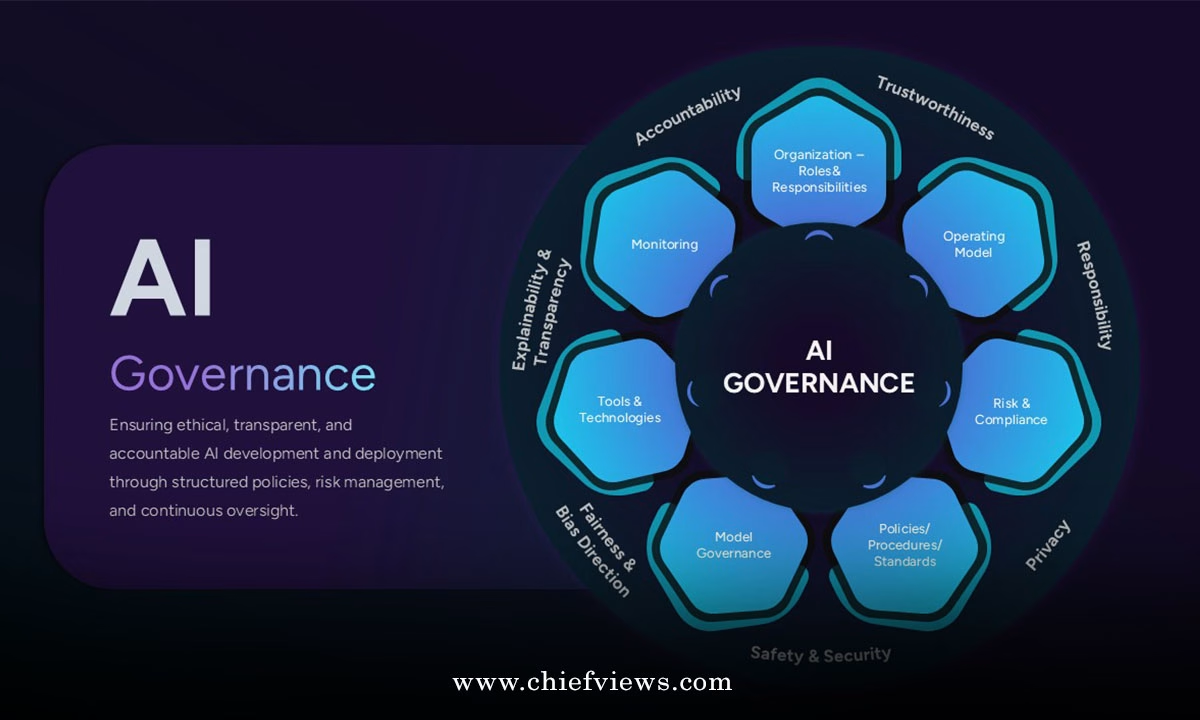
A workable framework usually covers six connected areas.
1. Strategy and Ambition Alignment
Every major AI initiative must map to enterprise goals and risk appetite. The CEO sets the boundaries: which outcomes matter, what level of autonomy is acceptable, and where human judgment remains non-negotiable.
2. Ownership and Decision Rights
Fragmented ownership is the most common failure mode. Assign a single accountable executive for enterprise AI outcomes while cascading clear rights to business-unit leaders. Many high-maturity organizations place ultimate responsibility with the CEO or a direct report who has cross-functional authority.
3. Risk Classification and Controls
Not every use case needs the same scrutiny. Tier systems by potential impact—data sensitivity, decision materiality, customer or financial exposure. High-impact or agentic applications require stronger human-in-the-loop or human-on-the-loop requirements, audit trails, and monitoring.
4. Inventory and Visibility
You cannot govern what you cannot see. Maintain a living inventory of AI systems, including sanctioned tools, shadow usage, and third-party models. Update it regularly and report exceptions.
5. Monitoring, Audit, and Incident Response
Move beyond static policies. Continuous monitoring, model-performance tracking, anomaly detection, and a tested incident-response plan are now baseline. Separate human review remains the most frequently cited guidance for higher-risk situations.
6. Board Reporting and Fluency
Boards need structured updates on strategy progress, material risks, value realization, and capability gaps. Directors themselves require enough fluency to ask sharp questions rather than receive passive briefings.
Building the Framework: A Practical Sequence
If I were advising a CEO starting from an uneven base, this is the sequence I would run.
- Map the current state. Inventory existing AI use, identify shadow tools, and surface the biggest decision-rights gaps.
- Define risk appetite and tiering criteria in one focused session with the executive team and general counsel.
- Assign clear owners and create a cross-functional governance body that reports regularly to the CEO.
- Extend existing enterprise risk and data-governance processes rather than inventing a parallel structure.
- Establish minimum viable controls for agentic systems: identity, least-privilege access, logging, and explicit autonomy boundaries.
- Set a reporting cadence—monthly for the CEO team, quarterly for the board—with defined metrics.
- Test the incident-response process with a tabletop exercise within the first 90 days.
This sequence produces usable guardrails without freezing progress.
Common Pitfalls and Fixes
| Pitfall | Typical Result | Practical Fix |
|---|---|---|
| Treating governance as pure compliance | Slows everything; teams work around it | Position it as the mechanism that enables faster, safer “yes” decisions |
| No single outcome owner | Projects stall or proliferate without results | Name one senior leader accountable for enterprise AI value and risk |
| Static policies only | Cannot keep pace with new models and agents | Build adaptive, use-case-based controls with continuous monitoring |
| Board receives only status updates | Weak oversight and late surprises | Require decisions on ambition, funding, and risk appetite |
| Ignoring shadow AI | Uncontrolled data and model exposure | Combine policy, approved-tool lists, and detection |
These patterns appear repeatedly. Addressing ownership and visibility first usually unlocks the rest.
Linking Governance to Broader Leadership
Strong CEO AI governance frameworks do not stand alone. They enable the rest of the leadership agenda: clear accountability, protected experimentation, workforce fluency, and measurable outcomes. Organizations that treat governance as an afterthought consistently under-perform on both speed and risk management. Those that design it early convert AI from scattered experiments into a managed enterprise capability.
The regulatory environment continues to evolve, with sector-specific expectations and growing attention to board accountability. Frameworks built on principles of transparency, accountability, and human oversight travel better across jurisdictions than those engineered solely for one rule set.
Key Takeaways
- CEO ownership of the overall AI governance agenda remains non-negotiable even when execution is delegated.
- Decision rights and accountability must be explicit, especially for agentic systems.
- Visibility through inventory and monitoring is the foundation; everything else builds on it.
- Tiered controls matched to risk allow speed without creating uncontrolled exposure.
- Boards need structured, decision-oriented reporting and sufficient fluency to exercise real oversight.
- Governance works best when integrated into existing risk and data structures rather than bolted on.
- Early design of autonomy boundaries and audit trails prevents costly rework later.
- The strongest frameworks accelerate responsible scaling rather than constrain it.
Start this week by asking three questions: Who owns enterprise AI outcomes today? Do we have a current inventory of systems and tools? What are the explicit boundaries for any agentic applications already in use? The answers will reveal the first gaps that need closing.
FAQs
What is the difference between AI governance and traditional IT governance?
Traditional IT governance focuses on systems, security, and service levels. AI governance adds layers for model behavior, decision accountability, data lineage used in training or inference, ethical considerations, and the unique risks of autonomous or semi-autonomous action.
How involved should the board be in CEO AI governance frameworks?
Boards should approve the overall risk appetite, receive regular reporting on material uses and incidents, and ensure management has the capabilities and structures in place. Day-to-day policy detail stays with management, but fiduciary oversight of strategy and risk belongs at board level.
Do smaller organizations need the same formal frameworks as large enterprises?
The principles scale. Smaller organizations can operate with lighter documentation and fewer committees, but they still need clear ownership, risk tiering, an inventory of tools, and defined human-review requirements for higher-impact uses. The cost of gaps is often higher when resources are limited.