




CMO guide to agentic AI for autonomous marketing workflows starts with one blunt truth: most marketing teams are still automating tasks, not decisions. Big difference. Automation follows a script. Agentic AI writes its own script, adjusts it mid-campaign, and tells you what it decided and why.
Here’s the quick-hit summary before we go deep:
- Agentic AI = software agents that plan, execute, and adjust marketing tasks with minimal human input, not just chatbots that answer questions.
- Autonomous workflows mean campaigns that optimize budgets, creative, and targeting in near real-time without a human clicking “approve” every step.
- Why it matters now: Gartner named agentic AI a top strategic technology trend heading into 2025-2026, and CMOs who ignore it risk losing speed to competitors who don’t.
- The real ROI shows up in time saved on reporting, testing, and campaign ops — not in replacing your creative team.
- Governance is non-negotiable. Autonomy without guardrails is how brands end up in a PR mess.
What Is Agentic AI, Really?
Forget the buzzword salad for a second. Agentic AI is software built around a goal, not a prompt.
You tell it “improve lead quality from paid search,” and it doesn’t wait for you to write ten follow-up prompts. It analyzes performance, tests bid adjustments, reroutes budget, and reports back with reasoning attached.
That’s the difference between a chatbot and an agent. A chatbot answers. An agent acts.
Think of it like the difference between a GPS that tells you the route and a self-driving car that actually takes it — recalculating when traffic hits, without you touching the wheel.


Why This CMO Guide to Agentic AI Matters Right Now
Marketing budgets are flat. Headcount isn’t growing. Yet the number of channels, formats, and personalization demands keeps multiplying.
Something has to bend. In my experience, it’s either burnout or automation — and burnout doesn’t scale.
This CMO guide to agentic AI for autonomous marketing workflows exists because the gap between “AI-curious” and “AI-operational” companies is widening fast. McKinsey’s ongoing research on AI adoption has repeatedly flagged that the biggest ROI gains go to organizations that redesign workflows around AI, not ones that just bolt AI onto old processes.
That’s the trap most CMOs fall into. They buy the tool. They skip the redesign.
Agentic AI vs. Traditional Marketing Automation
CMOs constantly ask me: “Isn’t this just marketing automation with better branding?” No. Not even close. Here’s the breakdown I walk clients through.
| Factor | Traditional Marketing Automation | Agentic AI Workflows |
|---|---|---|
| Decision-making | Follows pre-set rules (if X, then Y) | Evaluates goals and chooses actions dynamically |
| Human involvement | Constant setup and manual triggers | Human sets strategy; agent executes and adapts |
| Speed of optimization | Weekly or monthly review cycles | Near real-time adjustments |
| Example use case | Drip email sequence | Cross-channel budget reallocation based on live performance |
| Risk level | Low — predictable outcomes | Higher — needs governance and monitoring |
| Setup effort | Moderate, one-time workflow build | Heavier upfront: data integration, guardrails, testing |
Notice the tradeoff. More power, more responsibility. That’s not a cliché here — it’s operational reality.
Step-by-Step Action Plan: Rolling Out Agentic AI as a Beginner CMO
You don’t need to overhaul everything on day one. Start narrow. Prove value. Then expand.
Step 1: Pick One High-Volume, Low-Risk Workflow
Don’t start with brand campaigns. Start with something like paid search bid management or email send-time optimization. Low stakes, high repetition — perfect training ground.
Step 2: Audit Your Data Pipes Before Anything Else
Agentic AI is only as sharp as the data feeding it. If your CRM, ad platforms, and analytics tools don’t talk to each other cleanly, fix that first. Garbage in, garbage decisions out.
Step 3: Set Explicit Goals and Guardrails
Tell the agent exactly what “success” looks like and what it’s not allowed to do — spending caps, brand voice restrictions, approval thresholds for anything customer-facing.
Step 4: Run It in “Human-in-the-Loop” Mode First
Let it recommend, not execute, for the first few weeks. Review its reasoning. Build trust the way you’d build trust with a new hire, not a vending machine.
Step 5: Expand Autonomy Gradually
Once accuracy holds up over a few cycles, hand over more control. Widen the workflow. Add a second use case.
Step 6: Report Impact in Business Terms
Skip the AI jargon in your board deck. Talk about hours saved, cost-per-lead trends, and campaign velocity. That’s what earns you budget for round two.
Common Mistakes & How to Fix Them
I’ve watched smart CMOs stumble on the same handful of things. Here’s the pattern.
Mistake 1: Treating agentic AI like a “set it and forget it” tool.
Fix: Build in scheduled human reviews, at least weekly at first. Autonomy still needs oversight, especially early on.
Mistake 2: Skipping the data cleanup step.
Fix: Invest in integration and hygiene before deployment. This is unglamorous work, but it’s where most failures actually start.
Mistake 3: No clear escalation path for edge cases.
Fix: Define what triggers a human review — unusual spend spikes, off-brand messaging, negative sentiment surges.
Mistake 4: Measuring the wrong KPIs.
Fix: Track decision quality and speed-to-insight, not just output volume. More content isn’t automatically better content.
Mistake 5: Ignoring compliance and disclosure obligations.
Fix: Review guidance from the Federal Trade Commission on AI and deceptive marketing practices before your agents touch customer-facing claims or personalization.
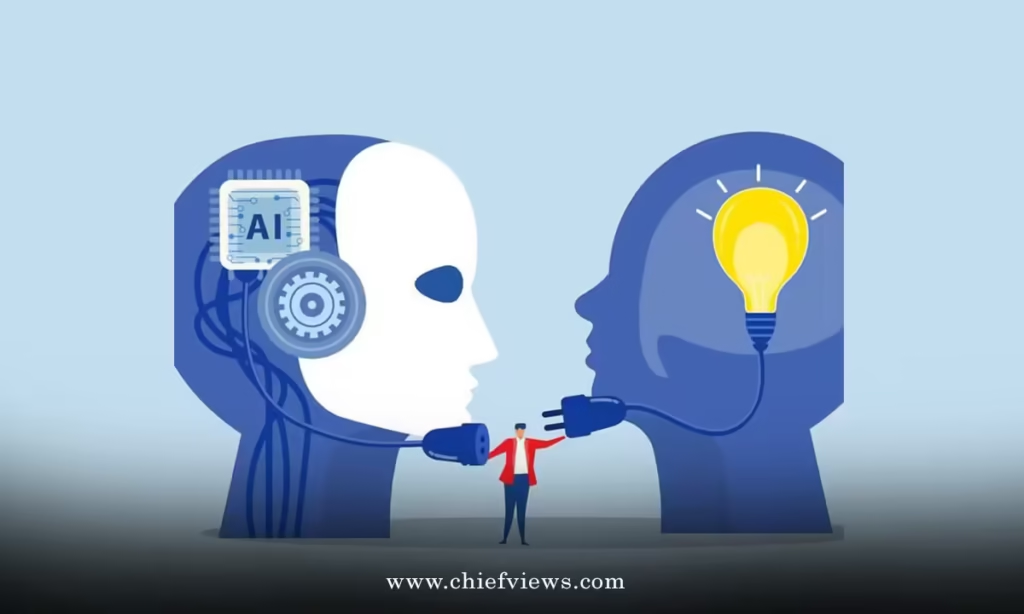
Building Governance Into Your CMO Guide to Agentic AI Rollout
Here’s the thing nobody wants to slow down for: governance. It’s not exciting. It’s essential.
Set up an approval tier system. Low-risk actions (A/B test variations, bid tweaks) run autonomously. Medium-risk actions (creative swaps, audience expansion) get flagged for quick review. High-risk actions (pricing changes, sensitive-topic messaging) require sign-off, full stop.
Harvard Business Review has covered this repeatedly in its work on AI adoption — the organizations that scale responsibly are the ones that formalize accountability structures early, not after something breaks.
What Success Actually Looks Like
Don’t expect a moonshot in month one. What you’ll actually see, if it’s working, is quieter and more useful than that.
Fewer late nights pulling reports. Faster test cycles. Campaign managers spending time on strategy instead of spreadsheet triage.
That’s the real payoff. Not magic. Leverage.
Key Takeaways
- Agentic AI acts on goals; traditional automation just follows fixed rules.
- Start with one narrow, low-risk workflow before scaling agentic AI across your marketing org.
- Clean, connected data is the foundation — skipping this step guarantees disappointing results.
- Human-in-the-loop review builds trust before you expand autonomous permissions.
- Governance tiers (low, medium, high risk) keep autonomous decisions from becoming brand liabilities.
- Measure decision quality and speed, not just content or campaign volume.
- Compliance review matters — check FTC guidance before autonomous agents touch customer messaging.
- The biggest ROI gains, per McKinsey’s ongoing AI research, go to teams that redesign workflows around AI rather than layering it on top of legacy processes.
The Bottom Line
Every CMO guide to agentic AI for autonomous marketing workflows you’ll read this year says roughly the same thing in different words: start small, build trust, scale deliberately. That advice holds because it’s true, not because it’s trendy.
The CMOs pulling ahead right now aren’t the ones with the flashiest AI stack. They’re the ones who redesigned how decisions get made — then let the technology catch up to that new structure.
Your next move? Pick one workflow. Audit the data behind it. Run a human-in-the-loop pilot for thirty days. That’s a Tuesday-morning task, not a moonshot.
FAQs
Does a CMO guide to agentic AI for autonomous marketing workflows apply to small marketing teams, or just enterprise brands?
It applies to both, but the entry point differs. Small teams should start with a single autonomous workflow, like ad bid optimization, since they usually lack the resources for a full-scale rollout.
How is agentic AI different from generative AI tools like chatbots or copywriting assistants?
Generative AI produces content when prompted. Agentic AI pursues a goal independently, making a sequence of decisions and adjustments without needing a new prompt for every step.
What’s the biggest risk CMOs should watch for when adopting agentic AI for autonomous marketing workflows?
Losing visibility into why decisions were made. Without clear guardrails and reporting, autonomous agents can drift from brand guidelines or overspend before anyone notices.