




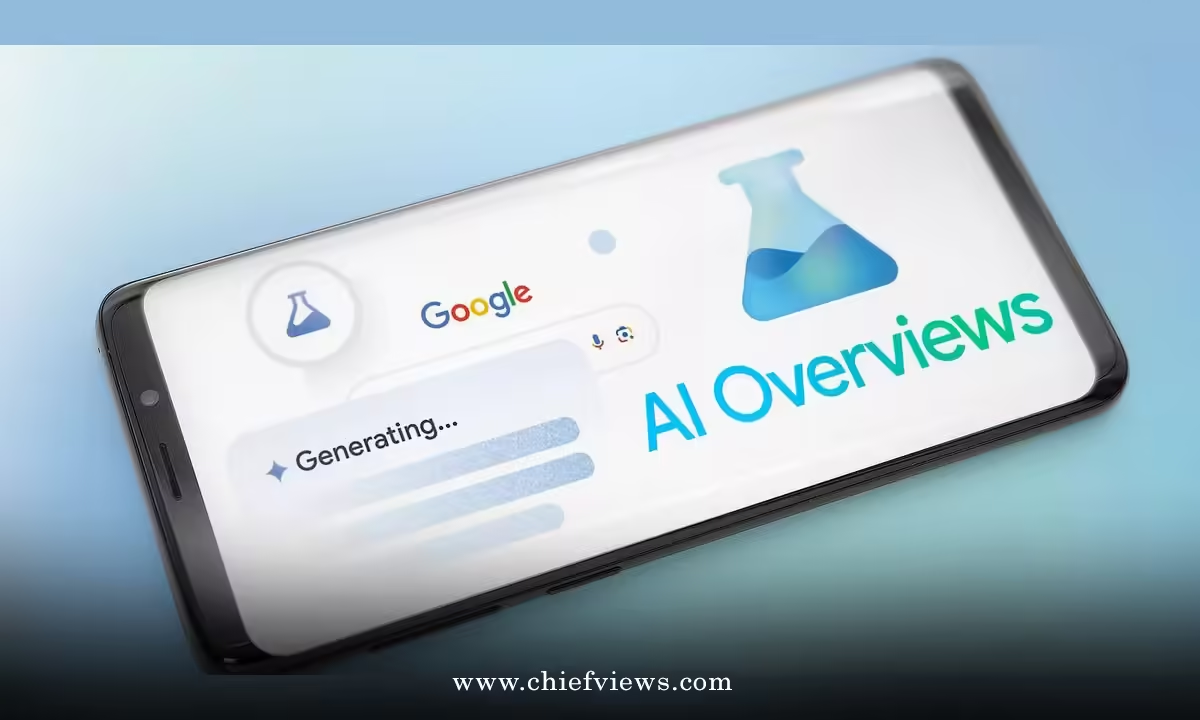
AI Overviews SEO strategy isn’t optional anymore. Google rolled AI Overviews out broadly, and now a growing share of search results carry an AI-generated summary sitting above the traditional blue links. If your content isn’t built to get pulled into that summary, you’re losing visibility before the user even scrolls.
Quick primer before we go deep:
- AI Overviews are Google’s AI-generated summaries that appear at the top of search results, synthesizing information from multiple sources.
- They pull from content that answers questions directly, clearly, and with verifiable structure — not from generic marketing copy.
- Getting cited in an AI Overview doesn’t guarantee a click, but it does build brand visibility and authority signals that compound over time.
- This sits inside a bigger shift — the same one driving how CMO can optimize for generative engine discovery 2026 — where AI-mediated answers are replacing a chunk of traditional click-through search.
- Winning here means restructuring content around clarity and citability, not chasing more keywords.
Why AI Overviews Changed the SEO Game
Traditional SEO rewarded you for ranking position one. Simple enough.
AI Overviews flipped that. Now Google’s model reads across several top-ranking pages, pulls the clearest answer fragments, and stitches together a summary — often without sending a single click to the source.
Here’s the uncomfortable part. You can rank #3 or #4 organically and still get cited in the Overview if your content states the answer more clearly than the page sitting at #1.
That’s a structural shift, not a tweak. Google’s own documentation on AI features in Search confirms this system draws on Search’s core ranking systems, meaning fundamentals still matter, but presentation now decides who gets quoted [1].



The Building Blocks of a Strong AI Overviews SEO Strategy
I’ve reviewed enough underperforming pages to spot the pattern immediately. Great content, buried lead. That’s the #1 killer.
An effective AI Overviews SEO strategy rests on a handful of pillars. Miss one, and citation odds drop fast.
Answer-First Content Architecture
Put your direct answer in the first one to two sentences of any section. Then expand with context, nuance, and supporting detail.
Why? Because the AI model scans for extractable, self-contained statements. Buried answers rarely get pulled.
Structured Data That Actually Gets Used
FAQ schema, HowTo schema, and Article schema all give Google’s systems machine-readable signals about what your content covers. Google’s structured data guidelines are explicit about this — properly marked-up content is easier for automated systems to parse and surface [2].
Original Data and Firsthand Insight
Generic rehashed content rarely gets cited. Original research, case studies, or clearly stated professional experience stand out because they’re not duplicated across fifty competing pages.
AI Overviews SEO Strategy vs. Traditional SEO: A Side-by-Side Look
| Factor | Traditional SEO Focus | AI Overviews SEO Strategy Focus |
|---|---|---|
| Content Structure | Narrative flow, storytelling intros | Answer-first, front-loaded clarity |
| Success Metric | Ranking position, click-through rate | Citation frequency, brand visibility in summaries |
| Keyword Approach | Density and exact-match repetition | Semantic clarity and entity consistency |
| Data Usage | Optional supporting stats | Original, attributable data as a core asset |
| Technical Priority | Backlinks and page speed | Schema markup plus crawl access for AI systems |
Step-by-Step Action Plan for Beginners
Here’s what I’d tell a marketing team starting from scratch.
- Identify your highest-intent queries. Focus on questions your audience actually types, not vanity keywords.
- Rewrite your top pages answer-first. Lead with the direct response, then support it below.
- Add relevant schema markup. FAQ and HowTo schema perform especially well for question-based queries.
- Cite verifiable sources for every stat. Link to .gov, .edu, or major industry reports — never invented numbers.
- Check crawler access. Confirm your robots.txt allows relevant bots, and review your server logs periodically.
- Build one strong data asset. A survey, benchmark report, or original study gives you something genuinely citable.
- Track AI Overview appearances. Tools like Search Console and third-party rank trackers are starting to flag Overview visibility separately from standard rankings.
- Review monthly. AI Overviews shift often. Treat optimization as ongoing upkeep, not a one-time fix.
Common Mistakes & How to Fix Them
Mistake 1: Burying the answer under a long intro.
Fix: Move your direct answer to the first two sentences of the section.
Mistake 2: Skipping schema markup entirely.
Fix: Implement FAQ and Article schema on all cornerstone content pages.
Mistake 3: Relying on thin, unoriginal content.
Fix: Add firsthand experience, original data, or a unique angle competitors haven’t covered.
Mistake 4: Ignoring E-E-A-T signals.
Fix: Add real author bios, credentials, and clear sourcing. Search Engine Land’s ongoing coverage of Google’s quality systems consistently ties visibility to demonstrated expertise and trust signals [3].
Mistake 5: Treating this as a one-time content update.
Fix: Set a recurring content audit — quarterly works well for most teams — to keep pages fresh and citation-ready.
What I’d Do If I Were Starting This Strategy Today
Pick five high-intent pages. Rebuild them answer-first, add schema, and cite one original data point per page.
Watch AI Overview appearances over 45 to 60 days. If it moves the needle, scale the approach across your top twenty pages.
Trying to fix your entire site simultaneously spreads resources too thin. Small, measurable batches win here.
AI Overviews SEO Strategy and the Bigger Generative Search Shift
Here’s the thing — AI Overviews are just one surface in a much larger transformation. The same content principles that get you cited in Google’s Overview also improve your odds inside ChatGPT, Perplexity, and Gemini responses.
That’s exactly the territory covered in our deeper breakdown of how CMO can optimize for generative engine discovery 2026, where we map out the cross-functional strategy marketing leaders need beyond just Google’s AI features.
If you’re building content for AI Overviews, you’re already halfway toward a broader generative engine strategy. Might as well close the gap.
Key Takeaways
- AI Overviews SEO strategy prioritizes answer-first structure over narrative-style writing.
- Ranking position alone no longer guarantees Overview citation — clarity often wins the spot instead.
- Schema markup gives Google’s systems the structured signals they need to parse and surface content accurately.
- Original data and firsthand professional insight outperform generic, duplicated content.
- E-E-A-T signals — real authors, credentials, sourcing — remain central to visibility.
- Crawler access and technical health still matter as the foundation underneath everything else.
- This strategy overlaps heavily with how CMO can optimize for generative engine discovery 2026, since both reward the same structural clarity.
- Track citation frequency, not just rankings, as your new core visibility metric.
AI Overviews aren’t a passing trend to wait out. They’re a permanent layer sitting on top of traditional search, and the brands treating this seriously now will own that visibility while everyone else keeps optimizing for a search experience that’s already shifting under their feet. Start with one content cluster, rebuild it answer-first, and measure what happens.
FAQs
Is an AI Overviews SEO strategy different from regular SEO best practices?
It builds on the same foundation — crawlability, authority, relevance — but adds a layer focused on answer-first structure and citability, since AI Overviews extract and summarize content rather than just ranking it.
How do I know if my content is appearing in AI Overviews?
Manually check target queries in Google Search, and monitor emerging AI Overview tracking features in tools like Search Console and major SEO platforms as they roll out dedicated reporting.
Does AI Overviews SEO strategy require completely different content than what supports how CMO can optimize for generative engine discovery 2026?
No. The core principles — structured clarity, schema markup, verifiable sourcing — support both Google’s AI Overviews and broader generative engine visibility across platforms like ChatGPT and Perplexity.