








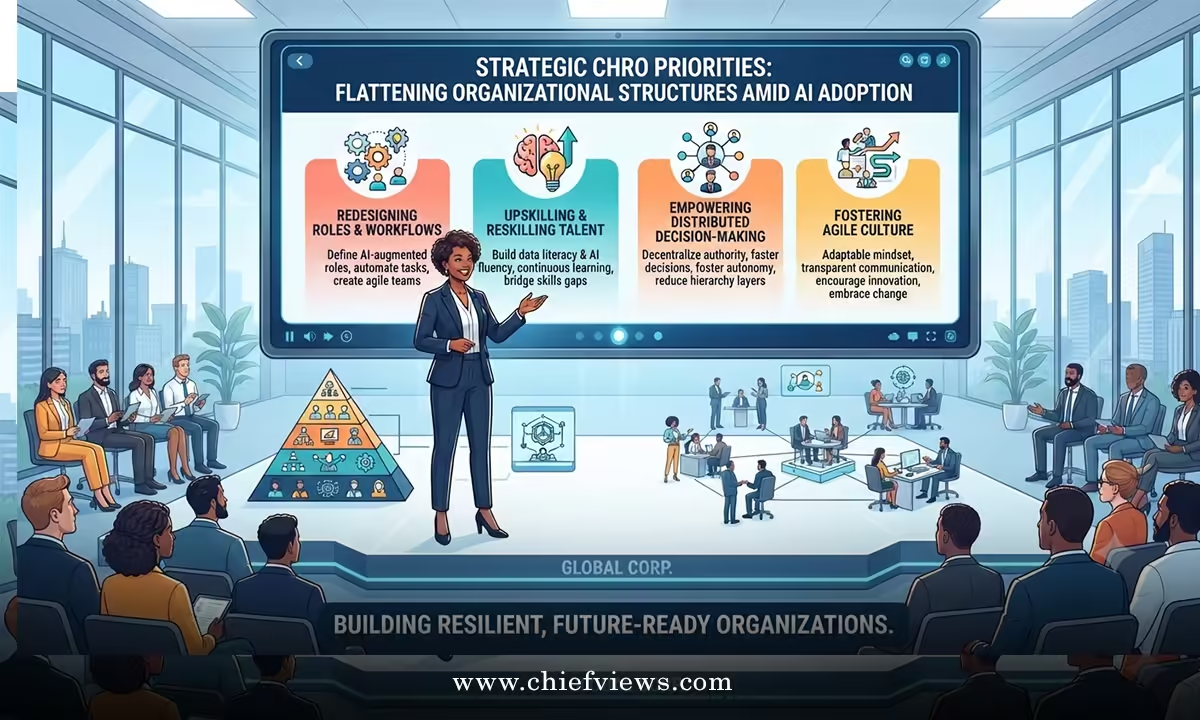
CHRO priorities for flattening structures amid AI adoption start with redesigning how work actually flows, not just drawing a thinner org chart. In 2026, AI agents handle coordination that once justified entire management layers. The result? Wider spans of control, fewer middle rungs, and a CHRO who must keep the remaining structure from collapsing under the weight of human judgment, coaching, and trust.
Here’s the quick take on what this means right now:
- AI absorbs routine synthesis and handoff work, letting organizations cut layers while expanding how many people (and agents) one manager oversees.
- CHROs sit at the center because the hard part is no longer the technology—it’s protecting decision quality, career paths, and engagement as hierarchies compress.
- Success hinges on treating managers as coaches of hybrid human-AI teams rather than pure coordinators.
- Skip the people redesign and you get faster decisions on paper but higher risk, skill erosion, and quiet attrition in practice.
- The payoff is real agility and lower coordination cost—if you redesign roles, skills, and oversight at the same time.
Think of the traditional hierarchy as a multi-story parking garage. AI is the automated valet system that moves cars between floors without humans running up and down. You can remove intermediate levels, but someone still has to decide which cars stay, which get upgraded, and what happens when the system misfires. That’s the CHRO’s new job.
Why Flattening Accelerates with AI in 2026
Spans of control have already climbed. Gallup data shows the average number of direct reports per manager rose from 10.9 in 2024 to 12.1 in 2025, with trajectories pointing higher as agentic tools mature. Gartner has projected that through 2026 one in five organizations will use AI to eliminate more than half of current middle-management positions. The logic is straightforward: when AI handles status updates, basic prioritization, and cross-team routing, the classic “information funnel” role shrinks.
Yet the CHRO priorities for flattening structures amid AI adoption go far beyond headcount math. IBM’s 2026 CHRO study found that nearly half of organizations still leave the CHRO out when AI strategy is defined. That gap shows up later as skills erosion—60 percent of employees worry AI is dulling their critical thinking—and as managers who inherit larger teams without the tools or time to coach them.
McKinsey’s research on AI reinventors makes the same point from the operating-model side: the highest-value organizations do not simply flatten. They reorganize around end-to-end value streams and give cross-functional teams real accountability. Structure follows the work, not the other way around.



Core CHRO Priorities for Flattening Structures Amid AI Adoption
Four practical priorities keep rising to the top in 2026 surveys from Gartner, Evanta, and the CHRO Association.
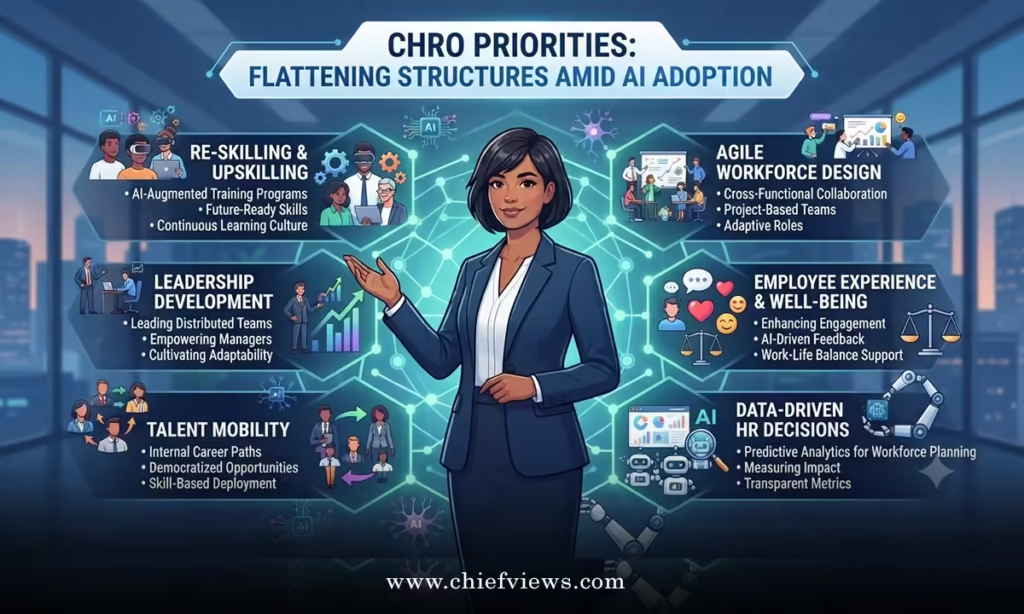
First, rebuild manager capability for hybrid oversight. Managers now supervise people plus autonomous agents. The old span-of-control formula no longer works. What matters is span of complexity—how many agents, how autonomous they are, and how tightly their outputs link to risk.
Second, redesign roles around skills and outcomes rather than titles. Delayering only sticks when the remaining jobs are clear, portable, and measurable. Skills-based progression models are moving from pilot to default in many U.S. firms.
Third, own the human-AI decision boundary. IBM data shows organizations that explicitly define workflows as human-led, AI-assisted, or AI-executed see measurable risk reduction and quality gains. CHROs who co-own that definition protect both performance and employee confidence.
Fourth, protect the leadership pipeline. Cut too many middle layers and you remove the apprenticeship path that produces senior leaders three years from now. The smartest teams keep selective “player-coach” roles and formal coaching quotas even as overall layers drop.
Step-by-Step Action Plan for CHROs Starting the Flatten
- Map the actual work, not the current chart. Sit with process owners and list every coordination task that AI can now absorb. Identify the residual human judgment points. This is the only honest starting inventory.
- Pilot one value stream. Choose a customer-facing or product workflow with clear outcomes. Remove one management layer, expand the remaining managers’ spans by 30–40 percent, and equip them with agent dashboards plus protected coaching time. Measure decision cycle time, quality, and engagement after 90 days.
- Reset manager success profiles. Add explicit accountability for agent oversight, exception handling, and people development. Train every manager on the new span-of-complexity mindset. Half of CHROs in recent Gallup polling still lack confidence that managers can guide AI use—close that gap first.
- Build mobility and skills architecture in parallel. As roles fuse or disappear, give people visible pathways into higher-judgment work. Link learning platforms directly to the new role requirements so the flattening does not strand talent.
- Establish joint CHRO-CIO governance. Require shared roadmaps and a regular operating cadence. IBM found only 28 percent of CHROs currently have this; the ones who do report higher employee willingness to challenge AI outputs.
- Communicate the “why” in human terms. Lead with the removal of grind work and the elevation of contribution, not cost savings. Trust is the scarce resource once layers disappear.
Common Mistakes & How to Fix Them
The biggest error is treating flattening as a pure cost play. Cut the layers, keep the same management practices, and you simply overload the survivors. Fix: recalculate sustainable spans using coaching hours as the constraint, not headcount targets.
Second mistake: leaving middle managers out of the design. They know where the informal coordination still lives. Involve them early or the new structure will recreate the old bottlenecks underground.
Third: ignoring career architecture. When the director and manager rungs vanish, high performers ask “what’s next?” Answer that question with skills-based progression and visible project-based growth paths before the exits start.
Fourth: measuring only efficiency. Track judgment quality, exception rates, and leadership bench strength alongside cycle-time gains. Otherwise you optimize for speed at the expense of resilience.
What the Data Shows on Structure Trade-offs
| Approach | Typical Span Increase | Risk if Done Alone | CHRO Focus Required | Observed Upside (when paired with redesign) |
|---|---|---|---|---|
| Layer removal only | 30–50% | Manager overload, coaching collapse | Training + protected coaching time | Faster decisions, lower overhead |
| Value-stream reorg + AI agents | 40–100% possible | Unclear accountability | End-to-end ownership + decision rights | Higher innovation throughput, clearer outcomes |
| Skills-based roles + selective delayering | Variable by function | Talent stranding | Mobility platforms + new success profiles | Stronger retention of high-judgment talent |
The numbers come from patterns in Gallup span data, Gartner projections, and McKinsey operating-model research. They are directional, not guarantees. Context always wins.
CHRO priorities for flattening structures amid AI adoption ultimately rest on one judgment call: how much human oversight does each critical workflow still need? Get that right and the thinner organization becomes more adaptive. Get it wrong and you trade bureaucracy for fragility.
Key Takeaways
- AI enables genuine delayering by absorbing coordination work that once required intermediate managers.
- Spans of control are already rising; treat complexity, not headcount, as the design constraint.
- Manager capability is the make-or-break variable—half of CHROs still doubt their managers can lead AI use.
- Involve the CHRO in AI strategy from the start; nearly half of organizations still do not.
- Protect the leadership pipeline even as layers disappear.
- Pair every structural cut with role redesign, skills architecture, and explicit human-AI decision boundaries.
- Measure judgment quality and bench strength alongside efficiency gains.
- Communicate the human upside first; cost savings alone erode trust.
The organizations pulling ahead in 2026 are not the ones with the flattest charts. They are the ones whose CHROs treat structure as a living system that must keep producing good decisions, capable leaders, and engaged people after the layers come out. Start with one value stream, protect coaching capacity, and own the decision boundaries. That is the practical next step most teams can take this quarter.
FAQ
What are the top CHRO priorities for flattening structures amid AI adoption in 2026?
Focus on rebuilding manager capability for hybrid human-AI teams, redesigning roles around skills and outcomes rather than titles, defining clear human-AI decision boundaries, and protecting the leadership pipeline so delayering does not wipe out future senior talent.
How do CHRO priorities for flattening structures amid AI adoption differ from traditional cost-cutting exercises?
Traditional cuts simply remove layers and expand spans. Effective priorities treat the thinner structure as a design problem: recalculate sustainable spans based on coaching capacity and agent complexity, update manager success profiles, and pair every structural change with skills architecture and decision-rights clarity.
Where should a CHRO start when addressing priorities for flattening structures amid AI adoption?
Begin with one high-value workflow. Map the coordination tasks AI can absorb, pilot the removal of one management layer with protected coaching time for remaining managers, measure decision quality and engagement after 90 days, then scale only after the hybrid oversight model proves stable.
