










Martech stack for continuous growth is the deliberate collection of platforms and integrations that turn marketing from one-off campaigns into a self-reinforcing system. Done right, it captures demand, nurtures relationships, and surfaces the next growth lever without constant firefighting. Done wrong, it becomes expensive shelfware.
Here’s the quick overview most teams need:
- A modern martech stack unifies customer data, automates execution, and measures impact in near real time.
- Continuous growth comes from tighter feedback loops, not more logos in the stack.
- In 2026 the market sits at roughly 15,500 tools with utilization still hovering near half—proof that selection and integration beat accumulation.
- Beginners should start with CRM + automation + analytics; intermediates layer in composable data and AI orchestration.
- The payoff is predictable pipeline, higher retention, and marketing that scales without linear headcount growth.
The kicker is simple: most stacks fail because teams buy for features instead of outcomes. What usually happens is a shiny new platform lands, integration lags, data stays siloed, and utilization tanks. In my experience, the teams that keep compounding reverse that order—they fix the foundation first.
Why a Martech Stack for Continuous Growth Beats Tool Sprawl
Picture your marketing operation as a river. A fragmented stack is a series of disconnected ponds. Water sits. A well-built martech stack for continuous growth keeps the current moving—data flows into decisions, decisions trigger actions, actions feed new data. That loop is the difference between growth that plateaus and growth that compounds.
By mid-2026 the landscape has effectively peaked at just over 15,500 commercial products. Net growth is under 1 percent, yet churn is fierce. Categories tied to AI readiness—CMS for machine-readable experiences, iPaaS for orchestration, analytics, and governance—are the ones expanding. Everything else is consolidating or disappearing. The signal is clear: stop collecting tools and start building infrastructure that AI agents and human teams can actually use together.
Gartner’s recent surveys show utilization still stuck around 49 percent. That means roughly half the money spent on martech is generating zero active output. The high performers treat their stack like a product: they measure adoption, kill redundant seats, and only add capability when a clear bottleneck appears.


Core Layers of a Martech Stack for Continuous Growth
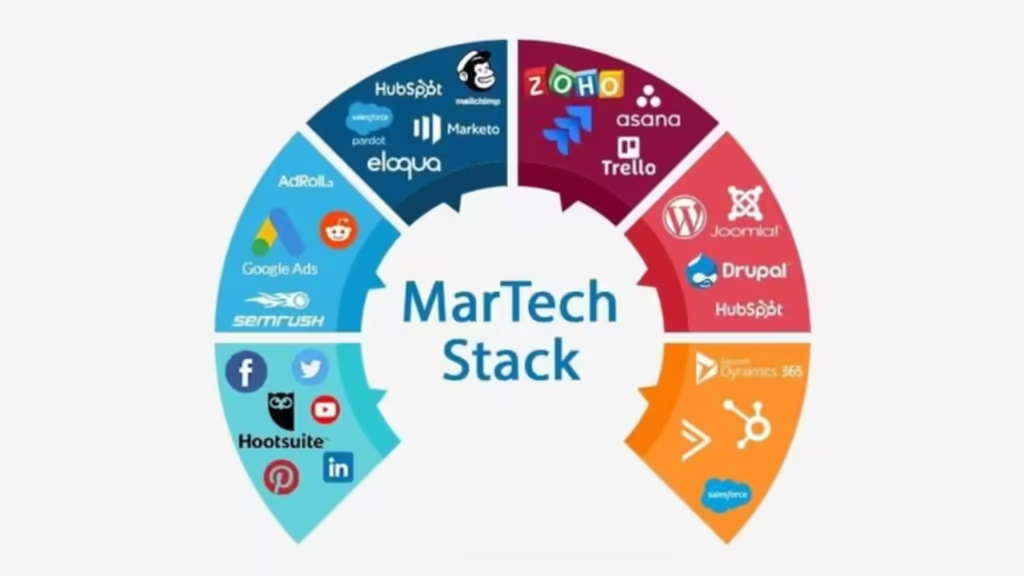
Every durable stack rests on five practical layers. Skip one and the loop breaks.
- Data foundation – CRM as the system of record for known contacts and deals, increasingly paired with a warehouse or lightweight CDP for behavioral and anonymous data.
- Orchestration & automation – The engine that triggers the next best action across email, ads, web, and sales.
- Activation & experience – CMS, personalization, and channel tools that deliver the message.
- Measurement & intelligence – Analytics, attribution, and the emerging AI insight layer.
- Integration & governance – iPaaS or native connectors plus consent and privacy controls so the whole thing stays compliant and maintainable.
For most beginner and intermediate teams in the U.S. market, HubSpot or Salesforce sits at the center for CRM and automation, Google Analytics 4 plus Looker Studio handles web measurement, and a simple integration layer (native connectors or a mid-market iPaaS) keeps data moving.
Starter vs. Intermediate Stack Comparison
| Layer | Beginner Stack (under ~50k contacts) | Intermediate Stack (scaling teams) | Why It Matters for Continuous Growth |
|---|---|---|---|
| CRM / System of Record | HubSpot CRM (free or Starter) or Salesforce Essentials | Salesforce or HubSpot Enterprise + clean data hygiene rules | Single source of truth prevents the “which list is real?” tax |
| Automation | Native HubSpot or ActiveCampaign workflows | Same platform + AI journey agents or dedicated orchestration | Turns one-time campaigns into always-on nurture |
| Analytics | GA4 + Looker Studio | GA4 + warehouse-fed dashboards (BigQuery + Looker) | Closes the loop between spend and revenue |
| Data Unification | CRM lists + GA4 audiences | Lightweight CDP or reverse ETL (Hightouch-style) into the warehouse | Feeds AI and personalization without new silos |
| Integration | Native connectors | iPaaS or middleware for reliability | Keeps the river flowing when tools update |
This table is not gospel. It’s a practical starting map. What I’d do if I were auditing a mid-market B2B team tomorrow: open the CRM, count active workflows, check how many tools actually push data back into the customer record, then kill anything that doesn’t.
Step-by-Step Action Plan to Build Your Martech Stack for Continuous Growth
Martech stack for continuous growth Start here if you’re a beginner or intermediate operator who wants results in 90 days, not another strategy deck.
- Audit what you already own. List every tool, monthly cost, primary user, and last meaningful use. Most teams discover 30–40 percent pure overlap. Gartner’s utilization numbers make this non-negotiable.
- Define the three growth loops you care about. Example: new lead → MQL → SQL; customer → expansion opportunity; content → organic pipeline. Every tool must serve at least one loop.
- Lock the CRM as the system of record. Clean the data first. Bad data in equals expensive automation of mistakes.
- Add or tighten automation around those loops. Start with three high-volume workflows. Measure open, click, and conversion rates weekly.
- Instrument measurement. Connect web analytics, CRM stages, and ad platforms so you can answer “what created revenue last month?” without a three-day spreadsheet scramble.
- Introduce one AI capability only after the above works. Embedded agents inside your CRM or automation platform beat stand-alone AI tools for most teams right now.
- Review utilization monthly. If a tool sits below 60 percent adoption for two consecutive months, sunset it or train harder.
Follow that sequence and you avoid the classic trap of buying the eighth marketing automation seat before fixing the data model.
Common Mistakes & How to Fix Them
Mistake 1: Buying for the feature list instead of the bottleneck.
Teams fall for the demo. The fix: write the specific growth problem first (“we lose 40 percent of MQLs between marketing and sales”). Only then evaluate tools against that problem.
Mistake 2: Treating integration as a phase-two project.
What usually happens is the new platform goes live with a CSV import and a promise to “connect later.” Later never comes. Fix it by making bidirectional data flow a go-live requirement.
Mistake 3: Ignoring utilization until renewal time.
Half the stack sits unused. Run a 15-minute monthly utilization check. Reclaim seats or retrain before the next invoice.
Mistake 4: Chasing AI agents without context.
AI without clean customer data and clear process knowledge just produces polished nonsense. Build the foundation layer first—then the agents become useful.
Mistake 5: Over-engineering for scale you don’t have.
A 10-person marketing team does not need an enterprise CDP on day one. Start lean, prove the loops, then add complexity.
Key Takeaways
- Continuous growth comes from closed data-action-measurement loops, not from collecting more tools.
- 2026 reality check: tool count has plateaued near 15,500 while utilization lingers around 49 percent—selection and activation beat accumulation.
- Beginners win with CRM + automation + analytics done well; intermediates add composable data and light AI orchestration.
- Audit ruthlessly, define the growth loops first, and make integration non-negotiable at go-live.
- Treat the stack like a product: measure adoption monthly and kill what doesn’t earn its keep.
- AI agents amplify a good foundation; they cannot rescue a messy one.
- The real competitive edge in 2026 is owned context—clean first-party data and documented processes that both humans and agents can use.
Build the river, keep the current strong, and the growth compounds. Start with the audit this week. Open every tool you pay for, ask who actually uses it last month, and cut the dead weight. That single move usually frees more capacity than any new platform purchase.
FAQs
What does a practical martech stack for continuous growth look like for a mid-market B2B team in 2026?
CRM (HubSpot or Salesforce) as the core, native automation, GA4 plus a lightweight reporting layer, and one reliable integration path. Add a warehouse or reverse-ETL tool only when you outgrow list-based audiences.
How often should I revisit my martech stack for continuous growth?
Quarterly utilization and outcome reviews, with a deeper architectural look once a year. Markets and AI capabilities move fast enough that annual is the minimum.
Is a customer data platform required in a martech stack for continuous growth?
Not for most beginners or early intermediate teams. A clean CRM plus good analytics and audience syncing covers the majority of use cases under roughly 50,000 profiles. Introduce a CDP or warehouse-native approach when identity resolution and real-time activation become clear bottlenecks.

