





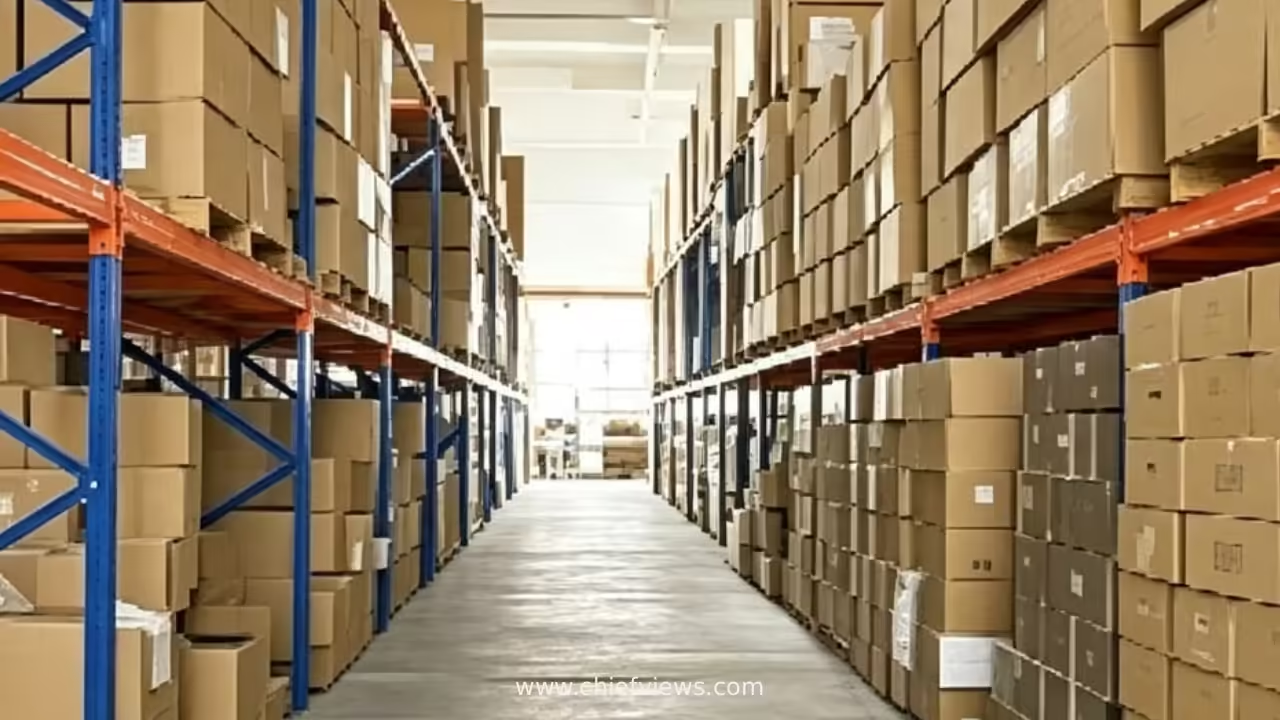
Inventory and logistics optimization with AI agents is no longer a pilot project sitting on a slide deck. It is software that senses demand shifts, supply hiccups, or cost spikes, reasons through constraints, decides the next move, and executes inside guardrails without waiting for a human to click “approve.”
Here’s the quick hit:
- AI agents continuously adjust safety stock, reorder points, and multi-echelon positions using live signals instead of static spreadsheets.
- They handle carrier selection, dynamic rerouting, and dock allocation in real time.
- Early adopters report faster fulfillment, fewer stockouts, and lower carrying costs when data quality and governance are solid.
- The real differentiator is autonomy with oversight—agents act within policy while escalating exceptions.
- For U.S. operators, this means tighter working capital and better service levels without adding headcount.
In my experience working with mid-market and enterprise teams, the biggest win is decision density. Traditional planning runs weekly or monthly. Agents can reoptimize daily or even hourly at the SKU-location level. That is the difference between reacting to a stockout and preventing it.
Why inventory and logistics optimization with AI agents changes the game
Old-school inventory tools gave you a forecast and a recommendation. You still had to open the ERP, build the PO, check the TMS, and hope the numbers held. Agentic systems close that loop.
An Inventory Agent, for example, can pull live demand signals, current lead times, service-level targets, and holding costs, then recalculate safety stock and trigger replenishment inside defined thresholds. A Logistics Agent can detect a capacity gap, solicit carrier bids, validate contracts, and book the move while updating the system of record.
Gartner projects that 40 percent of enterprise applications will integrate task-specific AI agents by the end of 2026, up from less than 5 percent recently. The same firm expects half of cross-functional supply chain solutions to rely on intelligent agents for autonomous decisions by 2030.
Inventory and logistics optimization with AI agents Microsoft has already put more than 25 agents into its own supply chain for demand simulation, spare-parts forecasting, and cargo optimization, with a goal of over 100 by year-end 2026. Logistics teams there report hundreds of hours saved monthly.
The kicker? Clean, governed data. Agents amplify whatever you feed them. Garbage in still equals expensive garbage out.
How inventory and logistics optimization with AI agents works in practice
Think of the agent stack as a small team of specialists that talk to each other and to your existing systems.
Core capabilities usually include:
- Continuous demand sensing that folds in weather, promotions, social signals, and point-of-sale data.
- Multi-echelon inventory rebalancing that moves stock between nodes before a shortage hits.
- Carrier selection and dynamic rerouting that weighs cost, transit time, reliability, and even carbon.
- Exception handling that escalates only when policy thresholds are breached.
BCG analysis shows agentic approaches can deliver 15–30 percent inventory reduction, 2–5 percent revenue uplift, and meaningful service-rate gains when implemented with proper decision rights.
What I’d do if I were starting from a typical U.S. mid-sized manufacturer or distributor: pick one high-pain, measurable process—say, safety-stock calculation for A-items or freight auditing—and give the agent narrow authority. Measure the outcome in dollars and service levels, not in “AI adoption” metrics.
Comparison of traditional vs. agentic approaches
| Aspect | Traditional Planning | Agentic AI Approach | Typical Impact Observed |
|---|---|---|---|
| Decision cadence | Weekly or monthly | Daily or continuous | Higher decision density |
| Inventory targets | Static DOH by product group | SKU-level, forecast-confidence weighted | 15–30% inventory reduction potential |
| Disruption response | Human-triggered after alert | Real-time detection and action within guardrails | Faster recovery (examples show 3–4×) |
| Human role | Build and approve every action | Set policy, review exceptions | Planning hours cut significantly |
| Data dependency | Historical averages | Live signals + constraints | Accuracy gains when data is clean |
Step-by-step action plan for beginners
Inventory and logistics optimization with AI agents Start small. Most teams that try to “AI the entire supply chain” on day one burn budget and patience.
- Audit your data foundation. Map the systems that hold inventory positions, open orders, lead times, and carrier contracts. Fix the biggest gaps first—duplicate SKUs, stale lead times, missing location attributes. Agents cannot invent truth.
- Choose a bounded use case. Safety-stock recalculation for high-velocity SKUs or automated replenishment within existing min/max policies works well. Avoid end-to-end autonomy until the first process is stable.
- Define clear guardrails. Set the maximum order quantity, the maximum dollar value an agent can commit, and the escalation triggers. Document them. This is non-negotiable for trust and auditability.
- Integrate with existing platforms. Most modern ERP and TMS systems now accept agent connections via APIs or marketplace connectors. Prefer vendors that already have production inventory or logistics agents rather than building from scratch.
- Run a controlled pilot. Parallel the agent against human decisions for 4–8 weeks. Track stockouts, excess inventory, planner time, and any policy violations. Adjust thresholds based on real results.
- Scale by process, not by geography. Once the first agent is reliable, expand to related decisions—multi-location rebalancing, then carrier tendering—rather than rolling out across every warehouse simultaneously.
- Train the humans. Planners shift from transaction processors to exception handlers and policy designers. That transition needs deliberate coaching.
Common mistakes and how to fix them
I’ve watched the same patterns play out across multiple rollouts.
Mistake one: treating agents like smarter dashboards. People still expect to approve every recommendation. Fix: deliberately expand autonomy for low-risk decisions while keeping humans on the exceptions. Measure the percentage of decisions that no longer need human touch.
Mistake two: skipping data governance. Agents will happily optimize on incomplete or conflicting data. Fix: assign clear ownership for master data quality before the pilot starts. One retailer I worked with delayed three months to clean location and supplier attributes and still came out ahead because the agent produced usable recommendations from day one.
Mistake three: ignoring change management. Planners who feel replaced push back. Fix: position the agent as the junior that handles the repetitive math so the experienced people can focus on supplier negotiations and scenario design. Show the time savings early.
Mistake four: measuring only cost. Service levels and working-capital velocity matter just as much. Fix: build a balanced scorecard from the start—stockout rate, inventory turns, on-time delivery, and planner productivity.
What usually happens after the first six months
Teams that stick with it move from “the agent recommends” to “the agent executes inside policy.” Decision latency drops. Carrying costs start to move. The planning team stops drowning in routine POs and starts asking better strategic questions.
Lenovo’s multi-agent setup across global operations delivered fulfillment decisions three times faster and delivery accuracy up 30 percent in reported results. Automotive and pharmaceutical pilots have shown similar directional gains in on-time performance and cost. These are not magic numbers—they come from disciplined scope and clean integration.
The analogy that sticks with me: traditional supply-chain planning is like driving by looking only in the rear-view mirror and stopping every few miles to recalculate the map. Agents keep both hands on the wheel, eyes on the road, and continuous GPS updates, while you set the destination and the speed limits.
Key Takeaways
- Inventory and logistics optimization with AI agents turns static policies into continuous, constraint-aware decisions.
- Start with one measurable process and strict guardrails rather than a full transformation program.
- Data quality and clear decision rights determine success more than model sophistication.
- Human planners become policy setters and exception handlers—roles that actually leverage experience.
- Early production results from companies like Microsoft and Lenovo show real time and service gains when the foundation is solid.
- Expect 15–30 percent inventory reduction potential only after the agent has proven reliability inside policy.
- Governance is not optional; agents that can move money need audit trails and escalation paths.
- The competitive edge goes to operators who treat agents as junior team members with defined authority, not as black-box tools.
The practical next step is straightforward. Pick your highest-pain inventory or logistics decision that already has decent data. Define the policy boundaries. Run a parallel pilot. Measure in dollars and service levels. Then expand. That sequence has produced more durable results than any big-bang AI initiative I’ve seen.
FAQs
How does inventory and logistics optimization with AI agents differ from traditional AI forecasting tools?
Traditional tools generate a forecast or recommendation and stop. Agents sense, reason, decide, and act within guardrails—placing orders, rebalancing stock, or booking carriers without waiting for a human click on every transaction.
What data readiness level is needed before starting inventory and logistics optimization with AI agents?
You need accurate, timely inventory positions, lead times, open orders, and basic cost parameters. Perfect data is rare; focus on the 20 percent of attributes that drive 80 percent of decisions and clean those first.
Can mid-sized U.S. companies realistically adopt inventory and logistics optimization with AI agents in 2026?
Yes. Many platforms now offer pre-built inventory and logistics agents that connect to common ERP and TMS systems. The barrier is less technology and more willingness to define clear policy boundaries and measure outcomes.
