







Skills-Based Workforce Planning is no longer a progressive experiment. In 2026 it has become the practical operating system for organizations that refuse to treat people as static headcount.
Traditional workforce planning asked one question: How many people do we need in which jobs next year? Skills-based workforce planning asks a sharper set: What capabilities will the work actually require, who already has them (or can build them quickly), and how do we move those capabilities to the moments of highest value?
The difference sounds semantic. It is not. Companies still running headcount models keep discovering they have the right number of people in the wrong places while critical skills sit idle or walk out the door.
Why Skills-Based Workforce Planning Matters Now
AI has compressed the half-life of many technical skills and simultaneously raised the premium on human ones—judgment, problem framing, systems thinking, and the ability to supervise and override machines. McKinsey’s 2026 HR Monitor found that only 11 percent of organizations take a genuinely long-term view of workforce planning. Most remain stuck in short-term capacity math while the skills required to deliver strategy shift underneath them.
Deloitte research shows organizations that treat skills as the primary unit of planning gain measurable advantages in agility and talent redeployment. When you know what people can actually do—not just the job title they hold—you stop over-hiring for roles that will be re-engineered in eighteen months and start moving capability to where it creates outcomes.
The practical payoff shows up in three places: faster response to new demand, lower reliance on expensive external hiring for every gap, and clearer visibility into where learning investment will actually move the needle.

The Core Mechanics of Skills-Based Workforce Planning
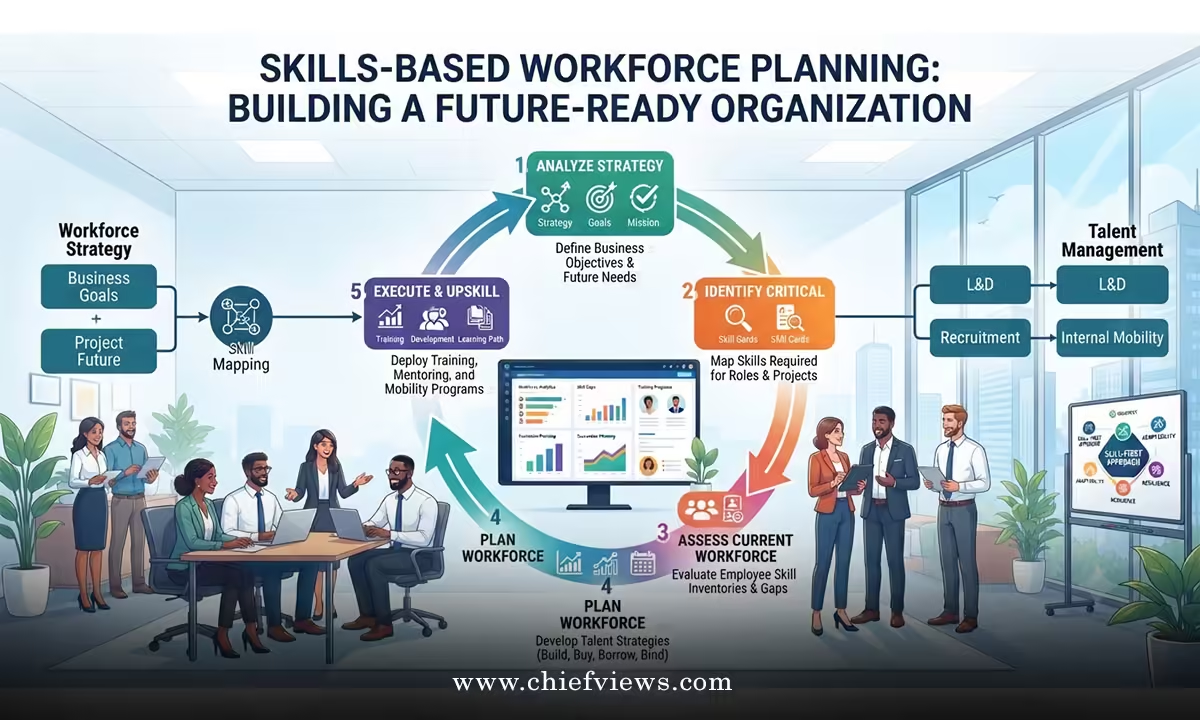
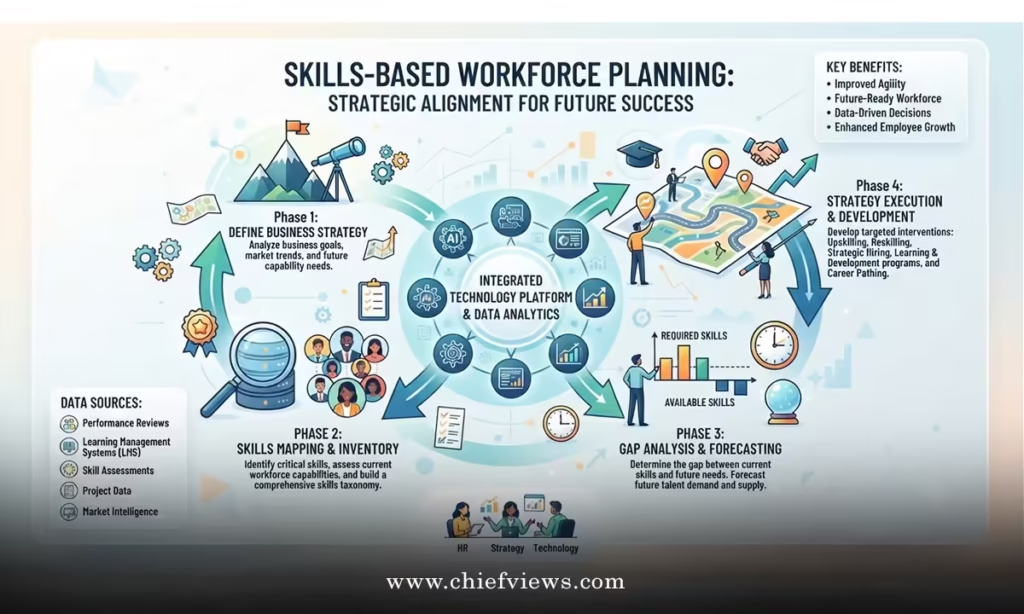
Start with the work, not the org chart. Break critical processes into the tasks and outcomes that drive value. Then identify the skills required to perform those tasks at the required level of quality and risk. This produces a demand signal that is independent of current job titles.
Next, map the current supply. Most organizations discover they already possess more relevant skills than their job architecture suggests. Hidden capabilities surface once you stop filtering talent through outdated role definitions.
The gap analysis that follows is different from classic headcount gaps. You see both deficits and surpluses, plus the velocity at which skills are becoming obsolete or emerging. That velocity data is what turns planning from reactive to anticipatory.
Finally, you activate the levers: internal mobility, targeted learning, selective hiring, and work redesign (including what should be handed to AI agents versus kept with people). This is where skills-based workforce planning connects directly to learning strategy. Organizations that treat learning as a separate HR program miss the point. The highest-leverage move is to align development tightly to the skills the plan has already identified as scarce or rising.
Many CHROs are finding that the most effective bridge is deliberate work on CHRO strategies for building personalized learning at scale. When learning paths are built from the same skills taxonomy used in workforce planning, employees see a clear line between today’s development and tomorrow’s opportunities, and the organization stops funding training that does not close real gaps.
A Practical Sequence Most Teams Can Follow
- Choose one or two high-stakes value streams rather than attempting an enterprise-wide skills inventory on day one. Critical customer journeys or product development processes usually deliver the fastest insight.
- Define the outcomes and the tasks required to deliver them. Resist the urge to catalogue every possible skill. Focus on the capabilities that differentiate performance.
- Assess current talent against those capabilities using a mix of manager input, self-assessment validated by work samples, and existing performance data. AI-assisted skills inference tools can accelerate this, but human calibration remains essential.
- Model multiple scenarios. What happens to skill demand if AI adoption accelerates in a particular function? What if a key market shifts? Scenario planning is what separates strategic capability planning from traditional headcount exercises.
- Build the action plan with clear ownership. Internal mobility targets, learning priorities, hiring filters, and role redesign decisions should all flow from the same skills picture.
- Measure what matters: time-to-capability for critical skills, percentage of demand met internally, reduction in premium external hires, and the actual movement of people into higher-value work.
Common Pitfalls and How to Avoid Them
The most frequent failure is creating an elegant skills taxonomy that never connects to real decisions. If managers still staff projects by job title and budget code, the taxonomy is decoration.
Another trap is over-investing in exhaustive skills data before the organization can use it. Start narrow, prove value, then expand. Verizon’s experience consolidating thousands of job codes into a smaller set of job families aligned to skills shows that simplification often unlocks more value than perfect granularity.
A third mistake is treating skills-based workforce planning as an HR-only exercise. Without tight linkage to finance (for investment decisions) and business leaders (for demand signals), the plan stays theoretical.
Finally, many teams forget that skills decay. Continuous assessment and deliberate practice against real work are required, or the inventory becomes outdated almost as fast as it is built.
What Good Looks Like in 2026
Organizations getting this right share a few patterns. They maintain a living skills language that is simple enough for managers to use in everyday conversations. They give employees visibility into which skills open which opportunities. They treat internal mobility as a first-line response rather than a last resort. And they measure the return on skills investment with the same discipline they apply to capital projects.
The result is not a perfectly optimized workforce. It is a workforce that can be reconfigured faster than competitors when strategy or technology shifts.
Skills-based workforce planning does not eliminate uncertainty. It simply gives leaders a clearer map of the capabilities they actually control and the ones they still need to build or acquire. In an environment where both customer demand and the tools of work keep changing, that clarity is a durable advantage.
The organizations that treat skills as the primary planning currency—and that connect planning tightly to personalized development—will keep more of their talent, waste less hiring budget, and move faster when the next wave of AI capability arrives. The rest will keep counting heads while the real work moves elsewhere.
Key Takeaways
- Skills-based workforce planning shifts the focus from headcount and job titles to the actual capabilities needed to deliver outcomes.
- Only a small minority of organizations currently take a long-term, capability-focused view—most remain stuck in short-term capacity math.
- Start narrow with one or two critical value streams rather than attempting a full enterprise skills inventory on day one.
- Connect planning directly to learning so development closes real gaps instead of funding generic training.
- Hidden internal skills often exceed what job titles suggest; mapping them reduces expensive external hiring.
- Scenario planning for AI-driven skill shifts separates strategic capability work from reactive headcount exercises.
- Measure time-to-capability, internal fill rates, and movement into higher-value work—not just training completion numbers.
- Without business and finance ownership, even the best skills taxonomy stays theoretical.
FAQs
What is the biggest difference between traditional and skills-based workforce planning?
Traditional planning counts people in jobs. Skills-based workforce planning identifies the capabilities required for outcomes, maps who already has them (or can build them), and moves that capability to where it creates the most value.
How long does it typically take to see results from skills-based workforce planning?
Most organizations that start with one high-impact value stream begin seeing clearer internal mobility and reduced external hiring pressure within 6–9 months. Full enterprise impact usually requires 12–18 months of disciplined iteration.
Does skills-based workforce planning replace learning and development programs?
No. It sharpens them. When learning priorities are driven by the same skills data used in workforce planning, training becomes a targeted lever for closing real gaps rather than a separate HR activity.
