







CXO strategies for omnichannel experience consistency aren’t a nice-to-have anymore — they’re the difference between a brand customers trust and one they quietly abandon. Here’s the thing: customers don’t experience your “channels.” They experience you. One brand, one promise, a thousand touchpoints — and if those touchpoints don’t talk to each other, the cracks show fast.
Quick summary (what you need to know):
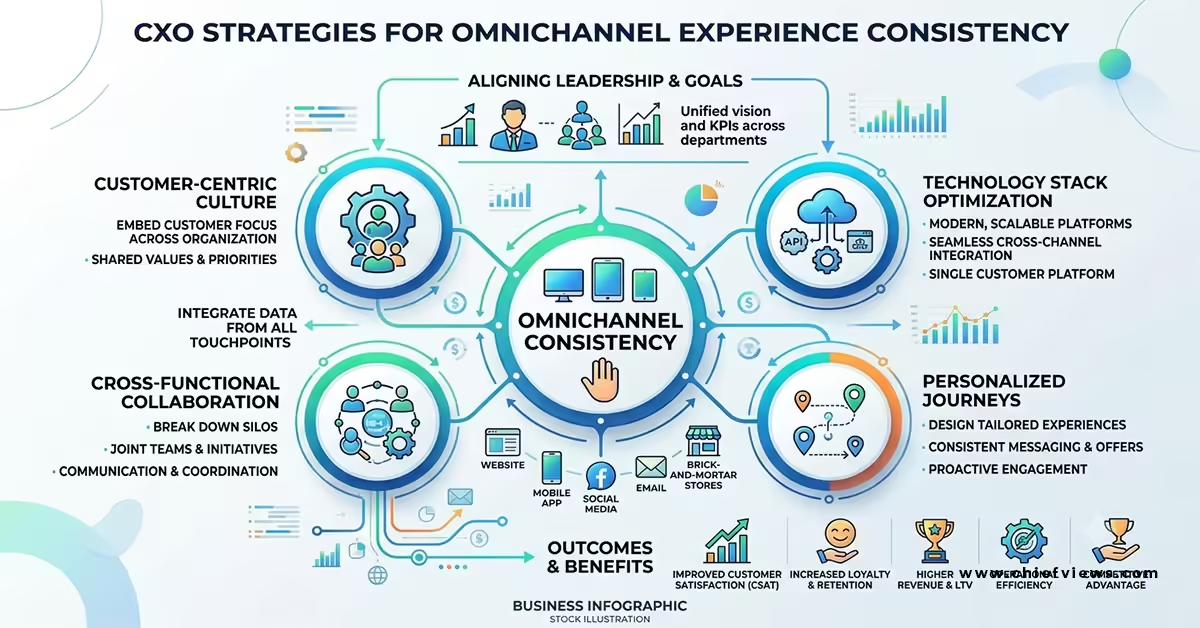
- What it is: CXO strategies for omnichannel experience consistency are the leadership-level frameworks a Chief Experience Officer uses to unify data, tone, and service quality across web, mobile, store, call center, and social channels.
- Why it matters: McKinsey reports 71% of consumers expect personalized, connected interactions, and 76% get frustrated when they don’t get it — frustration that translates straight into churn.
- The gap: A McKinsey/Periscope survey found 78% of retailers admit they have no single, unified brand experience across channels.
- The fix: Centralized customer data, shared KPIs across departments, and executive accountability for the whole journey — not just a slice of it.
Why Omnichannel Consistency Became A CXO-Level Problem
Ten years ago, this was a marketing ops issue. A ticket in Zendesk. Now? It’s boardroom material.
Why the shift? Because customers stopped thinking in channels a while back. They think in relationships. If the chatbot promises a refund and the store clerk has never heard of it, that’s not a “process gap” to the customer — that’s a broken promise.
This is exactly where CXO strategies for omnichannel experience consistency earn their keep. A CXO sits above the silos — above marketing, above IT, above ops — and forces those teams to agree on one version of the truth.
In my experience, the companies that get this right don’t have better technology. They have better governance. Technology without a decision-maker is just an expensive filing cabinet.


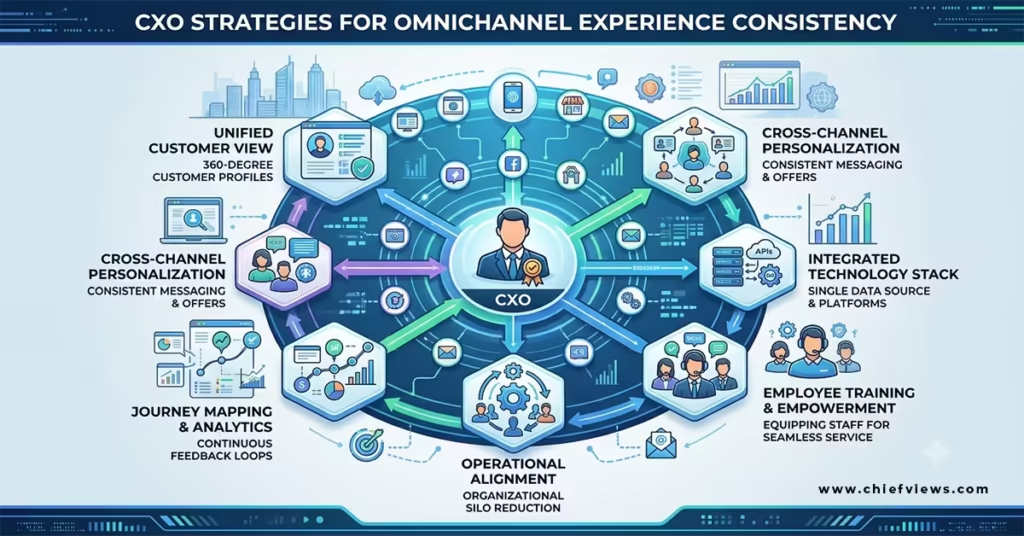
The Core Pillars Of CXO Strategies For Omnichannel Experience Consistency
Let’s break this down into pieces you can actually act on, not abstract theory.
1. Unified Customer Data (The Non-Negotiable Foundation)
If your CRM doesn’t know what happened on your website, you’re not omnichannel. You’re multichannel pretending to be omnichannel — and customers can tell.
What I’d do if I were walking into a CXO role tomorrow: audit every system touching customer data within the first 30 days. Not next quarter. Now.
2. Cross-Functional Governance
Here’s where most transformations die: a CXO builds a beautiful strategy deck, and then marketing, support, and retail ops each interpret it their own way. Three interpretations, zero consistency.
Fix it with a shared council — marketing, CX, IT, and store ops leadership — that meets monthly and owns the journey metrics together.
3. Consistent Voice And Service Standards
Tone matters more than people admit. A snarky chatbot and a formal email from the same brand, on the same day? Customers notice. It feels like two different companies wearing the same logo.
4. Real-Time Feedback Loops
You can’t fix what you can’t see. Build dashboards that surface friction points weekly, not quarterly. A quarterly review on an omnichannel breakdown is like checking a leaking roof once a season — by the time you look, the damage is done.
Omnichannel Vs. Multichannel: Why The Distinction Matters For CXOs
A lot of leaders use these terms interchangeably. Don’t. The gap between them is exactly where most customer frustration lives.
| Dimension | Multichannel Approach | Omnichannel Approach (CXO-Led) |
|---|---|---|
| Data Visibility | Siloed per channel | Unified, real-time, shared across teams |
| Ownership | Each department manages its own channel | Single CXO accountable for the full journey |
| Customer Context | Resets at every touchpoint | Carries forward across every touchpoint |
| Brand Voice | Inconsistent, channel-dependent | Standardized across every channel |
| Measurement | Channel-specific KPIs | End-to-end journey KPIs (e.g., CSAT across full lifecycle) |
Step-By-Step Action Plan For Building Omnichannel Consistency (Beginner-Friendly)
If you’re new to this, don’t try to fix everything in month one. Sequence matters.
- Map the full customer journey first. Every touchpoint, every handoff. You can’t unify what you haven’t mapped.
- Audit your data stack. Find out where customer records live and how many “versions” of the same customer exist.
- Appoint a single accountable owner. This is the CXO’s seat — someone with authority across departments, not just influence.
- Build one shared data layer (a CDP or equivalent) so every team sees the same customer history.
- Standardize service scripts and tone guidelines across chat, phone, email, and in-store staff training.
- Pilot in one journey segment — say, returns or onboarding — before rolling out company-wide.
- Measure consistency specifically, not just satisfaction. Track whether the same question gets the same answer across channels.
- Review monthly, adjust quarterly. Momentum dies in annual planning cycles.
Common Mistakes & How To Fix Them
Short version: most failures aren’t technical. They’re organizational.
Mistake 1: Treating it as an IT project. Fix: Put a business leader — ideally the CXO — in charge, with IT as the execution partner, not the owner.
Mistake 2: Chasing every new channel instead of fixing existing ones. Fix: Perfect three channels before adding a fourth. Breadth without depth just multiplies the inconsistency.
Mistake 3: No shared metrics across departments. Fix: Tie bonuses and reviews to a shared journey KPI, not siloed channel scores.
Mistake 4: Ignoring frontline staff training. Fix: Your digital experience can be flawless and still fail if the in-store associate hasn’t heard of the policy the app just promised.
Mistake 5: Launching big-bang transformations. Fix: Pilot small, prove the model, scale with evidence — not hope.
What Does Omnichannel Consistency Actually Look Like In Practice?
Picture a customer who starts a return on your app, calls support because the app glitched, then finishes the return in-store. Does the store associate see the app history? Does the call center note carry over? If yes — that’s consistency. If no — that’s three separate companies wearing your logo.
Isn’t that the whole point of having a CXO in the first place — someone whose entire job is making sure the seams don’t show?
Measuring Success: The KPIs CXOs Should Actually Track
Forget vanity metrics. Track these instead:
- Cross-channel resolution rate — how often an issue gets solved without the customer repeating themselves.
- Journey-level CSAT — satisfaction measured across the entire path, not one isolated channel.
- Data consistency score — percentage of customer records matching across systems.
- Channel switch friction — time or steps lost when a customer moves from one channel to another.
Companies with strong, well-executed omnichannel strategies also tend to outperform on revenue growth — Forrester Research has linked CX leadership to materially higher business outcomes compared to laggards. That’s not a soft metric. That’s board-level ammunition.
Key Takeaways
- CXO strategies for omnichannel experience consistency work only when one leader owns the entire customer journey, not just a channel.
- Data unification is the foundation — without it, consistency is impossible, no matter how good your marketing copy sounds.
- Most failures are organizational, not technical: siloed teams, siloed metrics, siloed accountability.
- Pilot in one journey segment before scaling company-wide; big-bang rollouts tend to break under their own weight.
- Frontline staff training matters as much as backend tech — a great app can’t save a confused store associate.
- Track journey-level metrics, not channel-level vanity stats, to know if consistency is actually improving.
- Customer frustration with inconsistent experiences is measurable and well-documented — this isn’t a theoretical risk anymore.
Getting this right isn’t about chasing the shiniest new platform. It’s about discipline — one owner, one data layer, one standard, applied relentlessly across every single touchpoint. Start with the journey map, appoint the owner, and build from there. That’s the whole game.
FAQs
Q: How long does it typically take to see results from CXO strategies for omnichannel experience consistency?
A: Most organizations see measurable improvement in cross-channel resolution rates within 6–9 months of piloting a unified data layer, though full-scale consistency across every channel usually takes 18–24 months to mature properly.
Q: Do small and mid-sized businesses need a dedicated CXO to pursue omnichannel consistency?
A: Not necessarily a formal CXO title — what matters is having one accountable leader with cross-departmental authority; smaller companies often assign this to a VP of Customer Experience or even a COO as an interim step.
Q: What’s the biggest warning sign that a company’s omnichannel strategy is failing?
A: Repeat customer complaints about having to “explain themselves again” after switching channels — that single friction point is usually the clearest signal that consistency efforts aren’t working yet.

