





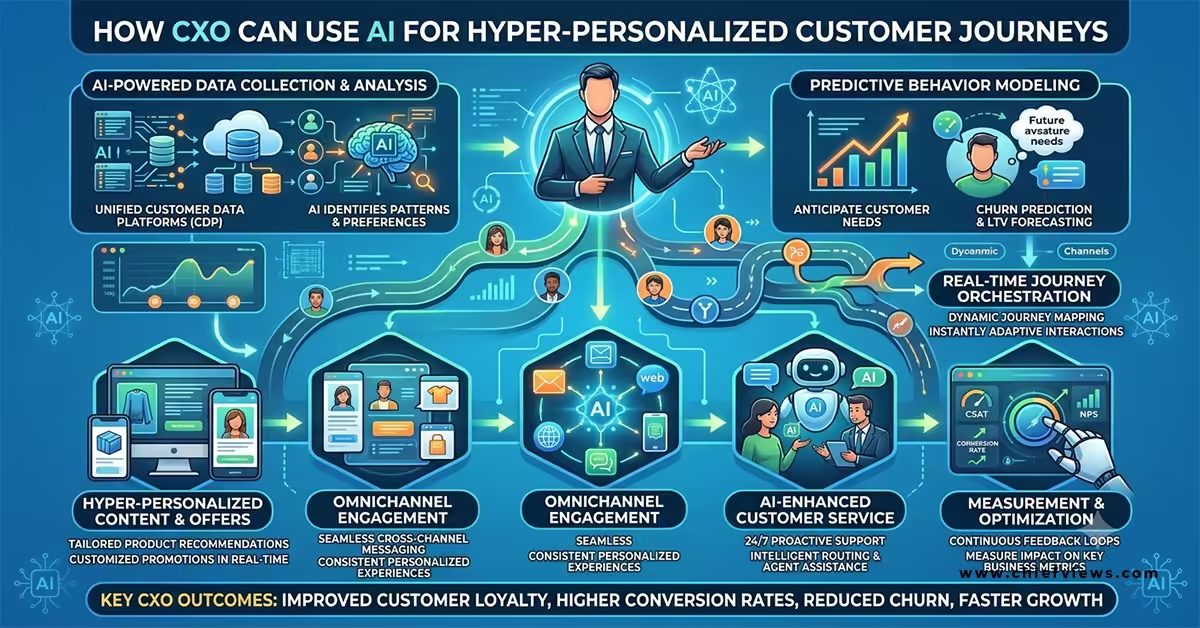
How CXO can use AI for hyper personalized customer journeys comes down to one move: stop treating customers as segments and start responding to individuals in real time. Here’s the quick version.
- What it is: AI models read each customer’s behavior, context, and history, then adapt content, offers, timing, and channels automatically.
- Why it matters: Customers now treat relevance as the baseline. McKinsey’s research on personalization found most consumers expect it, and many get frustrated when it’s missing.
- Who owns it: The CXO. This is a cross-functional customer experience problem, not a marketing tool purchase.
- Where to start: One journey, clean first-party data, and one measurable outcome.
Why Hyper-Personalization Lands on the CXO’s Desk
Personalization used to be a marketing project. Swap a first name into an email, call it a day.
Hyper-personalization is different. It stitches together marketing, sales, service, product, and data teams. Nobody below the CXO has the authority to make all of those groups move at once. That’s the real reason it lands on your desk.
The numbers back up the stakes. McKinsey’s analysis of personalization found that faster-growing companies earn a meaningfully larger share of their revenue from personalization than slower-growing peers. That’s a research finding, not a promise. Your results depend on execution.
So what separates the teams that get it right from the ones burning budget?
Usually it isn’t the model. It’s the plumbing.
What Hyper-Personalization Actually Means (And What It Doesn’t)
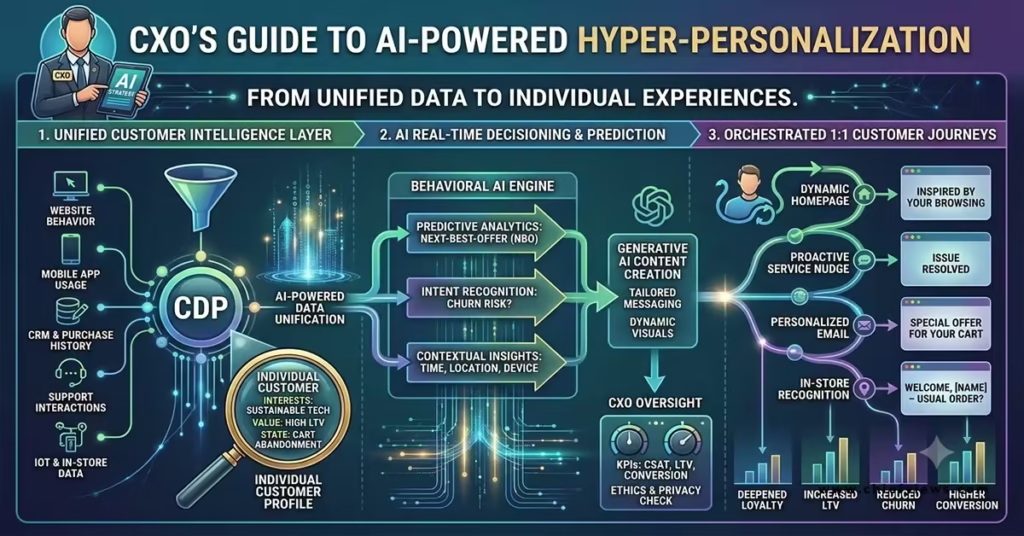
Basic personalization groups people. “Customers who bought X get email Y.” Hyper-personalization responds to one person, in the moment, using live signals: what they just browsed, what they asked support, what device they’re on, how they’ve behaved over months.
Think of a great maître d’. She doesn’t hand every guest the same menu. She remembers you hate the loud corner table, notices you’re with a client tonight, and quietly adjusts. AI lets you do that for a million guests at once.
Here’s the thing, though. It doesn’t mean spooky. The best personalization feels helpful, never watchful. If a customer wonders “how did they know that?” in a bad way, you’ve overshot.
The Core Building Blocks
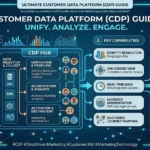
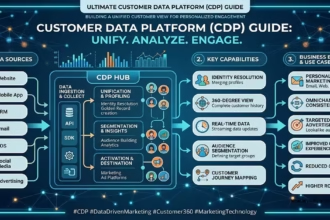
- Unified customer data: A customer data platform (CDP) or warehouse that merges web, app, CRM, and support data.
- Predictive models: Churn risk, purchase propensity, next-best-action.
- Generative AI: Tailored copy, product descriptions, and support replies.
- Real-time decisioning: An engine that picks the right action at the right millisecond.
- Governance: Consent management, bias checks, and human review.
How CXO Can Use AI for Hyper Personalized Customer Journeys: Stage by Stage
The easiest way to organize this is by journey stage. Each stage has a different AI job and a different data need. Here is your code converted into a properly formatted Markdown table:
| Journey Stage | What AI Does | Data Needed | Metric to Watch |
|---|---|---|---|
| Awareness | Predicts which content and channels each audience responds to | Ad engagement, site behavior, consented third-party signals | Click-through rate, cost per qualified visit |
| Consideration | Recommends products, tailors landing pages, powers smart chat | Browsing history, search queries, past purchases | Conversion rate, time to decision |
| Purchase | Adjusts offers, payment options, and checkout friction | Cart data, device, pricing sensitivity signals | Cart abandonment, average order value |
| Onboarding | Personalizes setup guidance and first-use tips | Product usage events, account type | Time to first value, activation rate |
| Retention | Flags churn risk and triggers tailored save actions | Usage trends, support tickets, sentiment | Churn rate, repeat purchase rate |
| Advocacy | Identifies likely promoters and times referral asks | NPS, engagement depth, purchase history | Referral rate, review volume |
How CXO Can Use AI for Hyper Personalized Customer Journeys in Service
Service is where most leaders should look first. Why? Because the data is rich, the pain is obvious, and the payoff is easy to measure.
In my experience, the strongest early wins come from AI that gives agents the customer’s full context before the first word is spoken. Order history, recent frustrations, likely intent. The agent skips the interrogation. The customer skips repeating themselves.
What usually happens is that teams chase flashy front-end chatbots while the unglamorous agent-assist work quietly cuts handle time.
Personalizing the Moments That Move Revenue
Not every touchpoint deserves a model. Pick the handful where a better decision changes behavior: the post-purchase email, the pricing page, the renewal notice, the abandoned cart. Start there.
Step-by-Step Action Plan for Beginners
If you’re new to this, don’t boil the ocean. Here’s what I’d do if I were stepping into this role next Monday.
- Pick one journey. Choose a single, high-volume path, like new-customer onboarding or cart recovery. Not five.
- Audit your data. List what you collect, where it lives, and how clean it is. Be honest. Messy data sinks more AI projects than bad algorithms do.
- Define one outcome. “Raise repeat purchases by a set percentage in six months” beats “improve experience.”
- Unify the customer record. Connect CRM, web analytics, and support into one profile using a CDP or your existing warehouse.
- Start with proven use cases. Product recommendations, send-time optimization, and churn prediction are mature. Save experimental generative ideas for round two.
- Pilot with a control group. Hold back a slice of customers from personalization. Without a control, you’re guessing at impact.
- Add human review. Put a person in the loop for sensitive messaging, pricing, and anything touching regulated decisions.
- Measure, learn, expand. Once one journey proves out, replicate the playbook on the next.
Short version? Small, measured, repeatable.
Privacy, Trust, and the US Rulebook
Here’s where careless programs blow up. Personalization runs on personal data, and US rules are a patchwork. A growing number of states have comprehensive privacy laws, and federal regulators watch deceptive data practices closely.
The FTC’s business guidance on privacy and security is a solid starting point for understanding what regulators expect around data collection, disclosure, and protection. Treat it as a floor, and have counsel review your specific obligations by state and industry. I’m not a lawyer, and nothing here is legal advice.
For governing the AI itself, the NIST AI Risk Management Framework gives you a practical structure for mapping, measuring, and managing risk. It’s voluntary, but it’s a useful shared language between your technical teams and your board.
My opinion, separate from the facts above: lean on first-party and zero-party data. Ask customers directly what they want. They’ll often tell you, and you’ll sidestep a lot of risk.
Common Mistakes & How to Fix Them
I’ve watched the same errors repeat across industries.
Mistake 1: Buying the tool before defining the problem.
Fix: Write the customer problem and success metric first. Then shop.
Mistake 2: Dirty, siloed data.
Fix: Spend the first quarter on data quality. It’s boring. It works.
Mistake 3: Personalizing everything.
Fix: Target the moments with real revenue or retention impact. Over-personalization creates noise and cost.
Mistake 4: Crossing the creepy line.
Fix: Use signals customers knowingly shared. Offer clear controls. Test messages with a skeptical eye.
Mistake 5: No control group.
Fix: Always hold out a baseline so you can prove lift.
Mistake 6: Treating it as a marketing-only project.
Fix: Give one executive accountability for the full journey, and tie incentives across teams.
Mistake 7: Set it and forget it.
Fix: Models drift. Customer behavior shifts. Review performance monthly.
How CXO Can Use AI for Hyper Personalized Customer Journeys: Organizing Your Team
Technology is maybe 40% of this. People and process are the rest.
You’ll want a small cross-functional squad: someone from marketing, service, product, data science, legal, and IT. Give them a shared dashboard and a weekly rhythm. The CXO’s job is clearing roadblocks and keeping everyone pointed at the customer outcome rather than their own department’s metrics.
Hire or partner for analytics translation, too. The person who can explain a propensity model to a retail director in plain English is worth their weight in gold.
Build, Buy, or Blend?
Most mid-sized US companies land on a blend. Buy the commodity layers, such as the CDP, messaging, and experimentation platform. Build only where your data or process is truly unique. If you’re a beginner, buying and configuring beats building from scratch almost every time.
Key Takeaways
- Hyper-personalization responds to individuals in real time, not static segments, and it needs executive ownership across departments.
- Start with one journey, one outcome, and one clean data foundation.
- Customer service and agent assist often deliver the fastest, most measurable early wins.
- Always run pilots with a control group so you can prove the lift.
- First-party and zero-party data keep you safer and customers happier.
- Use the FTC’s guidance and NIST’s AI risk framework as guardrails, and get legal review for your state and sector.
- Keep humans in the loop for sensitive decisions, and monitor models monthly.
- Personalization should feel helpful, never watchful.
Here’s the bottom line. Done right, this approach turns every interaction into a small act of recognition, and customers reward recognition with loyalty and spend. Your next step is simple: pick one journey this week, audit its data, and write down the single metric you’ll move in the next 90 days.
FAQs
1. How can a CXO use AI for hyper personalized customer journeys without a huge budget?
Start narrow. Use the AI features already inside your CRM, email platform, or e-commerce system, like recommendation engines and send-time optimization. Prove value on one journey before you invest in custom models or new platforms.
2. What data do I need to begin?
At minimum: customer identifiers, purchase or usage history, web and app behavior, and support interactions, all gathered with proper consent. You don’t need perfect data to begin, but you do need it connected and reasonably clean.
3. Is it safe to personalize with generative AI?
It can be, with guardrails. Keep humans reviewing sensitive messages, avoid feeding unnecessary personal data into models, and follow your legal team’s guidance. For many CXOs, hyper personalized customer journeys work best when generative AI drafts and people approve.

