









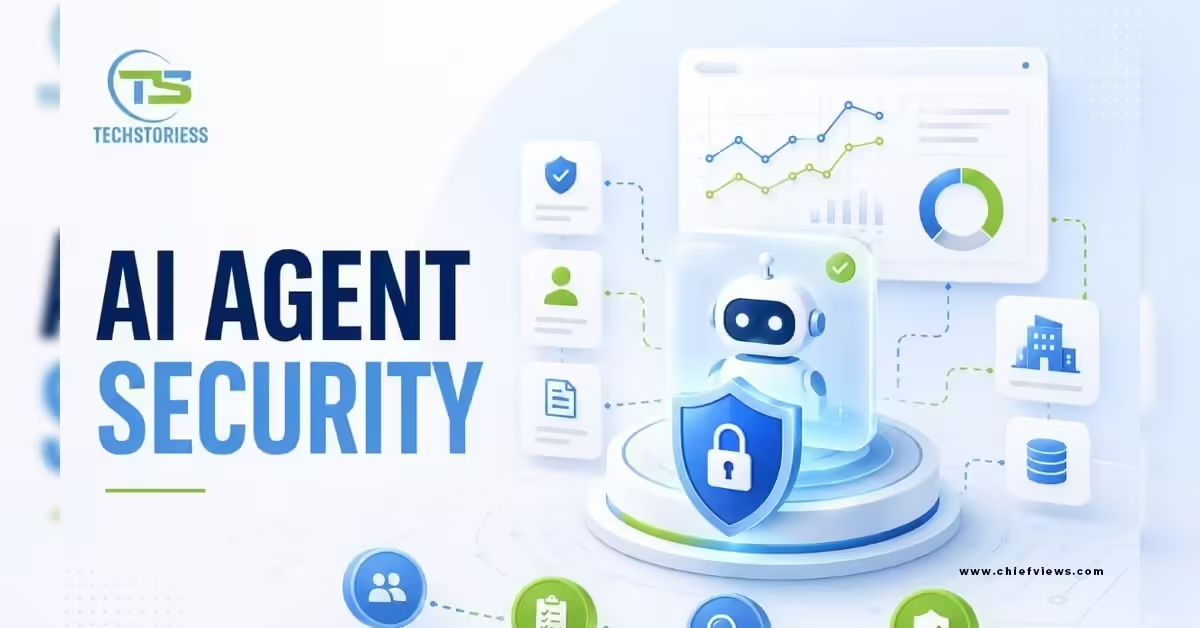
AI agent security best practices have become non-negotiable for any enterprise running autonomous systems in 2026. Agents don’t just suggest. They act—executing code, moving data, calling APIs, and triggering workflows at machine speed. Get the controls wrong and a single compromised or poorly scoped agent can create blast radius that traditional software never approached.
This sits at the heart of how CTOs are balancing AI safety risks with enterprise AI adoption in 2026. Speed without identity, least privilege, and kill switches is just risk with better branding.
Here’s the distilled view:
- Every agent needs its own unique, short-lived identity—not a shared service account.
- Permissions must be task-scoped and time-bound, not role-based leftovers from human IAM.
- High-impact actions require enforced human approval or independent circuit breakers.
- Continuous discovery and immutable logging are table stakes; quarterly audits are too slow.
- Treat tool outputs and external content as untrusted by default.
Ignore these and you inherit the exact control gap IBM and EY surveys keep documenting.
Why AI Agents Break Traditional Security Models
Agents combine reasoning, memory, and tool use. That combination creates new failure modes: prompt injection that hijacks goals, excessive agency that escalates privileges, memory poisoning, and tool misuse that looks legitimate because the agent itself is authenticated.
In practice, the most common conditions security teams find are over-privileged identities, abandoned agents still holding tokens, and zero visibility into what agents are actually doing after deployment. Shared credentials and long-lived tokens turn a single compromise into lateral movement at scale.

The fix is not more policy documents. It is architecture that assumes agents will eventually behave in unexpected ways.
Core AI Agent Security Best Practices
1. Inventory and continuous discovery
You cannot secure what you cannot see. Run automated discovery across cloud, SaaS, developer environments, and endpoints. Map every agent to a human owner, purpose, and risk tier. Shadow agents are the new shadow IT—only faster and harder to revoke.
2. Unique, cryptographically verifiable identity
Give each agent its own non-human identity. Prefer short-lived credentials issued by a central identity provider. Avoid inherited user sessions or long-lived service accounts. Attestation and immutable logs let you prove which agent did what and on whose behalf.
3. Least privilege and task-scoped access
Permissions should match the task, not the platform. A reporting agent should not hold write access to production systems. Enforce scopes at the tool and API layer, not just in the prompt. Just-in-time access that expires when the task ends is the practical standard.
4. Human oversight and independent kill switches
Reserve human-in-the-loop for irreversible or high-value actions. Place circuit breakers and kill switches outside the agent’s control plane so a compromised agent cannot disable its own restraints. Fail closed when monitoring is unavailable.
5. Runtime isolation and untrusted inputs
Sandbox execution environments. Segment networks. Deny outbound access by default. Treat every tool response and external content as potentially hostile. Guardrails on inputs and outputs buy time; they are not a complete defense.
6. Immutable logging and behavioral baselines
Log prompts, tool calls, decisions, approvals, and outcomes with enough fidelity to reconstruct sequences. Establish normal behavior baselines and alert on deviations. Attribution matters: you need to know whether the agent or a human initiated the action.
Step-by-Step Action Plan
- Run a full agent inventory this week. Include sanctioned and shadow agents. Assign a named human owner to each one already in production.
- Replace shared or long-lived credentials with unique, short-lived identities for every production agent.
- Define risk tiers and map approval requirements. Low-risk read-only agents can run with monitoring; high-impact agents need explicit gates.
- Implement independent kill switches and test them. Confirm you can revoke credentials and stop execution in under five minutes.
- Add continuous monitoring and SIEM integration. Start with action frequency, unusual data volumes, and privilege escalation patterns.
- Update incident response playbooks specifically for agentic systems. Include credential mass-revocation and forensic log collection.
- Red-team the highest-risk agents for prompt injection, tool misuse, and goal hijacking before expanding autonomy.
- Review ownership and scopes quarterly—or faster when agents gain new tools or data access.
What I’d do first if I inherited an agent-heavy environment: visibility and identity. Everything else is theater until those two are solid.
Common Mistakes and How to Fix Them
Relying on prompt-level instructions for security. Prompts are not enforcement. Fix: move hard controls into identity, policy enforcement points, and runtime isolation.
Granting broad standing privileges “for convenience.” This is the single most frequent finding in agent audits. Fix: task-scoped, just-in-time access only.
Skipping ownership assignment. Orphaned agents become permanent risk. Fix: no owner, no production. Make ownership a hard gate.
Treating agents like regular applications. They are non-human identities that act continuously. Fix: apply Zero Trust principles adapted for machine-scale speed and autonomy.
Waiting for a perfect inventory before acting. Start with the highest-risk agents you already know about and expand coverage.
Comparison of Control Approaches
| Control Focus | Implementation Difficulty | Risk Reduction Impact | Scalability | Common Failure Mode |
|---|---|---|---|---|
| Prompt guardrails only | Low | Low | High | Easily bypassed by injection |
| Shared service accounts | Low | Very Low | Medium | Lateral movement & attribution loss |
| Unique short-lived identity + least privilege | Medium | High | High | Poor lifecycle management |
| Full isolation + kill switches + continuous monitoring | High | Highest | Medium-High | Overly restrictive without risk tiers |
The highest-leverage combination in 2026 is unique identity + task-scoped least privilege + independent kill switches. Everything else layers on top.

Connecting Security Controls to Broader Governance
These practices are how security teams operationalize the larger question of how CTOs are balancing AI safety risks with enterprise AI adoption in 2026. Strong agent controls let organizations scale agents faster, not slower, because residual risk becomes measurable and containable. Teams that embed these controls early report fewer incidents and higher deployment volumes—the same pattern seen in the IBM data on embedded versus manual governance.
Authoritative references worth bookmarking include the NIST AI Risk Management Framework for the overall structure, Microsoft’s guidance on least privilege for AI agents, and Okta’s identity-first rules for autonomous agents.
Key Takeaways
- Unique per-agent identity with short-lived credentials is the foundation.
- Least privilege must be task-scoped and time-bound, not role-based leftovers.
- Independent kill switches and circuit breakers are mandatory for production agents.
- Continuous discovery and ownership mapping close the visibility gap that enables most failures.
- Treat tool outputs and external content as untrusted by default.
- Human oversight belongs on high-impact actions, not every routine step.
- Logging must support attribution: agent versus human, with immutable trails.
- Security done right enables faster, safer scaling rather than blocking it.
Start with inventory and identity this month. The organizations that treat agents as first-class non-human identities with enforceable boundaries will be the ones still expanding autonomy confidently at the end of 2026. Those that don’t will spend the year responding to the next avoidable incident.
FAQs
What are the highest-priority AI agent security best practices for enterprises just starting out?
Inventory every agent and assign a human owner, issue unique short-lived identities, enforce least-privilege tool access, and implement an independent kill switch. These four moves close the most common and highest-impact gaps quickly.
How do AI agent security best practices differ from securing traditional applications?
Agents reason, maintain memory, and take actions continuously. Controls must therefore focus on identity lifecycle, task-scoped authorization, behavioral monitoring, and the ability to stop execution independently of the agent itself.
Can strong AI agent security best practices slow down innovation?
When designed with risk tiers, they do the opposite. Teams with clear identity, ownership, and kill-switch coverage approve and expand agents faster because residual risk is visible and containable rather than unknown.

