








CMO strategies for AI driven personalization at scale start with one hard truth: most brands still treat customers like segments instead of individuals, and the gap shows up in wasted spend and flat growth. In my experience working with marketing teams that cracked this, the winners stop chasing shiny tools and build systems that turn real-time signals into relevant experiences without collapsing under their own complexity. Here’s the quick overview of what works in 2026:
- Unify fragmented customer data into living profiles that update as behavior happens.
- Deploy AI for dynamic decisioning and content generation so every touchpoint feels one-to-one.
- Rebuild workflows so humans set the guardrails and strategy while machines handle the volume.
- Measure relentlessly against revenue and retention, not vanity metrics.
- Scale only after proving lift on a single high-impact channel.
Get this right and you move from batch campaigns that feel generic to continuous, adaptive journeys that drive measurable gains.
Why Most Personalization Efforts Stall
Here’s the thing. Customers notice when the experience misses. McKinsey research has shown that AI-driven personalization can enhance customer satisfaction by 15 to 20 percent, increase revenue by 5 to 8 percent, and cut the cost to serve by up to 30 percent when executed well. Yet most organizations still run on yesterday’s batch segments. The result? Offers that arrive after the purchase, creative that ignores context, and teams buried in manual variant production.
What usually happens is the tech stack gets bolted on without fixing the operating model. Data stays siloed. Content remains rigid. Governance lags. The brands pulling ahead treat personalization less like a campaign add-on and more like a continuous decision engine that learns with every interaction.
Core CMO strategies for AI driven personalization at scale
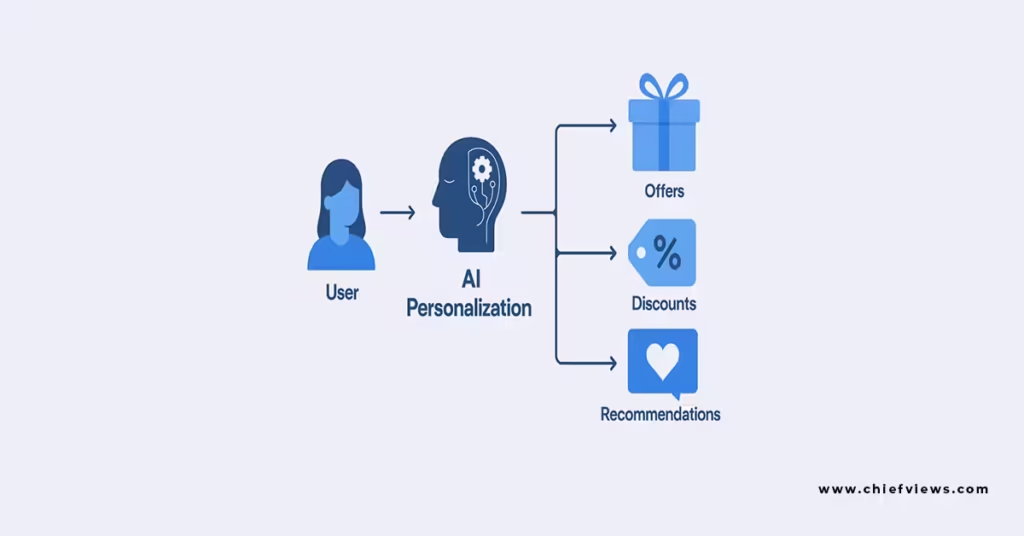
The strongest CMO strategies for AI driven personalization at scale rest on three connected layers: data foundation, real-time decisioning, and modular creative. Skip any one and the system underperforms.


Start with identity resolution and a real-time customer data platform. Disparate sources—web behavior, CRM, support tickets, offline purchases—must resolve into a single, consent-aware profile that updates as events occur. Omnicom’s recent work on 1:1 personalization highlights how brands that connect systems and standardize workflows complete projects up to 40 percent faster. Batch processing creates lag; real-time profiles close it.
Next comes decisioning. Static rules (“if age range X, then message Y”) break at scale. Predictive models and next-best-action engines score propensities in the moment—likelihood to convert, risk of churn, preferred channel, optimal offer. Generative AI then produces the matching content variants while staying inside brand and legal guardrails. The human role shifts from writing every line to curating quality and setting the strategic boundaries.
Finally, distribution has to be channel-agnostic and always-on. Email, site, app, paid media, even in-product experiences all pull from the same profile and decision layer. Silos kill relevance.
In practice I’ve seen mid-market teams get the biggest early lift by focusing on one high-traffic channel first—usually email or on-site recommendations—then expanding. Trying to personalize everything on day one is a classic overreach.
Step-by-Step Action Plan for Beginners and Intermediate Teams
If you’re just getting serious about CMO strategies for AI driven personalization at scale, follow this sequence. It prioritizes foundation over flash.
- Audit and unify data. Map every customer touchpoint. Identify the biggest silos. Clean what you have and prioritize first-party signals with clear consent. Without this, AI simply amplifies noise. Aim for a usable unified profile in 60–90 days.
- Pick one high-impact use case. Choose something measurable and close to revenue: abandoned cart recovery, post-purchase cross-sell, or trial-to-paid conversion. Limit the scope so you can isolate results.
- Stand up modular content. Break creative into reusable components—headlines, body copy, images, offers—that AI can recombine. Build a simple brand voice guide the models must follow. This is where generative tools shine.
- Layer in decisioning and test. Connect your CDP or customer intelligence platform to a decision engine. Run controlled experiments against a holdout group. Track conversion, average order value, and retention—not just open rates.
- Build governance and skills. Create clear rules for data use, model outputs, and escalation to humans. Upskill the team on interpreting AI recommendations rather than treating them as black-box magic. Hire or develop for curiosity and judgment over pure tech fluency.
- Expand and automate. Once you have proven lift, extend to additional channels and introduce agentic workflows for routine optimization. Keep humans in the loop for strategy and brand risk.
This path keeps risk contained while building organizational muscle. What I’d do if I walked into a new CMO role tomorrow: start the data audit in week one and launch the first pilot within 90 days.
Comparison of Approaches: Traditional vs. AI-Driven Personalization
| Dimension | Traditional Personalization | AI-Driven Personalization at Scale | Typical Impact for CMOs |
|---|---|---|---|
| Segmentation | Static demographics or broad personas | Dynamic, behavior + intent clusters | Sharper targeting, less wasted media |
| Content Production | Limited manual variants | Generative creation of hundreds of on-brand versions | Faster testing cycles, higher relevance |
| Decision Logic | Fixed rules or batch updates | Real-time next-best-action with continuous learning | Higher conversion and retention |
| Time to Launch | Weeks for new campaigns | Days once foundation is set | More agile response to market shifts |
| Scalability | Breaks beyond a handful of segments | Handles individual-level experiences | Sustainable growth without linear headcount |
| Measurement Focus | Campaign-level opens and clicks | Incremental revenue, LTV, efficiency gains | Clearer ROI story to the C-suite |
Common Mistakes & How to Fix Them
Mistake one: Treating AI as a content factory without fixing data quality. Garbage in still produces garbage—just faster and at higher volume. Fix: Make data hygiene a standing workstream with clear ownership between marketing and data teams.
Mistake two: Scaling before proving value. Teams roll out enterprise-wide programs that look impressive in decks but deliver marginal lifts. Fix: Insist on controlled pilots with hard financial metrics before expanding budget or headcount.
Mistake three: Ignoring privacy and consent as afterthoughts. Regulations keep tightening and customer trust is fragile. Fix: Bake governance into the architecture from day one. Every personalization decision should be auditable and opt-out friendly.
Mistake four: Leaving creative and brand teams out of the loop. AI can drift off-brand quickly if left unsupervised. Fix: Establish lightweight review processes and continuous feedback loops so models improve against actual brand standards.
The kicker is that most of these failures stem from viewing personalization as a technology project instead of an operating-model change. The tech is the easy part. Aligning people, process, and incentives is where the real work lives.
Measuring What Matters
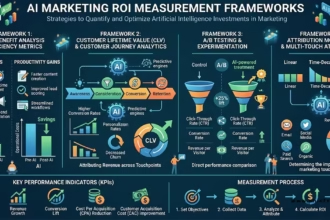
Stop celebrating vanity metrics. Track incremental revenue attributable to personalized experiences, marketing efficiency (cost per acquisition or cost to serve), customer lifetime value shifts, and retention among high-value cohorts. Advanced attribution that accounts for multi-touch, multi-channel journeys becomes essential. McKinsey’s work on the topic underscores that organizations treating personalization as a long-term capability—not a campaign expense—see compounding returns.
For external validation and deeper frameworks, review McKinsey’s analysis of AI capabilities shaping marketing, explore Deloitte’s research on personalization maturity and customer outcomes, and consult Gartner’s guidance on the enablers beyond pure technology for successful personalization programs.
Key Takeaways
- Data unification and real-time profiles form the non-negotiable foundation.
- Start with one revenue-tied use case and prove lift before scaling.
- Shift human effort from production to strategy, quality control, and governance.
- Generative and predictive AI together deliver the volume and relevance traditional methods cannot match.
- Measurement must focus on incremental business outcomes, not just engagement.
- Privacy and brand integrity are competitive advantages when handled deliberately.
- Organizational redesign matters as much as the tools you buy.
- Continuous learning loops turn every customer interaction into better future decisions.
The real advantage in 2026 belongs to CMOs who treat AI-driven personalization as a system, not a series of campaigns. Customers feel the difference when the experience adapts in the moment. Competitors who stay stuck in batch mode will keep leaving money on the table. Your next step is straightforward: audit your current data foundation this month, pick the single use case most likely to move a core metric, and run a tightly scoped pilot. The teams that move first and measure honestly will set the pace for everyone else.
FAQs
What makes CMO strategies for AI driven personalization at scale different from basic segmentation?
Basic segmentation groups people by shared traits and serves similar messages. AI-driven approaches use live behavioral signals, predictive models, and generative content to tailor experiences to the individual in real time, adjusting across channels as context changes.
How long does it typically take to see results from CMO strategies for AI driven personalization at scale?
Focused pilots on a single channel often show measurable lift within 90 days once data is usable. Broader scale and compounding gains usually require 6–12 months of iteration and process redesign.
Do smaller marketing teams need enterprise-level tech for effective CMO strategies for AI driven personalization at scale?
No. Many intermediate teams start with existing CDP or marketing automation platforms that already include AI features, then layer generative tools for content. The constraint is usually data quality and clear use-case focus, not budget size.

