









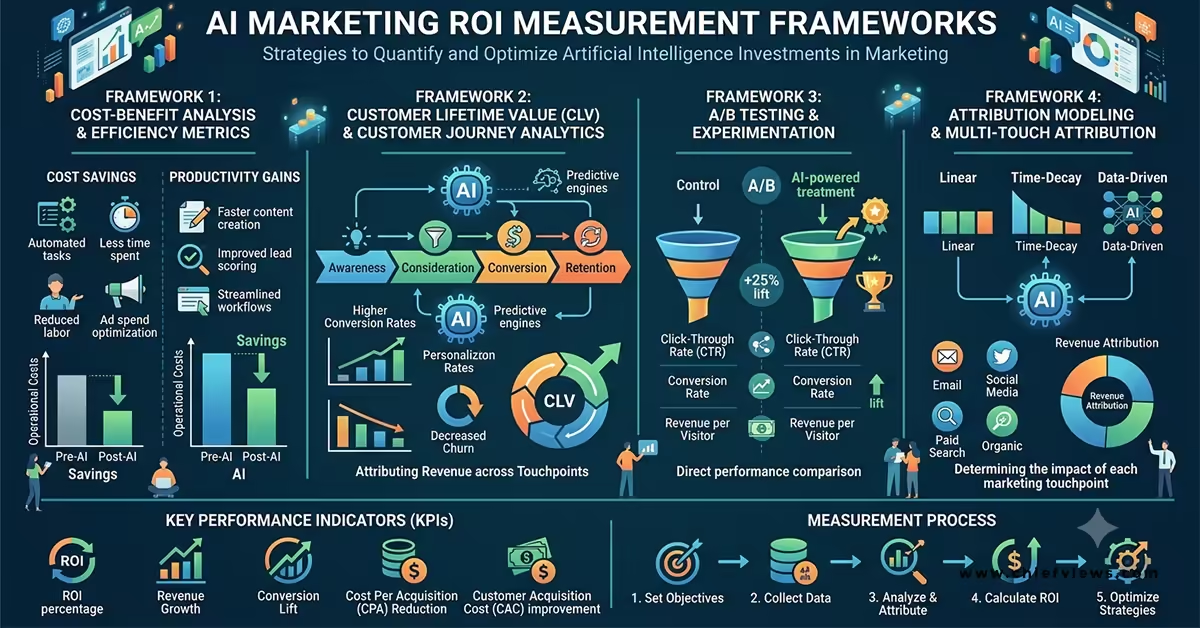
AI marketing ROI measurement frameworks separate teams that keep getting budget from those stuck defending dashboards. Most marketers still report opens, clicks, or “AI-generated assets produced.” Those numbers impress no one in the C-suite. Real frameworks isolate incremental impact, account for full costs, and prove whether the technology moved revenue, efficiency, or customer value.
Here’s the short version of what works in 2026:
- Establish clean baselines before any AI goes live.
- Separate productivity gains, quality/engagement lifts, and hard business outcomes.
- Prioritize incrementality testing over last-click attribution.
- Calculate full total cost of ownership, not just license fees.
- Report in language CFOs already understand: net impact in dollars, payback period, and risk-adjusted ranges.
Without a disciplined framework, AI spend becomes another black box. With one, it becomes a repeatable growth lever—especially when tied to high-value programs like CMO strategies for AI driven personalization at scale.
Why Traditional Marketing Metrics Fail AI
AI changes the economics of marketing work. It lowers the cost of testing, multiplies creative variants, and accelerates decision cycles. Measuring only campaign-level ROAS or content volume misses most of the value.
McKinsey research shows many organizations still struggle to quantify martech and AI returns beyond surface metrics. Bain’s 2026 analysis found only a small subset of marketers—true leaders—credit AI with double-digit revenue growth or meaningful cost savings. The difference? Leaders rebuild measurement around incrementality and full costs instead of vanity output.
The practical problem is simple. Attributed conversions often include activity that would have happened anyway. Holdout tests routinely reveal 20–40% of claimed lift is not incremental. Ignore that and your ROI numbers look great until the board asks hard questions.



The Three-Layer AI Marketing ROI Measurement Framework
The most usable frameworks stack three distinct layers. All three must trend positive before you scale spend.
| Layer | What It Measures | Key Metrics | Evidence Required |
|---|---|---|---|
| Productivity | Input efficiency | Time per task, cost per asset, output volume, experiment throughput | Timed workflows before/after, same team |
| Quality & Engagement | Whether the output still works | CTR, conversion rate, brand-voice match, CSAT, approval rates | Controlled A/B or holdout groups |
| Business Outcomes | Money made or saved | Incremental revenue, CAC/LTV shifts, pipeline contribution, cost-to-serve reduction | Holdouts + multi-touch attribution + finance-approved valuation |
This stack prevents the common trap of celebrating faster content production while conversion or retention stays flat.
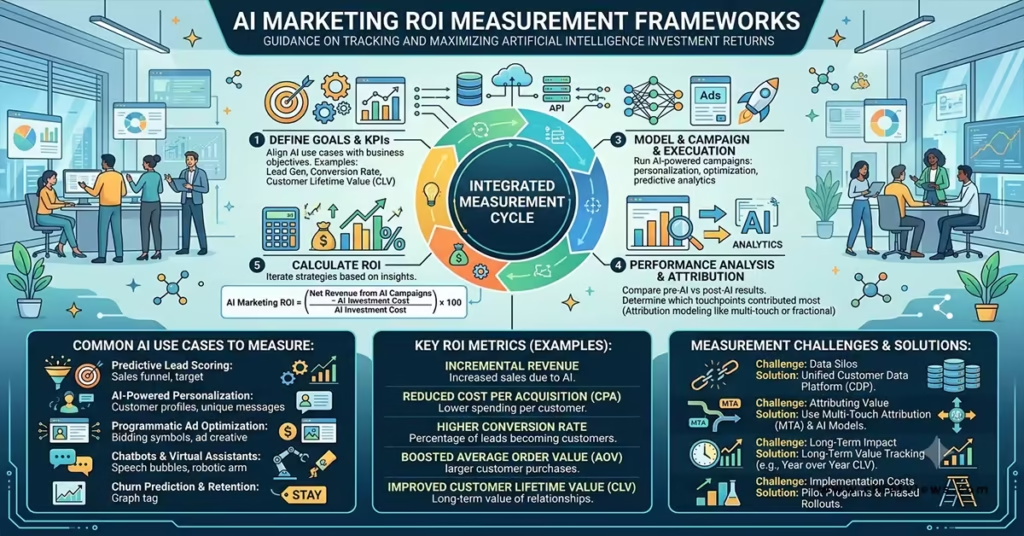
Step-by-Step Action Plan to Implement AI Marketing ROI Measurement Frameworks
- Lock the baseline first. Before any new AI tool or workflow, capture current performance for the exact processes you plan to change. Time content production end-to-end. Record conversion rates, response times, and fully loaded costs. Document the methodology so the post-AI comparison is apples-to-apples.
- Define the success metrics in advance. Choose one primary business outcome (e.g., incremental revenue from personalized journeys or reduced CAC) and two supporting metrics. Tie them explicitly to the AI use case. For personalization programs, this often means tracking lift in LTV or repeat purchase rate among exposed cohorts versus holdouts.
- Run proper incrementality tests. Use holdout groups (10–20% of the audience) or geo-based experiments wherever possible. Platform-reported ROAS is useful for optimization but rarely sufficient for ROI claims. True incremental return on ad spend (iROAS) or incremental revenue is what survives finance review.
- Calculate full total cost of ownership. Include licenses, token/usage fees, human oversight time, integration and data-cleanup work, training, and ongoing model maintenance. Teams that ignore the human and data layers watch their ROI collapse under scrutiny.
- Report net impact in dollars with ranges. Structure every update the same way: baseline → result → full cost → net dollars → confidence range → key learnings. Executives retell clean stories. Messy ones get cut.
- Review and refine quarterly. AI models drift. Customer behavior shifts. What delivered 4x ROI in Q1 may deliver less later. Continuous measurement is part of the operating system, not a one-time project.
This sequence works whether you are measuring generative content engines, predictive lead scoring, or full-scale personalization systems.
Common Mistakes and How to Fix Them
Mistake: Counting every attributed conversion as incremental.
Fix: Always run holdouts or use causal methods. Reallocate budget away from over-credited channels.
Mistake: Reporting only efficiency (hours saved) as ROI.
Fix: Convert time savings into redeployed capacity or reduced headcount cost, then show whether that capacity produced additional revenue or quality.
Mistake: Ignoring second-order effects. Faster creative can flood channels with lower-quality variants and hurt brand metrics. Track quality consistency scores alongside volume.
Mistake: Treating all AI the same. Generative content, predictive models, and agentic workflows have different cost structures and value timelines. Use tailored measurement windows and KPIs for each.
In my experience, the teams that avoid these traps treat measurement design as seriously as the AI implementation itself.
Connecting Measurement to High-Impact Use Cases
Strong AI marketing ROI measurement frameworks become especially powerful when applied to programs that compound. Personalization at scale is a prime example. When you can prove that AI-driven next-best-action journeys lift conversion or retention beyond a clean control group, budget conversations change. The same discipline that validates a content-production pilot also validates larger bets on real-time customer decisioning.
For deeper reading on proven approaches, review McKinsey’s analysis of AI value and marketing capabilities, Bain’s research distinguishing AI marketing leaders from laggards, and Deloitte’s work on AI ROI performance indices and measurement practices.
Key Takeaways
- Baseline everything before AI touches the process.
- Stack productivity, quality, and business-outcome metrics; require all three to move.
- Prioritize incrementality testing over platform-reported attribution.
- Include every cost—licenses, people, data, integration—in the denominator.
- Report net dollar impact with ranges and clear methodology.
- Align measurement language with CFO and board expectations from day one.
- Treat measurement as an ongoing operating discipline, not a post-launch report.
- Link frameworks tightly to high-value strategies such as personalization so results compound.
Measurement is the difference between AI as a cost center and AI as a growth engine. Build the framework once, apply it consistently, and the numbers start speaking for themselves. Start this week by documenting the baseline for your highest-potential AI use case. Everything else follows from that single act of discipline.
FAQs
What is the simplest starting point for AI marketing ROI measurement frameworks?
Capture a clean pre-AI baseline for time, cost, and conversion on one specific workflow, then introduce a holdout group when you activate the AI. That combination alone eliminates most common reporting errors.
How do AI marketing ROI measurement frameworks differ for personalization versus content generation?
Content generation often shows fast productivity gains. Personalization requires longer measurement windows focused on incremental revenue, retention, and LTV because the value compounds over multiple customer interactions.
How long before reliable ROI numbers appear?
Focused pilots with proper baselines and holdouts can produce directional results in 8–12 weeks. Credible, finance-ready numbers for scaled programs usually take a full quarter of clean data plus another cycle for validation.

