










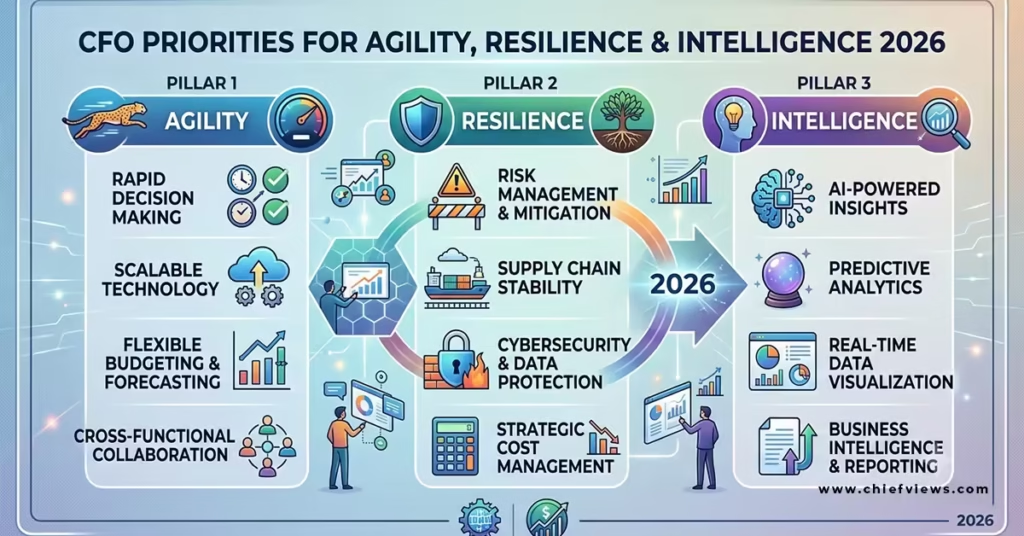
CFO priorities for agility resilience and intelligence 2026 center on turning finance from a reporting engine into the company’s fastest decision system. In plain terms, finance leaders must move capital and people quicker, absorb shocks without breaking, and turn data into usable foresight before competitors do.
Here’s the short version of what matters right now:
- Agility means rapid scenario planning and capital reallocation when conditions shift.
- Resilience focuses on liquidity buffers, cash discipline, and enterprise risk that no longer has a single dominant threat.
- Intelligence is AI-driven forecasting, anomaly detection, and decision support that actually scales inside finance workflows.
- The payoff is higher forecast accuracy, lower cost-to-serve, and a finance team that shapes strategy instead of chasing it.
Boards and CEOs now expect the CFO to own pieces of digital transformation, AI investment, and risk orchestration. Ignore any one of the three and the other two lose force.
Why CFO priorities for agility resilience and intelligence 2026 look different this year
Cost pressure never left. Growth still matters. What changed is the speed of both. Markets move in weeks, not quarters. Geopolitical, regulatory, and technology shocks arrive stacked on top of each other.
Gartner’s 2026 CFO Agenda survey of more than 200 finance leaders shows cost optimization still ranks high for over half of CFOs, yet a clear subset is already shifting budget toward growth bets that require better data and faster execution. Deloitte’s CFO Signals work points to digital transformation of finance and integration of AI agents as top-of-mind for roughly half of respondents. Salesforce research adds that nearly three-quarters of finance leaders say their role expanded in the past year, with AI strategy now sitting on many CFO desks.
The practical result? Finance must deliver three things at once: move faster, stay standing under pressure, and see around corners with better models. That is the core of CFO priorities for agility resilience and intelligence 2026.



Building agility into the finance operating model
Agility is not a soft skill. It is the ability to reforecast, reallocate, and re-staff inside the same quarter without chaos.
In my experience, the CFOs who pull this off treat planning as a continuous process rather than an annual event. They run multiple scenarios weekly or bi-weekly, keep decision rights clear, and give business partners real-time visibility into cash and margin impact.
What usually happens when agility is missing? Teams burn cycles debating last month’s variance while the next shock is already forming. The fix starts with data architecture and process redesign, not another dashboard.
Practical moves for faster capital and people decisions
Start with liquidity and working-capital visibility that updates daily, not monthly. Layer in driver-based models that let you stress-test price, volume, and cost assumptions in minutes. Then give the finance business partners authority to recommend small reallocations without waiting for the full quarterly review.
One fresh analogy: think of the finance function as the company’s shock absorbers. Stiff ones transmit every bump straight to the cabin. Soft, well-tuned ones keep the ride stable while the driver still steers. Agility is the tuning.
Strengthening resilience without freezing the business
Resilience used to mean cash on the balance sheet and a solid credit line. Those still matter. The new layer is the ability to sequence risks—currency, supply chain, cyber, regulatory—as conditions change, rather than treating every threat as equal and permanent.
U.S. Bank’s Fall 2026 CFO Insights report notes that finance leaders are learning to live with uncertainty as a permanent condition. Cost discipline remains a top priority for many, yet optimism about three-year prospects has risen. The ones succeeding keep cost control tight while protecting the capabilities that create optionality.
Cash remains the first line of defense. Working-capital discipline—receivables, inventory, payables—still separates companies that weather a rough quarter from those that scramble. Beyond cash, resilience now includes tech and data resilience. When systems or models fail, the finance team needs fallback processes that do not grind to a halt.
Scaling intelligence through AI and decision systems
Intelligence is the multiplier. Forecast accuracy, anomaly detection, automated compliance checks, and scenario engines all sit under this banner.
Salesforce data shows that more than 90 percent of finance leaders already using AI agents report benefits in productivity, cost reduction, and forecast accuracy. Gartner notes that while most finance teams plan or deploy AI, only about a third of CFOs feel confident they will drive meaningful outcomes. The gap is prioritization.
High-value use cases that actually move the needle: cash-flow forecasting, accounts-payable orchestration, anomaly detection in spend or revenue, and real-time variance analysis. The CFOs getting results treat AI as workflow redesign, not a side project. They measure ROI on specific processes, not on “AI adoption.”
Here’s a quick comparison of where finance teams typically start versus where the highest-ROI moves sit:
| Focus Area | Common Starting Point | Higher-Value Move in 2026 | Typical Time to First Value |
|---|---|---|---|
| Forecasting | Monthly Excel roll-ups | Driver-based + AI-augmented continuous forecasts | 8–12 weeks |
| Cost control | Annual zero-based reviews | Real-time spend anomaly detection + workflow automation | 6–10 weeks |
| Risk visibility | Quarterly risk registers | Dynamic scenario sequencing with live data feeds | 10–16 weeks |
| Decision support | Static dashboards | Embedded AI agents that surface recommendations inside existing tools | 12–20 weeks |
| Talent & skills | Traditional FP&A hiring | Adding digital finance and AI-fluent roles | Ongoing |
Step-by-step action plan for beginner and intermediate finance leaders
- Map your current decision latency. How many days between a material change in the business and a revised forecast or capital recommendation? Write the number down. That is your baseline.
- Pick two high-frequency processes (cash forecasting and AP or expense management are good starts). Document the manual steps that slow them.
- Choose one AI or automation pilot that removes those steps. Set a clear success metric—hours saved, forecast error reduced, or cycle time cut—before you spend a dollar.
- Build a simple weekly scenario cadence. Three scenarios is enough: base, downside, and opportunity. Review them with the same group every week.
- Create a short list of “reallocation triggers.” When cash, margin, or demand hits a pre-defined threshold, capital or headcount moves without a full board cycle.
- Audit your data sources for the two pilot processes. Clean the inputs first. Bad data plus AI still equals bad decisions.
- Brief the CEO and board on the three priorities in one page: what agility looks like in numbers, what resilience buffers you maintain, and which intelligence capabilities you will scale this year.
What I’d do if I were walking into a mid-market company tomorrow: start with the cash and forecast pilot. Prove value in 90 days. Use that credibility to expand.
Common mistakes & how to fix them
Mistake one: treating AI as a technology project instead of a process redesign. Fix—own the business outcome and the workflow change, not just the tool.
Mistake two: building resilience by cutting every cost line equally. That starves the very capabilities that create future optionality. Fix—protect and fund the data, talent, and systems that enable faster decisions.
Mistake three: running annual planning cycles while the market moves monthly. Fix—shorten the feedback loop. Weekly or bi-weekly light reviews beat perfect quarterly books that arrive too late.
Mistake four: measuring success only by cost savings. Intelligence and agility create growth capacity and risk reduction that do not show up on a pure cost scorecard. Track forecast accuracy, decision speed, and capital velocity alongside savings.
Key Takeaways
- CFO priorities for agility resilience and intelligence 2026 require simultaneous progress on speed, buffers, and foresight.
- Cost discipline remains foundational, yet growth and AI investments now sit on the same agenda.
- High-value AI use cases in forecasting, anomaly detection, and workflow automation deliver measurable ROI when prioritized.
- Liquidity and working-capital discipline still form the core of resilience; dynamic risk sequencing is the new layer.
- Continuous scenario planning and clear reallocation triggers turn agility from aspiration into operating rhythm.
- Finance leaders who own both the tech investment case and the process redesign move faster than those who wait for IT.
- Talent shifts toward digital and AI fluency are non-negotiable for sustaining the new operating model.
The companies that treat these three priorities as a single system will outpace those that tackle them in isolation. Start with the decision-latency map and one high-ROI pilot. Measure it. Expand from there. That sequence keeps the work practical and the results visible to the board.
FAQs
What are the top CFO priorities for agility resilience and intelligence 2026 that boards care about most?
Boards want evidence of faster capital reallocation, maintained liquidity under stress, and improved forecast accuracy from AI and better data. Cost control still matters, but they increasingly ask how finance is enabling growth and risk intelligence at the same time.
How should a mid-sized company start addressing CFO priorities for agility resilience and intelligence 2026 without a large tech budget?
Begin with process and data hygiene on cash forecasting and one high-volume transaction process. Layer lightweight AI or automation only after the inputs are clean. Use existing tools where possible and measure cycle-time or error reduction before expanding spend.
Is AI already delivering returns for CFOs focused on intelligence in 2026?
Yes for those who have moved past experimentation. Multiple 2026 surveys from Salesforce and others show the large majority of finance leaders using AI agents report benefits in productivity, cost, and forecast accuracy—provided the use cases are tightly scoped and measured.

