










Measuring AI productivity and ROI starts with one hard truth: most companies track activity, not value. Hours saved, prompts sent, or agents deployed look impressive on a dashboard. They rarely move the P&L.
Here’s the practical snapshot leaders need right now:
- Individual productivity gains are common (roughly 80% of users report them in recent McKinsey data), yet only about 37% of organizations attribute any positive EBIT impact to AI, and just 6% qualify as high performers.
- The gap is almost always measurement failure, not technology failure.
- Strong ROI shows up when you measure accepted outcomes against a pre-deployment baseline and full costs—including the cost of AI talent and total workforce economics.
- Pure efficiency metrics underperform; growth and quality metrics correlate with stronger reported returns.
- A simple ledger that tracks baseline → intervention → accepted result → financial conversion beats most fancy frameworks.
Get this right and AI stops being a cost center with vague upside. Get it wrong and you keep funding pilots that never scale.
Why Most AI ROI Calculations Fall Apart
The classic mistake is counting the easy numbers. Generation speed. Token volume. Self-reported time savings.
Those numbers ignore rework, review cycles, failed outputs, and the fact that freed capacity often gets absorbed rather than converted into lower headcount, higher throughput, or new revenue. McKinsey’s 2026 State of AI findings make the pattern clear: personal productivity is widespread, enterprise financial impact is not.
Bain research on realization rates points the same way. Organizations convert only a fraction of AI’s theoretical potential into measurable deployed value. The difference comes from workflow redesign and disciplined outcome tracking, not better models.



Productivity only becomes ROI when three conditions hold:
- You have a clean pre-AI baseline for the specific workflow.
- You measure the complete path to an accepted, usable result.
- You convert the capacity or quality gain into a financial or risk outcome the business already cares about.
Anything short of that is theater.
Core Metrics That Actually Matter for Measuring AI Productivity and ROI
Focus on a short list. More metrics create noise.
| Metric Category | What to Track | Why It Matters | Example Conversion |
|---|---|---|---|
| Baseline Performance | Cycle time, error rate, cost per transaction, throughput before AI | Without this, every claim is relative | Pre-AI invoice processing: 18 min average |
| Accepted Output | Share of AI-assisted work that requires zero or minimal human fix | Activity ≠ value | 72% of drafts accepted without revision |
| End-to-End Cycle Time | Request to accepted outcome (including review and rework) | Reveals hidden delays | Median drops from 4.2 days to 1.8 days |
| Cost per Accepted Outcome | Full cost (model + human oversight + tools) divided by successful results | Production reality check | $47 per resolved support ticket vs $81 prior |
| Capacity Conversion | How saved time or higher quality is actually used | Prevents phantom savings | Hours reallocated to higher-value work or deferred hiring |
| Business Outcome | Revenue, margin, risk reduction, or customer metric moved | The only number that survives a board review | +4.1% conversion on AI-assisted outreach |
Track one primary business outcome per use case. Gartner-style categorization (productivity, revenue growth, risk reduction, innovation) helps keep projects honest. Trying to claim all four usually delivers none.
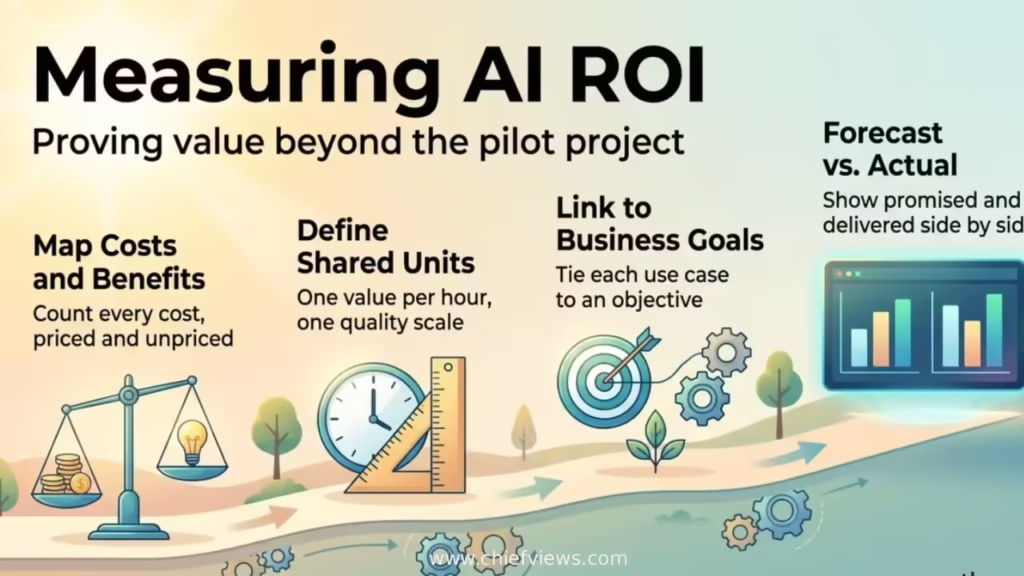
Step-by-Step Action Plan for Measuring AI Productivity and ROI
- Pick one high-frequency workflow with clear ownership. Invoice handling, first-line support, content drafts, code review, or forecasting all work. Avoid “transform the enterprise” scope.
- Establish the baseline for 4–6 weeks before any AI goes live. Record time, cost, quality, volume, and error rates the business already tracks. Do not invent new metrics if existing ones exist.
- Define “accepted” in writing. What does a finished, usable result look like? Who signs off? How much rework still counts as success?
- Capture full costs from day one. Model and API spend, infrastructure, human review time, change management, and the fully loaded cost of any specialized talent. This is where the cost of AI talent and total workforce economics becomes non-negotiable input data.
- Run a controlled pilot long enough to see steady-state behavior (usually 60–90 days). Compare accepted outcomes and cycle times against the baseline. Ignore the first two weeks of novelty effects.
- Convert capacity into a decision. Did you reduce overtime, delay a hire, increase volume without more people, improve quality enough to cut refunds or escalations, or generate measurable new revenue? If the answer is none of the above, you have productivity without ROI.
- Review monthly and reallocate. Kill or redesign anything that fails to move the chosen business metric after a fair test period. High performers treat AI as a portfolio, not a collection of pilots.
Measuring AI productivity and ROI What I would do if walking into a new AI program tomorrow: insist on the baseline spreadsheet and the “accepted outcome” definition before any tool budget is released. That single gate eliminates most of the later arguments.
Common Mistakes and How to Fix Them
Mistake: Treating hours saved as ROI.
Fix: Treat hours saved as capacity. Convert it deliberately or stop claiming financial return.
Mistake: Measuring only the AI step.
Fix: Measure the full workflow to acceptance. Generation speed is irrelevant if review and correction eat the gains.
Mistake: Ignoring total cost of ownership.
Fix: Include talent, oversight, data, monitoring, and rework. A low model bill with high human correction is still expensive.
Mistake: Using the same payback window for every use case.
Fix: Operational efficiency can show returns in 6–18 months. Revenue and structural changes often take longer. Set expectations by tier.
Mistake: Celebrating adoption instead of outcomes.
Fix: Adoption is table stakes. Track the percentage of use cases that reach measured P&L or risk impact.
Key Takeaways
- Measuring AI productivity and ROI requires baselines, accepted outcomes, and conversion of capacity into business results.
- Individual gains are common; enterprise EBIT impact remains the exception for most organizations.
- Cost per accepted outcome and end-to-end cycle time beat vanity metrics every time.
- Full costs—including the cost of AI talent and total workforce economics—belong in the denominator.
- Growth and quality metrics correlate with stronger reported returns than pure efficiency tracking.
- Treat AI initiatives as a portfolio: fund what moves the needle, stop what does not.
- Discipline at the start (baseline + definition of done) prevents most measurement failures later.
Measuring AI productivity and ROI The organizations pulling ahead are not the ones with the most agents or the biggest model budgets. They are the ones who can show, with clean numbers, that AI changed a cost, a revenue line, or a risk profile the business already cared about. Start there and the rest of the stack becomes easier to justify.
FAQs
How do you start measuring AI productivity and ROI if we have no baseline?
Pick one workflow, instrument it for 4–6 weeks with existing tools, then introduce AI. Retrospective claims without data are almost always inflated.
Is hours saved still useful when measuring AI productivity and ROI?
Yes—as a leading indicator of capacity. It only becomes ROI when that capacity is deliberately converted into lower cost, higher output, or new value.
How does the cost of AI talent and total workforce economics fit into ROI calculations?
It belongs in the full cost side of the equation. Specialized talent, review time, and ongoing oversight are real expenses. Leaving them out produces false positives.

