








NIST AI Risk Management Framework implementation guide starts with a clear decision: treat the framework as a practical operating system for AI risk, not a compliance checkbox. Organizations that succeed map the four functions—Govern, Map, Measure, Manage—directly onto their existing processes, inventory every AI system (including shadow and embedded ones), and build Current and Target Profiles that drive real action.
Quick overview:
- The NIST AI RMF is a voluntary U.S. framework that helps organizations manage AI risks across the full lifecycle.
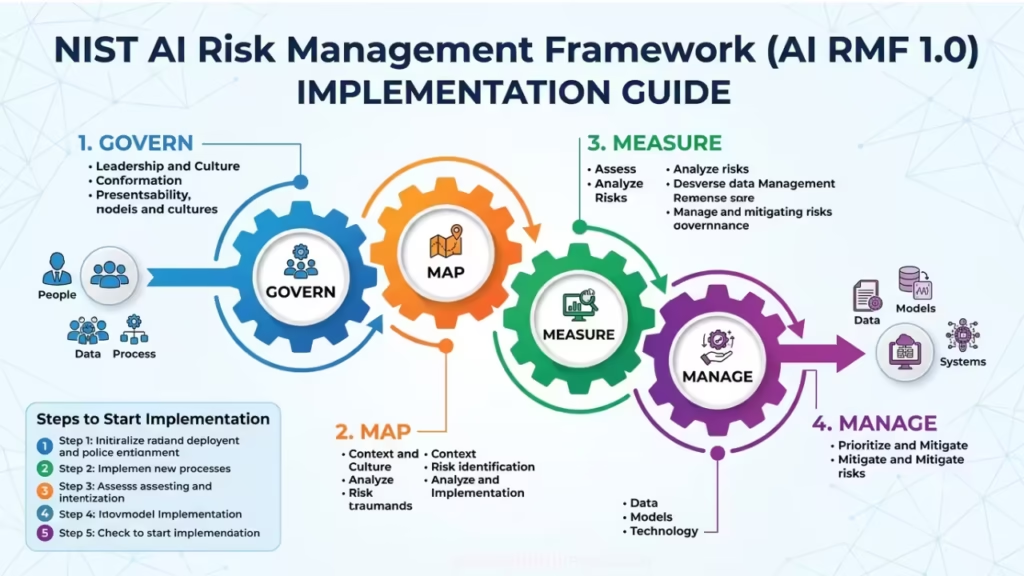
- Its core consists of four iterative functions: Govern, Map, Measure, and Manage.
- Implementation relies on the official Playbook for suggested actions and on Profiles (Current vs. Target) to identify gaps.
- The Generative AI Profile (NIST AI 600-1) adds specific guidance for large language models and generative systems.
- Technology leaders use it to create accountable, measurable AI risk programs that support faster, safer deployment.
Understanding the Four Functions
Govern sits across everything. It builds the culture, policies, roles, and accountability structures so risk management is not an afterthought. Map identifies the context, intended purpose, stakeholders, and potential impacts of each AI system. Measure evaluates performance, trustworthiness characteristics, and risks through testing, evaluation, verification, and validation. Manage takes the outputs of the other functions and turns them into prioritization, response, and continuous improvement.
These functions are not a rigid sequence. Most teams establish Govern first, then cycle through Map–Measure–Manage as systems evolve. The official NIST AI RMF Playbook supplies concrete suggested actions aligned to every subcategory. It is explicitly not a mandatory checklist—borrow what fits your risk tolerance and context.
NIST AI Risk Management Framework Implementation Guide: Step-by-Step Action Plan
Here is the sequence that works in practice for technology leaders and risk owners.


Step 1: Establish ownership and scope (Govern).
Appoint an executive AI risk owner and name responsible parties for each major system. Document your organization’s risk tolerance and the legal or regulatory requirements that apply. Decide which systems are in scope: built, bought, SaaS-embedded, and agents.
Step 2: Build the AI inventory (Govern 1.6).
List every model, agent, dataset, vector store, and third-party component. Include version, owner, purpose, data sources, and access rights. Without a living inventory, later steps only address the systems you already knew about.
Step 3: Create Current Profiles.
For a pilot set of three to five systems of different risk levels, score each relevant subcategory. Record existing evidence (or the lack of it). This becomes your baseline.
Step 4: Define Target Profiles by risk tier.
High-impact systems that affect people, money, or critical decisions need stronger evidence across Measure and Manage. Lower-risk internal tools can start with lighter requirements. Use the Generative AI Profile when large language models or generative systems are involved.
Step 5: Close the gaps with Playbook actions.
Select suggested actions that move you from Current to Target. Assign owners, deadlines, and evidence requirements. Prioritize deactivation paths, third-party contingencies, and continuous monitoring.
Step 6: Pilot, measure, and expand.
Run the selected controls on the pilot systems. Test the ability to revoke access or shut systems down. Roll the approach out by risk tier, updating Profiles as systems change.
Step 7: Maintain and improve.
Treat Profiles as living documents. Revisit them when models, data, or threat landscapes shift. Feed lessons back into Govern policies.
This sequence turns the framework into an operating rhythm rather than a one-time project.
Current vs. Target Profile Comparison
| Element | Current Profile | Target Profile |
|---|---|---|
| Purpose | Describes how AI risk is managed today | Describes the desired outcomes based on risk tolerance |
| Content | Evidence (or gaps) against subcategories | Specific outcomes and evidence standards by tier |
| Ownership | Often incomplete or informal | Named owners for every critical subcategory |
| Generative AI handling | May lack specific testing for confabulation or prompt injection | Incorporates AI 600-1 suggested actions |
| Use | Reveals gaps | Drives the action plan and resource allocation |
| Update frequency | Static until forced | Reviewed at major changes or on a set cadence |
Common Mistakes and How to Fix Them
NIST AI Risk Management Framework implementation The biggest mistake is treating the RMF like a certification standard. It is voluntary guidance. Fix: use it to structure decisions and evidence, not to chase a perfect score across all 72 subcategories.
Another frequent error is skipping the inventory. Teams jump straight to policies or tools and later discover untracked agents and shadow AI. Fix: make the inventory a hard gate before any new system goes live.
Many organizations write beautiful Target Profiles and then fail to fund the Measure and Manage work. Fix: tie Profile gaps directly to budget and roadmap items, and prove the deactivation path early with tabletop exercises.
Finally, some treat the Generative AI Profile as optional even when they run large language models. Fix: apply the twelve generative-specific risks and suggested actions to any system that produces content or uses tool-calling agents.
Connecting the Framework to Broader Security Practice
The NIST AI RMF pairs cleanly with technical security work. When technology leaders focus on securing AI by design for technology leaders, the RMF supplies the governance and risk structure while zero-trust identity, deterministic policy gates, and continuous monitoring supply the technical controls. Use the framework to decide what must be protected and measured; use secure-by-design architecture to make those protections real.
Official resources remain the best starting point. Download the core framework and Playbook from the NIST AI Resource Center, and consult the Generative AI Profile for systems that generate content or use agents.
Crosswalks to other frameworks (ISO 42001, NIST CSF, SP 800-53) help organizations that already run mature security programs avoid duplicate effort.
Key Takeaways
- Start with Govern and a complete inventory—everything else depends on them.
- Build Current and Target Profiles for real systems, not abstract categories.
- Use the Playbook selectively; it is a menu of suggestions, not a mandatory list.
- Apply the Generative AI Profile whenever large language models or generative systems are in play.
- Prove deactivation and third-party contingency paths early.
- Keep Profiles living documents that update with system changes.
- Link RMF outcomes to technical controls such as agent identity, least privilege, and deterministic policy enforcement.
- Track the ongoing revision of AI RMF 1.0 so Target Profiles can be adjusted when the updated text appears.
NIST AI Risk Management Framework implementation Technology leaders who treat the NIST AI Risk Management Framework as an operating system rather than a document gain clearer accountability, faster risk decisions, and stronger evidence for boards and regulators. The practical next step is simple: pick three systems of different risk levels this week, draft Current Profiles for them, and identify the three highest-priority gaps that move you toward your Target state.
FAQs
What is the fastest way to begin a NIST AI Risk Management Framework implementation guide process?
Begin with an AI inventory and a named executive owner, then create Current Profiles for a small pilot set of systems. This surfaces real gaps faster than writing policies in isolation.
How does the Generative AI Profile fit into a NIST AI Risk Management Framework implementation guide?
NIST AI 600-1 is a companion profile that adds twelve generative-specific risks and suggested actions mapped to the same four functions. Use it for any system that generates content or employs tool-using agents.
Does a NIST AI Risk Management Framework implementation guide require certification?
No. The framework and Playbook are voluntary. Organizations use them to structure risk management and produce evidence; they do not confer formal certification.

