







COO guide to building operational resilience in 2026 is what you search when something just broke, a supplier went dark, a system froze, and the board wants answers by Monday. Here’s the short version.
- What it is: a repeatable system for keeping your most important services running through disruption, and recovering fast when they don’t.
- Why it matters: supply shocks, cyber incidents, vendor outages, and severe weather now hit US operators in clusters, not one at a time.
- Who owns it: the COO. IT, procurement, and facilities each hold a piece, but someone has to hold the whole picture.
- How to start: map critical services, find single points of failure, set recovery targets, then test.
Let’s get into it.
What Operational Resilience Actually Means (and What It Doesn’t)
Operational resilience is your ability to deliver critical services through disruption and bounce back quickly afterward. That’s the whole definition.
It isn’t a binder of policies. It isn’t a disaster recovery plan that lives on a shared drive nobody opens. And it isn’t the same as efficiency, which is where many operators trip.
Here’s the thing: lean operations and resilient operations pull in opposite directions. Lean strips out slack. Resilience needs some of it back. Your job is deciding where slack earns its keep.
Business continuity planning is one input. Resilience is the broader discipline, and it covers people, process, technology, suppliers, and facilities as one connected system. The international standard for continuity, ISO 22301 on business continuity management, is a solid reference point if you want a formal framework to anchor against.


Why the COO Guide to Building Operational Resilience in 2026 Looks Different
A few years back, resilience meant a backup site and a phone tree. Not anymore.
What usually happens now is a chain reaction. A cloud vendor has an outage, your order system stalls, your warehouse can’t ship, and customer service gets buried. One failure, four departments, zero warning.
Several pressures shape the 2026 picture, and none of them are going away:
- Trade and tariff volatility that can reprice or reroute a supply chain on short notice.
- Cyber incidents that stop operations, not just steal data.
- Concentration risk from leaning on one cloud provider, one logistics partner, or one sole-source component.
- AI dependency, as more workflows quietly route through models and vendors you don’t control.
- Severe weather hitting facilities and transportation corridors across the country.
- Labor and skills gaps that make key-person risk very real.
Notice that most of these live outside your four walls. That’s the shift. Resilience in 2026 is as much about your ecosystem as your own operation.
The Four Pillars Inside Any COO Guide to Building Operational Resilience in 2026
Strip away the jargon and every resilience program rests on four things:
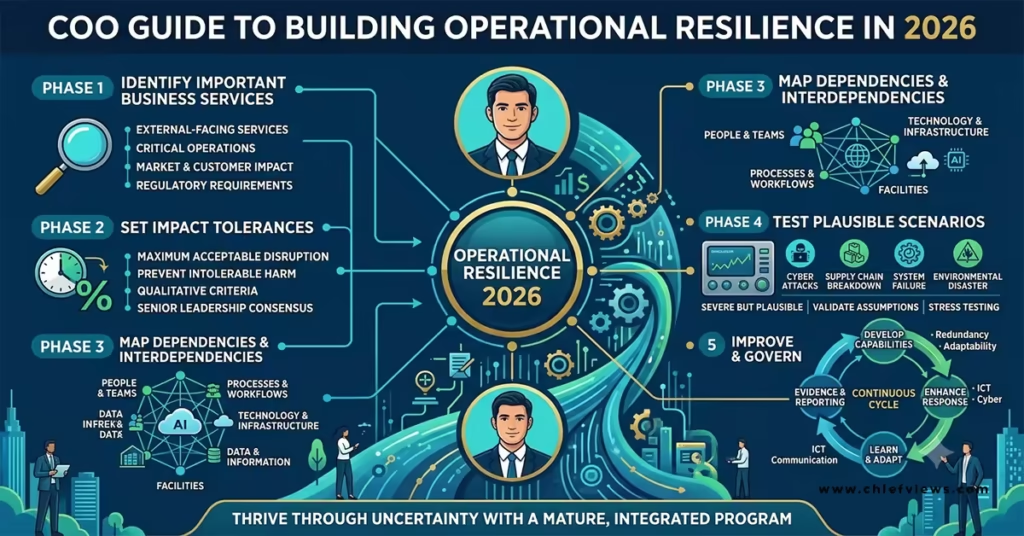
- Know what matters. Identify the services that would hurt most if they stopped.
- Know what they depend on. People, systems, vendors, sites, data.
- Set limits. Decide how long you can be down and how much disruption you can tolerate.
- Prove it works. Test, learn, fix, repeat.
Think of a ship with watertight compartments. A hull breach doesn’t sink the vessel because the damage stays contained. You’re building bulkheads for your business.
Resilience Levers Compared: Where Should a Beginner Put the First Dollar?
You can’t fund everything at once. This table gives you a quick read on where common investments sit.Here is the table in a copy-paste-friendly format:
| Resilience Lever | What It Protects Against | Effort to Start | Best First Move |
|---|---|---|---|
| Critical service mapping | Blind spots and surprise dependencies | Low | One workshop with department leads |
| Supplier diversification | Sole-source failures, trade shocks | Medium to High | Qualify one backup for your top-risk input |
| Backup and recovery testing | Ransomware, outages, data loss | Medium | Run a restore drill on one core system |
| Cross-training staff | Key-person risk, absenteeism | Low to Medium | Document and rotate your three most fragile roles |
| Inventory buffers | Short-term supply interruptions | High (cash tied up) | Buffer only the parts with long lead times |
| Tabletop exercises | Slow, confused incident response | Low | Simulate one realistic outage in two hours |
My take? Start with mapping and tabletop exercises. They’re cheap, they’re fast, and they tell you where to spend the expensive money.
Step-by-Step Action Plan for Beginners
New to this? Follow these six steps in order. Don’t skip ahead.
Step 1: Build Your COO Guide to Building Operational Resilience in 2026 Around a Critical-Services Map
List the 10 to 15 services your customers or regulators would notice immediately if they stopped. Order fulfillment. Payroll. Claims processing. Whatever applies to you.
Then trace each one backward. Which people, applications, vendors, and facilities does it need? This is your dependency map, and it’s the single most useful artifact you’ll create.
Step 2: Hunt Single Points of Failure
Look for the one person, one vendor, one server, or one route that everything leans on. What if that one thing vanished tomorrow?
Circle every answer that makes you wince. Those are your priorities.
Step 3: Set Impact Tolerances
For each critical service, decide the longest outage you can survive before real damage lands. Hours? A day? A week?
Be honest. Leadership usually says “we can’t be down at all.” Push back gently and ask what actually breaks at hour four.
Step 4: Close the Biggest Gaps First
Match your gaps against the levers in the table above. Pick two or three. Fund them properly rather than sprinkling pennies across fifteen initiatives.
If I were running your operation, I’d pick one supplier risk, one technology risk, and one people risk. Balanced, but focused.
Step 5: Run Tests Before You Need Them
Plans fail on contact with reality. A tabletop exercise exposes the awkward gaps: who has the authority to shut down a system, who talks to customers, who calls the insurer.
For cyber and infrastructure scenarios, the CISA critical infrastructure security and resilience resources offer practical guidance US organizations can borrow from.
Step 6: Review on a Fixed Cadence
Set a quarterly review. Update the map, retire old assumptions, log lessons from near-misses. Resilience decays the moment you stop maintaining it.
Where the COO Guide to Building Operational Resilience in 2026 Meets the Board
Boards don’t want a technical briefing. They want three answers: what could stop us, how long would it last, and what are we doing about it?
Bring your dependency map, your impact tolerances, and a short list of funded fixes. That’s a credible story. Add a simple scorecard showing test results over time, and you’ve turned resilience from a cost line into a governance asset.
Common Mistakes & How to Fix Them
I’ve watched smart teams stumble in the same places again and again. Here’s the short list.
Mistake 1: Treating resilience as an IT project.
IT owns recovery for systems. It doesn’t own your suppliers, your people, or your facilities. Fix: put the COO’s office in charge, with named owners in each function.
Mistake 2: Writing plans nobody tests.
An untested plan is a guess with a cover page. Fix: schedule exercises on the calendar this quarter, not “when things calm down.”
Mistake 3: Ignoring third-party risk.
Your vendors’ outages become your outages. Fix: ask critical suppliers about their own continuity arrangements, and put recovery expectations into contracts. The Ready.gov business preparedness guidance is a useful starting checklist for smaller operators.
Mistake 4: Trying to cover every risk.
Boiling the ocean kills momentum. Fix: anchor on critical services, not on an endless threat catalog.
Mistake 5: Cutting every ounce of slack.
Efficiency drives are good until the first shock hits. Fix: decide deliberately where buffers, spare capacity, or backup suppliers belong, and defend them in budget season.
Mistake 6: Forgetting people.
Systems recover faster than exhausted teams do. Fix: plan for shift coverage, clear escalation paths, and real rest during long incidents.
Key Takeaways
- Operational resilience means keeping critical services running through disruption and recovering quickly, not just having a continuity binder.
- Start with a critical-services map. Everything else builds on it.
- Single points of failure, whether a vendor, a system, or a person, deserve your first attention.
- Set impact tolerances in hours and days so decisions get easier under pressure.
- Test early and often. Tabletop exercises are cheap and brutally revealing.
- Third-party and supply chain concentration is the risk most often underestimated.
- Treat resilience as a standing management discipline with quarterly reviews, not a one-time project.
- Take the COO guide to building operational resilience in 2026 to your board with a simple scorecard they can track.
Your Move
Resilience isn’t a luxury for when budgets loosen up. It’s the cost of staying in business when the unexpected shows up uninvited, and in 2026 it does. The payoff is simple: shorter outages, calmer teams, and customers who barely notice when something goes wrong.
So what’s the next step? Block two hours this week, pull your department heads into one room, and sketch the dependency map for your single most important service. You’ll find a gap before lunch.
FAQs
How is operational resilience different from business continuity?
Business continuity is a plan for resuming operations after a disruption. Operational resilience is wider: it covers anticipating, absorbing, adapting to, and recovering from disruption across the whole organization. A solid COO guide to building operational resilience in 2026 treats continuity planning as one tool inside a bigger system.
How long does it take to build a basic resilience program?
A beginner can get a workable foundation, meaning a critical-services map, initial impact tolerances, and a first tabletop exercise, running within a quarter. Maturity takes longer. Expect a year or more of testing cycles before your recovery claims hold up under pressure.
Who should own resilience inside a company?
The COO, or whoever runs operations end to end, should hold accountability. Function heads own their pieces, but one executive needs to connect them. If your structure is different, the principles in this COO guide to building operational resilience in 2026 still apply; just name a single accountable owner.

