






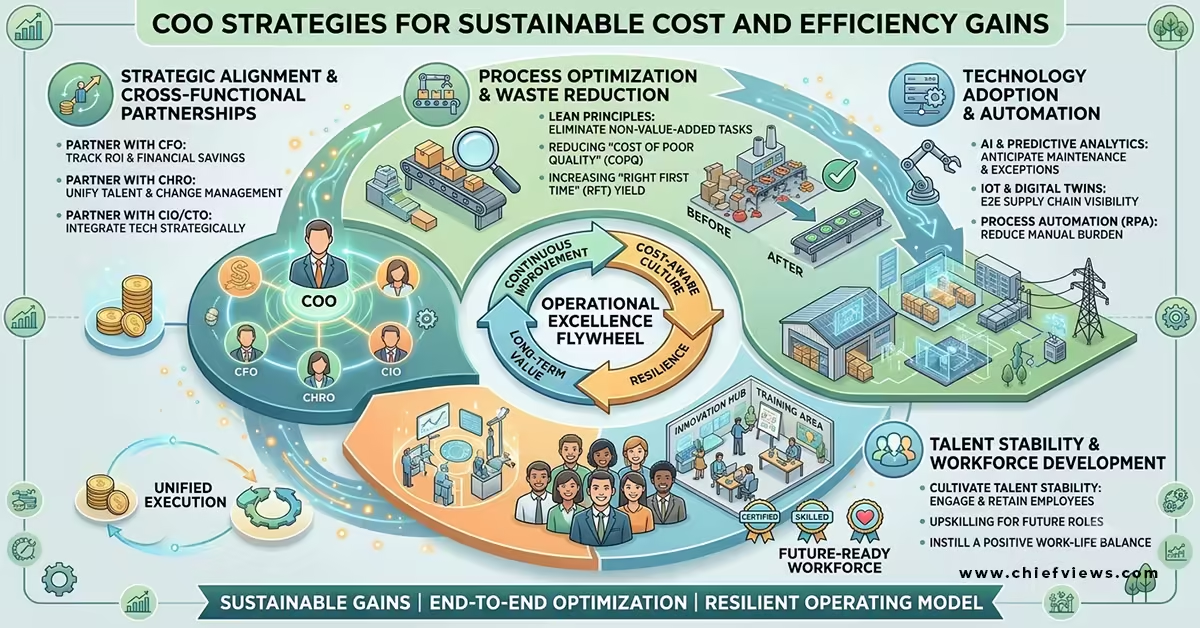
COO strategies for sustainable cost and efficiency gains demand more than annual budget trims. They require embedding cost discipline into daily operations so savings stick and operations scale without the usual bloat. In my experience, the companies that treat this as a one-time project watch the costs creep back within 18 months. The ones that treat it as an operating system keep the gains.
Here’s the quick view of what works:
- Build real cost visibility first so you cut waste, not muscle.
- Standardize and simplify processes before you automate anything.
- Layer in AI and digital tools only where the process is already clean.
- Tie every efficiency move to resilience and long-term value, not just this quarter’s margin.
- Drive a culture where cost ownership lives at every level, not just the C-suite.
That approach turns short-term savings into durable advantage.
Why most cost programs fail and what successful COOs do differently
Most cost-reduction efforts deliver temporary relief. A Bain study of hundreds of companies found only a small fraction of transformations produced lasting performance improvement. Costs return because the underlying operating model never changed.
Successful COOs start differently. They treat cost discipline as a capability, not a project. They map true unit economics, strip non-value work, and then use technology to lock in the gains. BCG research shows that firms embedding cost consciousness into culture achieve meaningfully better long-term reductions than those relying on episodic cuts.
The practical difference shows up in three places: visibility, process design, and technology sequencing. Skip any of those and the savings leak.

Core COO strategies for sustainable cost and efficiency gains that actually stick
Build cost transparency before you touch a single process
You cannot manage what you cannot see. Many organizations still run on high-level budget lines that hide the real drivers. Start by creating detailed cost-to-serve models by product, customer segment, and process step.
What I usually do is force a zero-based look at the top 20 cost categories. Rank them by size and by how controllable they are. Then assign clear owners. Without this foundation, every later initiative becomes guesswork.
Simplify before you automate
Automation layered on messy processes just produces faster mess. Map the critical workflows—order-to-cash, procure-to-pay, issue resolution—and strip the waste. The classic seven wastes still apply: overproduction, waiting, unnecessary transport, over-processing, excess inventory, motion, and defects.
In practice, simplification alone often removes 10-20 percent of effort. Only then does automation deliver compounding returns. BCG notes that GenAI applied to large supply bases can drive efficiency gains of up to 20 percent across operations functions when the underlying processes are already rationalized.
Deploy AI and digital tools with a clear ROI sequence
AI is no longer optional, but it is easy to waste money on. Focus first on high-volume, rules-heavy work: inventory optimization, predictive maintenance, freight audit, contract review, and demand sensing.
McKinsey estimates that generative AI holds multi-trillion-dollar productivity potential over the long term. Real operators capture the near-term slice by targeting specific pain points rather than chasing every shiny use case. Pair every tool investment with a simple before-and-after metric: cycle time, error rate, cost per transaction, or inventory turns.
Redesign the operating model for flexibility
Sustainable gains require an operating model that flexes with demand. Cross-train teams. Create modular processes. Convert fixed costs to variable where it makes sense by working with external partners on non-core work. This is not pure outsourcing. It is selective collaboration that keeps strategic control inside while letting specialists handle the rest.
Embed sustainability as a cost lever, not a side project
Energy efficiency, waste reduction, and smarter logistics often pay for themselves. Retuning HVAC systems and installing sub-metering have shown median paybacks under two years in large building studies. Renewable power purchase agreements and supplier scorecards reduce both carbon exposure and long-term cost volatility. Treat these as operational decisions, not ESG checkboxes.
Step-by-step action plan for beginners and intermediate COOs
- Week 1-2: Diagnose. Pull the last 12 months of spend data. Identify the top cost categories and the processes that drive them. Create a simple heat map of pain versus opportunity.
- Week 3-4: Visibility sprint. Build or refine unit-cost models for the highest-impact areas. Assign clear owners and set baseline metrics.
- Month 2: Process cleanup. Select three to five high-volume workflows. Run value-stream mapping. Remove obvious non-value steps and unnecessary approvals. Document the new standard.
- Month 3: Quick-win automation. Apply off-the-shelf tools or light RPA to the cleaned processes. Target measurable labor or error reduction within 90 days.
- Months 4-6: Vendor and network moves. Renegotiate or consolidate key suppliers. Review logistics network design. Pilot dual-sourcing on critical items where resilience matters.
- Months 6-12: Scale and lock. Expand successful pilots. Introduce predictive tools for maintenance or demand. Update incentives so managers own both cost and service outcomes. Review results monthly against the original baselines.
This sequence prevents the common trap of buying technology before the process is ready.
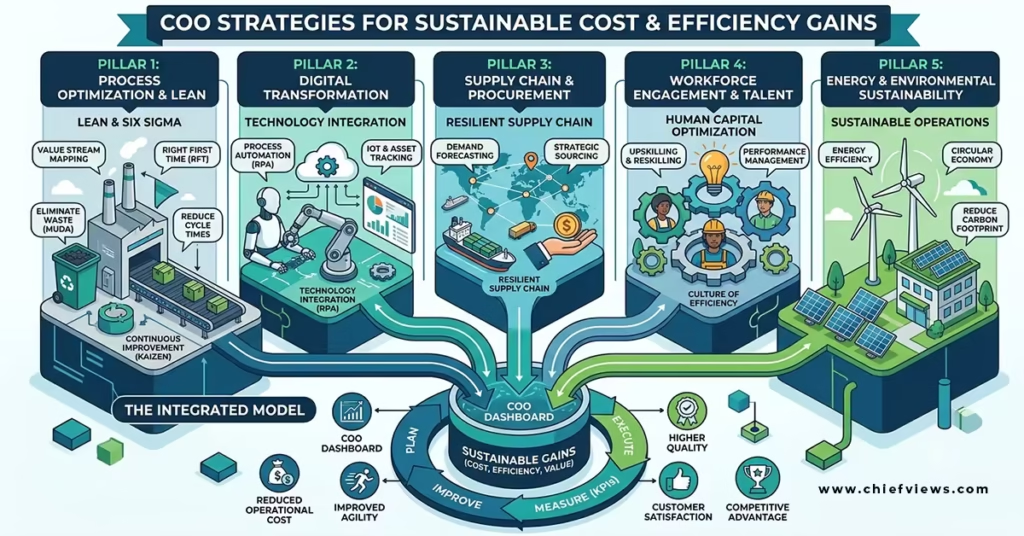
Comparison of key levers for sustainable gains
| Lever | Primary Goal | Typical Time to Impact | Relative Cost Impact | Scaling Benefit |
|---|---|---|---|---|
| Cost visibility & unit economics | Expose true waste | 4-8 weeks | Medium (enables all other cuts) | High |
| Process standardization | Cut variation and rework | 1-3 months | High | High |
| Targeted automation / GenAI | Remove low-value manual work | 3-6 months | High over time | Very high |
| Vendor rationalization | Lower external spend | 2-4 months | Medium-High | Medium |
| Operating model redesign | Align capacity to demand | 6-12 months | Medium | Very high |
| Energy & resource efficiency | Reduce utility and waste costs | 3-12 months | Medium | Medium-High |
Use this as a prioritization grid. Start left and move right only when the earlier steps are solid.
Common mistakes and how to fix them
Mistake 1: Across-the-board percentage cuts. These damage capability and morale. Fix: Target specific waste using the visibility work. Protect customer-facing and growth-critical areas.
Mistake 2: Automating broken processes. You just accelerate the mess. Fix: Force process simplification first. Measure the clean baseline before any tool spend.
Mistake 3: Treating cost as a finance-only project. Operations owns the levers. Fix: Make the COO the accountable leader and give cross-functional teams clear decision rights.
Mistake 4: Ignoring culture. Savings evaporate when people revert to old habits. Fix: Tie incentives to both cost and service metrics. Celebrate the small wins publicly.
Mistake 5: Chasing too many initiatives at once. Complexity kills follow-through. Fix: Limit the active portfolio. Rank by ROI and capacity. Kill or pause the rest.
Key Takeaways
- Start with radical cost visibility. Everything else depends on it.
- Simplify processes before layering technology. Automation on chaos fails.
- Sequence AI and digital tools against clean, high-volume workflows for measurable returns.
- Convert fixed costs to variable where strategy allows and keep strategic control inside.
- Treat energy, waste, and supplier practices as core cost levers, not side projects.
- Limit the number of concurrent initiatives and track them ruthlessly.
- Embed ownership at the front line so gains survive leadership changes.
- Review progress monthly against original baselines, not just budget variance.
Sustainable cost and efficiency gains are not about cutting deeper each year. They come from redesigning how work actually happens so the organization gets leaner and more resilient at the same time. Pick one high-pain process this week, map it, and remove the first obvious waste. Momentum starts there.
FAQs
What are the most effective COO strategies for sustainable cost and efficiency gains in 2026?
The highest-return moves combine cost visibility, process simplification, selective GenAI deployment, and operating-model flexibility. Culture and clear ownership turn temporary savings into permanent capability.
How long does it take to see results from COO strategies for sustainable cost and efficiency gains?
Quick wins from waste removal and simple automation often appear in 60-90 days. Material, sustainable impact typically shows in 6-12 months once processes are standardized and technology is properly sequenced.
Can smaller companies apply the same COO strategies for sustainable cost and efficiency gains?
Yes. The principles scale down cleanly. Focus on the top three cost categories, clean the highest-volume workflows first, and use accessible tools rather than enterprise platforms. The discipline matters more than the budget size.

