








How to build a C-suite succession plan is a question more boards are asking out loud — and fewer companies can actually answer with confidence. Here’s the blunt reality: SHRM found only 21% of HR professionals have a formal executive succession plan in place, while 56% have none at all. That gap is a liability sitting in plain sight on most org charts.
Quick Answer — What a C-Suite Succession Plan Is and Why It Matters:
- A C-suite succession plan is a structured, ongoing process for identifying, developing, and preparing internal candidates to step into top executive roles — CEO, CFO, COO, CHRO — before a vacancy happens.
- Egon Zehnder’s research found nearly 1 in 3 CEOs is likely to exit with little advance warning, which is exactly the scenario a strong plan protects against.
- Boards now treat succession as continuous governance, not a binder that gets dusted off during a crisis.
- Weak succession planning creates leadership gaps that ripple into strategy execution, investor confidence, and workforce morale.
- Modern plans increasingly lean on the CHRO’s advisory input — which is why the CEO advisory role of enterprise CHROs in AI era has become central to how succession gets built and executed.
Why Most C-Suite Succession Plans Fail Before They Start
Let’s be honest about the usual failure mode. Most companies treat succession planning like a fire extinguisher — ignored until something’s already burning.
The Harvard Law School Forum on Corporate Governance flagged this directly in its 2026 coverage: boards are now treating leadership continuity as a sustained imperative rather than a reactive scramble, especially as CEO tenures shrink and turnover accelerates. That’s not a nice-to-have anymore. It’s table stakes.
In my experience, the plans that fail share one trait. They’re built in isolation by HR, shelved in a drawer, and never stress-tested against an actual emergency. Nobody owns the follow-through.
The Real Cost of Skipping This
What happens when a CFO leaves with zero bench strength behind her? Panic hiring. Overpaying external candidates. Months of strategic drift while the board plays defense instead of offense.



That’s the quiet tax companies pay for treating succession as an HR checkbox instead of a board-level priority.
How to Build a C-Suite Succession Plan: Step-by-Step
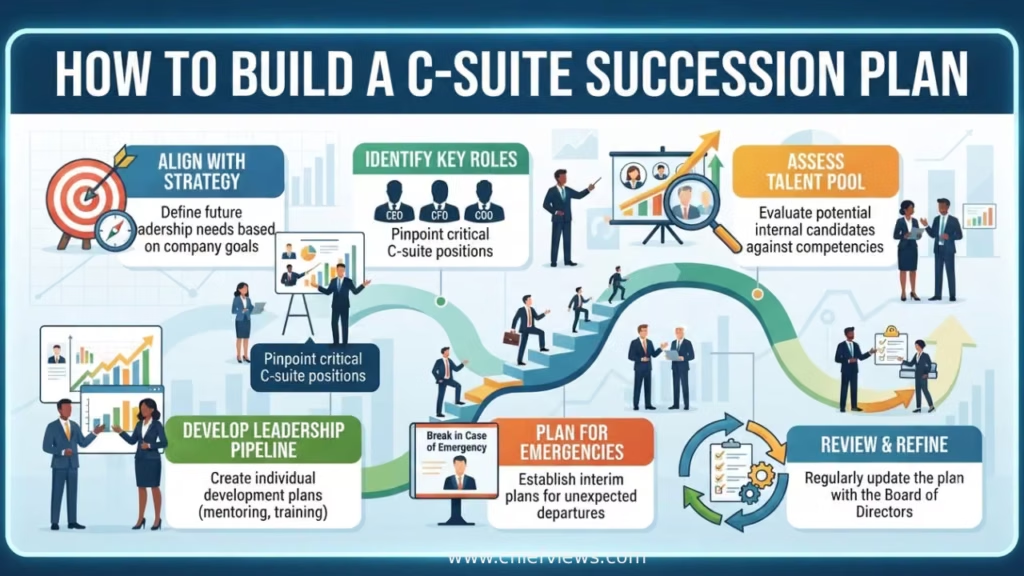
How to Build a C-Suite Succession Plan Here’s the sequence that actually holds up under pressure — not the theoretical version, the one that survives contact with a real resignation letter.
- Map every critical role, not just the CEO seat. CFO, COO, CHRO, CTO — each needs its own readiness timeline. A plan that only covers the CEO is half a plan.
- Identify internal candidates 2–3 years before you need them. Waiting until a role opens guarantees a rushed, reactive search.
- Build individualized development plans for each candidate. Stretch assignments, board exposure, cross-functional rotations — not generic leadership training.
- Get the board directly involved, not just briefed. NACD’s governance guidance is clear that succession oversight belongs at the board level, with regular review cadence, not an annual slide deck.
- Pressure-test with scenario planning. What happens if your CEO leaves tomorrow, not in three years? Run the emergency scenario alongside the planned one.
- Loop in your CHRO as a strategic co-architect. This is where the CEO advisory role of enterprise CHROs in AI era really earns its keep — CHROs now bring workforce data, AI-driven skills forecasting, and culture-fit judgment that boards can’t get anywhere else.
- Review and refresh annually, minimum. Candidates grow, leave, or lose interest. A static plan goes stale fast.
What I’d do if I inherited a company with no plan: start with the single highest-risk role — usually CEO or CFO — and build backward from there. Don’t try to solve all five seats on day one.
Succession Planning Approaches Compared
| Approach | Speed to Fill Role | Cost | Cultural Fit Risk | Best For |
|---|---|---|---|---|
| Formal internal pipeline | Fast (weeks) | Low | Low | Companies with strong leadership bench |
| External emergency search | Slow (months) | High | High | Unplanned departures with no internal ready |
| Hybrid (internal + external bench) | Moderate | Moderate | Moderate | Most mature enterprises |
| No formal plan | Unpredictable | Highest (long-term) | Highest | Nobody — this is the risk category |
How to Build a C-Suite Succession Plan The hybrid row is where most sophisticated companies land. Internal candidates for continuity, an external bench mapped as backup — nobody gets caught flat-footed.
Common Mistakes & How to Fix Them
- Mistake: Only planning for the CEO seat. Fix: build parallel plans for every C-suite role with meaningful strategic weight, especially CFO and CHRO.
- Mistake: Keeping the plan secret from candidates themselves. Fix: have honest conversations with high-potential leaders about their trajectory — ambiguity drives your best people to competitors.
- Mistake: Treating it as an annual HR exercise instead of ongoing governance. Fix: put succession on the board agenda quarterly, not once a year.
- Mistake: Ignoring AI-driven skills shifts when assessing readiness. Fix: factor in whether candidates can lead through AI transformation, not just traditional P&L management — this is exactly where the CEO advisory role of enterprise CHROs in AI era adds real value, since CHROs are tracking these skill gaps in real time.
- Mistake: No emergency succession protocol. Fix: document exactly what happens in the first 48 hours if a C-suite executive leaves unexpectedly tomorrow.
The companies that fix these early don’t just avoid a crisis. They build a leadership bench that becomes a genuine competitive advantage.
Key Takeaways
- A strong C-suite succession plan covers every critical executive role, not just the CEO chair.
- Only 21% of HR professionals currently have a formal executive succession plan — most companies are exposed.
- Nearly 1 in 3 CEOs exit with little warning, making proactive planning a real risk-mitigation tool, not bureaucratic overhead.
- Boards should own succession as continuous governance, reviewed quarterly, not an annual slide deck.
- Individualized development — stretch roles, board exposure — beats generic leadership training every time.
- The CEO advisory role of enterprise CHROs in AI era is now central to succession planning, since CHROs bring the workforce data and skills forecasting boards need.
- Emergency protocols matter as much as long-term pipelines — plan for the sudden departure, not just the planned retirement.
How to Build a C-Suite Succession Plan A company without a real succession plan is building its future on a single point of failure. Start with your highest-risk seat this quarter, loop your CHRO in as a true strategic partner, and build outward from there — that’s the fastest path to a bench that actually holds up when you need it most.
FAQs
How often should a company update its C-suite succession plan?
At minimum annually, though quarterly board-level reviews are becoming standard practice for high-risk roles like CEO and CFO. Candidates’ readiness, interest, and life circumstances shift faster than most companies realize.
Who should be responsible for building and maintaining the succession plan?
The board holds ultimate oversight, but execution is typically a partnership between the CEO and CHRO — reflecting the broader CEO advisory role of enterprise CHROs in AI era, where HR leadership co-owns strategic workforce decisions rather than just administering them.
Does a C-suite succession plan need to be different for a CHRO role versus a CEO role?
Yes. CEO succession typically weighs strategic vision and external stakeholder credibility heavily, while CHRO succession increasingly requires AI literacy, workforce-risk judgment, and data fluency — skills that didn’t top the list a decade ago.
