







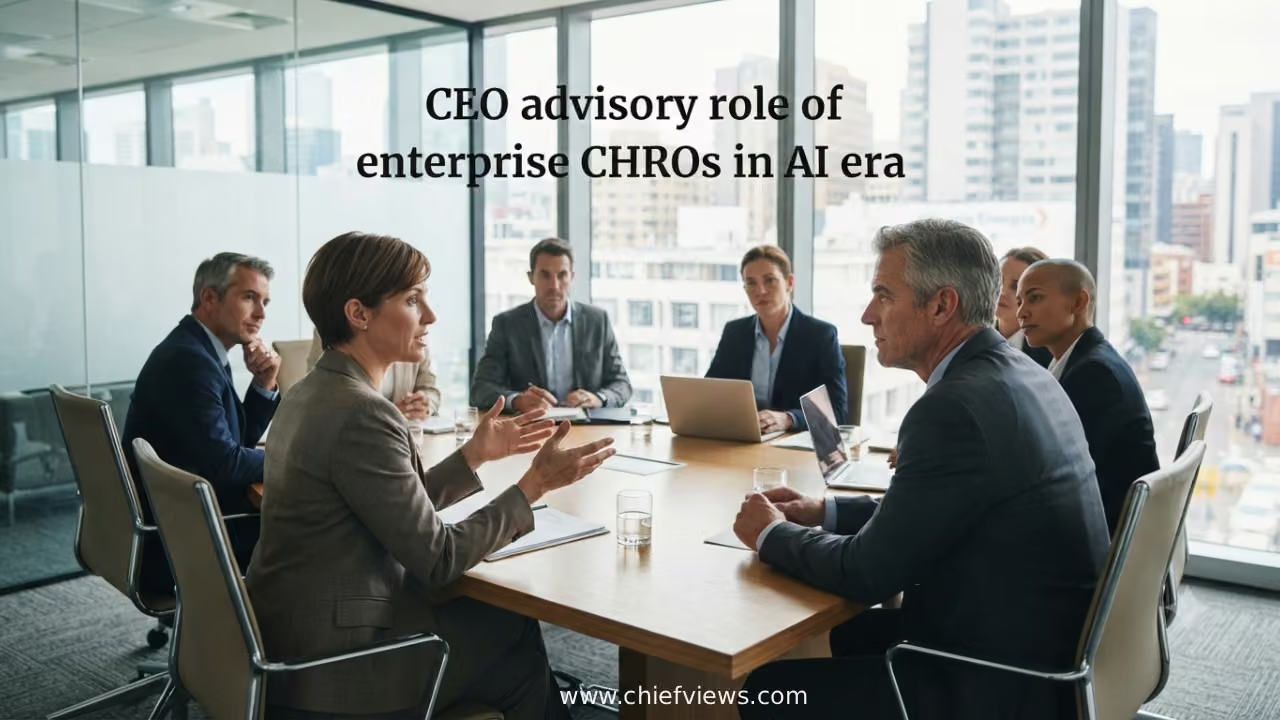
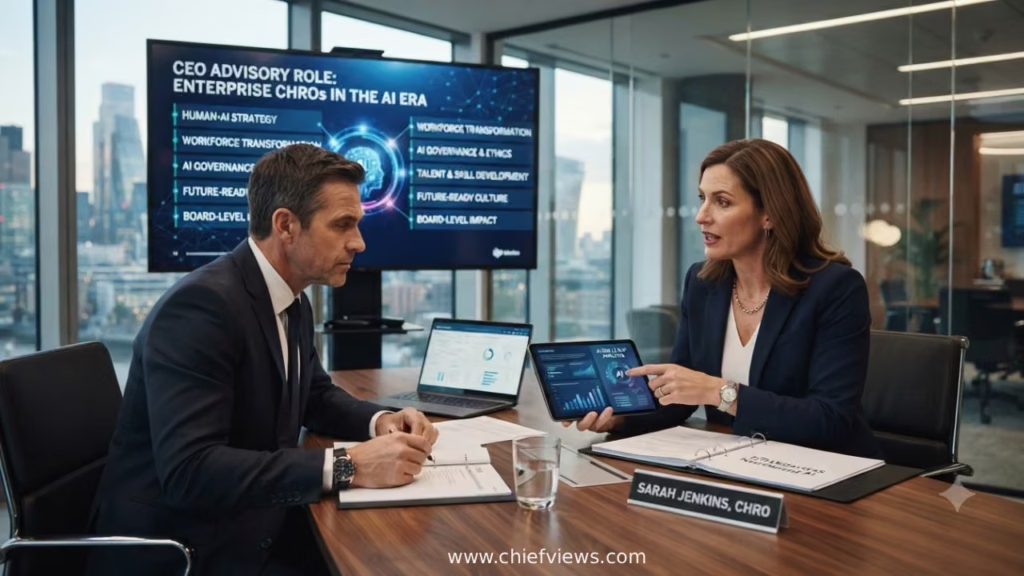
The CEO advisory role of enterprise CHROs in AI era has quietly become one of the most consequential shifts in corporate leadership happening right now. Here’s the thing: HR used to sit at the kids’ table during big strategy calls. Not anymore. CHROs at Fortune 500 companies are now sitting shoulder-to-shoulder with CEOs on AI adoption, workforce risk, and succession planning — and the ones who aren’t there yet are scrambling to catch up.
Quick Answer — What This Means and Why It Matters:
- The CEO advisory role of enterprise CHROs in AI era means CHROs now co-own AI strategy, workforce transformation, and risk oversight alongside the CEO — not just HR policy.
- Boards increasingly expect CHROs to brief them directly on AI-driven workforce risk, talent gaps, and culture shifts.
- CEOs lean on CHROs for human-capital judgment calls that algorithms can’t make — layoffs, reskilling bets, leadership succession.
- This shift is accelerating because AI is reshaping jobs faster than most org charts can keep up with.
- Companies lagging here risk slower AI ROI and higher executive turnover.
What the CEO Advisory Role of Enterprise CHROs in AI Era Actually Looks Like Day-to-Day
Forget the old image of HR fielding benefits questions. The modern CHRO advisory function looks more like a chief strategy officer who happens to specialize in people.
In my experience watching this play out across mid-cap and large enterprises, three things define the job now. First, the CHRO gets pulled into AI deployment decisions before the rollout, not after the layoff announcement. Second, they’re translating workforce sentiment into numbers the CFO actually respects. Third, they’re the one in the room telling the CEO “this reorg will blow up morale” when nobody else will say it out loud.
Gartner’s research on CHRO priorities heading into 2026 pegs “realizing AI value” and “driving performance amid uncertainty” as the top two agenda items for HR chiefs — a notable shift from pure cost-control mandates of years past.
That’s a seismic change in mandate. HR isn’t managing headcount spreadsheets anymore. It’s managing the human side of a technology bet the whole company is riding on.
Why CEOs Need This Advisory Relationship Now, Specifically
Why now, though? Three forces collided at once.
AI adoption outpaced workforce planning in most organizations. Leadership succession pipelines got thinner as boomer-era executives retired en masse. And employees — spooked by AI headlines — started asking sharper questions about job security than any previous generation.
A CEO quoted in a Conference Board-authored piece published through Harvard Law School’s governance forum put it bluntly: the CHRO is often “the closest advisor on the things that can make or break this company — leadership, culture, and talent”. That’s not HR fluff. That’s a CEO admitting the org chart lies — real influence sits wherever the trust is.
The CHRO’s New Toolkit: Skills That Didn’t Exist on the Job Description a Decade Ago
Here’s where it gets interesting. Deloitte’s analysis of CHRO job postings found the skill set demanded of HR chiefs has expanded faster than any other C-suite role over the past five years — with business strategy, operations, and management skills now showing up in roughly half of all CHRO listings.
Translation: today’s CHRO needs to read a P&L, understand AI model limitations well enough to ask smart questions, and still know how to run a credible engagement survey. It’s a weird hybrid job, honestly — part therapist, part data analyst, part boardroom tactician.
How the CEO Advisory Role of Enterprise CHROs in AI Era Differs From Traditional HR Leadership
| Dimension | Traditional CHRO Role | CEO Advisory Role (AI Era) |
|---|---|---|
| Primary focus | Policy, compliance, benefits administration | Enterprise strategy, workforce risk, AI transformation |
| Board interaction | Occasional, compensation-committee only | Regular, cross-committee strategic briefings |
| Core metric | Turnover rate, engagement scores | AI ROI on workforce, reskilling velocity, succession readiness |
| CEO relationship | Reporting function | Trusted strategic partner |
| Decision authority | Implements decisions made elsewhere | Co-shapes decisions before they’re finalized |
| Required skillset | HR operations, employee relations | Business acumen, data fluency, AI literacy, change leadership |
That table isn’t theoretical. It’s the actual shift happening inside companies that are getting AI adoption right versus the ones stumbling through it.
Step-by-Step: How a CHRO Builds Real CEO Advisory Influence
If you’re an HR leader trying to earn this seat — or a CEO trying to build the relationship properly — here’s a practical sequence that works.
- Get fluent in the business’s financial story. You can’t advise on AI workforce bets if you don’t understand margin pressure, headcount cost, and where the CFO’s anxiety lives.
- Build a direct line to the board, not just the CEO. One-off meetings don’t cut it. Push for a standing agenda slot on workforce risk at least quarterly.
- Own the AI-skills gap narrative with data. IBM’s 2026 CHRO study found 80% of HR leaders already have a reskilling roadmap in place — but a roadmap without execution metrics is just a PowerPoint. Bring numbers, not vibes.
- Say the hard thing early. If a planned AI rollout will tank morale or trigger attrition in a critical team, flag it before launch, not during the post-mortem.
- Pair every people recommendation with a business outcome. “Engagement will improve” doesn’t move a CEO. “This cuts voluntary attrition in our AI engineering team by X%” does.
- Keep a tight feedback loop with line managers. The CEO advisory role of enterprise CHROs in AI era only works if the CHRO isn’t operating in a boardroom bubble — ground truth matters.
What I’d do if I were stepping into this seat fresh: spend the first 90 days just listening to frontline managers about where AI tools are actually landing. That intel is worth more than any survey.
Common Mistakes & How to Fix Them
Even sharp HR leaders stumble here. The jump from operational HR to strategic advisor trips people up in predictable ways.
- Mistake: Leading with empathy, not evidence. CEOs respect conviction backed by data. Fix: pair every people-risk warning with a number — turnover cost, productivity delta, hiring-pipeline impact.
- Mistake: Staying silent on AI ethics and bias risk. Someone has to own this, and if HR doesn’t, legal or PR will — reactively, after a mess. Fix: proactively audit AI tools used in hiring and performance review for disparate impact.
- Mistake: Treating the CEO relationship as transactional. Showing up only when there’s a crisis erodes trust. Fix: schedule regular informal check-ins, not just formal reviews.
- Mistake: Underinvesting in your own AI literacy. You can’t advise on what you don’t understand. Fix: get hands-on with the actual AI tools your workforce uses, don’t just read vendor decks.
- Mistake: Letting the board see HR as a cost center. Fix: reframe every presentation around enterprise value — revenue protection, risk mitigation, talent ROI.
The CHRO who fixes these fastest tends to become the CEO’s go-to person within 18 months. The one who doesn’t stays stuck presenting headcount reports nobody reads twice.
External Validation: Why This Isn’t Just an HR Trend
This isn’t HR wishful thinking dressed up as a trend piece. SHRM’s research into 2026 HR priorities points to AI-driven performance expectations and organizational strain as defining forces reshaping the CHRO agenda across industries. McKinsey’s broader workforce research has similarly flagged persistent skills gaps as companies race to adopt AI — a gap CHROs are now expected to close, not just report on.
Put plainly: the CEO advisory role of enterprise CHROs in AI era is being driven by hard business pressure, not a feel-good leadership trend. Boards are watching whether companies can actually execute AI transformation without torching their talent base. That’s a human-capital problem first, a technology problem second.
Key Takeaways
- The CEO advisory role of enterprise CHROs in AI era centers on co-owning AI strategy, workforce risk, and succession planning with the CEO.
- Boards increasingly expect direct CHRO briefings on AI-driven workforce risk, not filtered through other executives.
- CHROs need business, financial, and AI literacy now — not just HR operations expertise.
- Reskilling roadmaps mean nothing without execution data tied to business outcomes.
- The biggest trust-killer is showing up only during a crisis instead of building a steady advisory rhythm.
- AI ethics and bias oversight in hiring and performance tools is becoming a core CHRO responsibility.
- Companies that get this relationship right tend to execute AI transformation with far less workforce disruption.
The bottom line? A CEO without a strong CHRO advisor in the AI era is flying half-blind on the most unpredictable variable in the business — people. Start treating the CHRO seat like a strategic co-pilot role, not a support function, and the AI transformation gets noticeably smoother. If you’re a CEO reading this and your CHRO isn’t in your weekly strategy conversations yet, that’s the fix to make this quarter.
FAQs
Does the CEO advisory role of enterprise CHROs in AI era replace the Chief AI Officer position?
No. They’re complementary. A Chief AI Officer (where one exists) typically owns technical AI strategy and infrastructure, while the CHRO focuses on the human and organizational side — adoption, reskilling, culture, and workforce risk tied to AI deployment.
How is the CEO advisory role of enterprise CHROs in AI era different at smaller companies without a formal board structure?
The core function stays similar — strategic input on workforce and AI decisions — but it’s less formalized. Smaller company CHROs often advise the CEO directly in ad hoc conversations rather than through structured board briefings, which can actually speed up decision-making.
What background best prepares a CHRO for this expanded advisory role?
A mix of operational HR experience, financial literacy, and hands-on exposure to AI tools tends to work best. Many high-impact CHROs today have rotated through business-unit leadership roles earlier in their careers, which builds the commercial credibility CEOs look for.
