







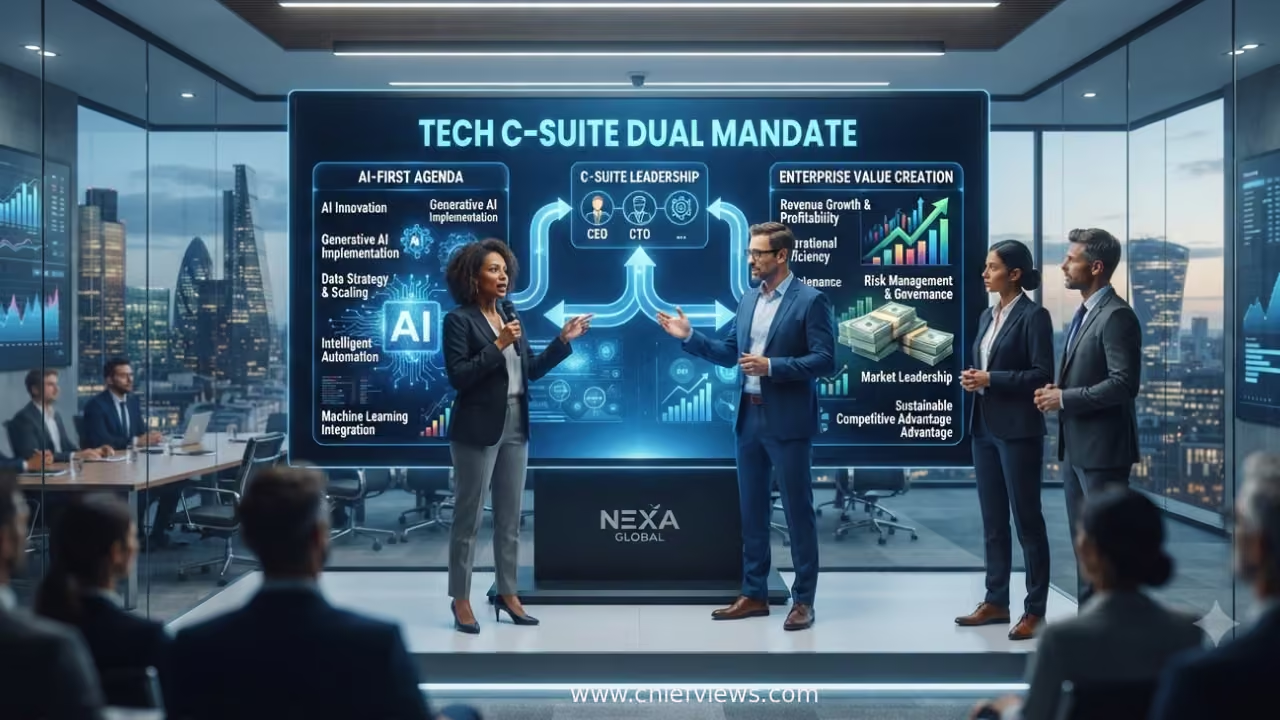
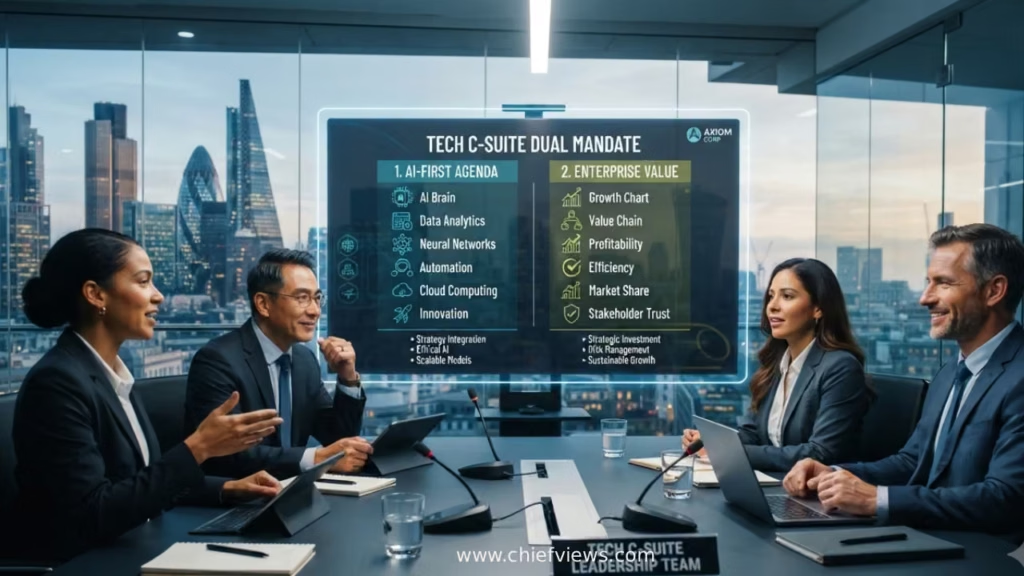
Tech C-suite dual mandate: AI-first agenda and enterprise value sits at the center of every serious technology leadership conversation in 2026. Boards no longer accept “we’re exploring AI.” They want measurable outcomes that show up in the P&L while the organization still moves at the speed of the latest models.
Here’s the quick read:
- Tech leaders must push an aggressive AI-first agenda without losing sight of hard enterprise value.
- Success is now judged by business outcomes, not system uptime or pilot volume.
- The dual mandate forces CIOs, CTOs, and emerging CAIOs to operate as both deep technologists and enterprise operators.
- Organizations that treat AI as a pure tech project almost always stall; those that redesign work capture returns faster.
- Clear ownership, tight prioritization, and ruthless measurement separate the winners from the rest.
The pressure is real. CEOs and boards expect technology leaders to drive both innovation velocity and quantifiable impact. That tension defines the job.
Why the Dual Mandate Exists
For years, technology organizations measured themselves on reliability, cost efficiency, and project delivery. Those still matter. But they no longer define success.
AI changed the equation. When generative tools and agentic systems started showing up in every function, the bar rose. Technology leaders are now expected to identify high-leverage use cases, fund them, scale them, and prove the economic return. At the same time, the broader enterprise still needs secure infrastructure, compliant data practices, and resilient operations.
Deloitte’s 2026 Global Technology Leadership Study captures this shift cleanly. Technology leaders report that AI has become the primary lens through which they define success, even as their overall mandate expands. Delivering measurable business outcomes now ranks at the top of their priority lists, followed by compliance and cybersecurity.


Tech C-suite dual mandate: AI-first agenda and enterprise value In my experience, the organizations that struggle most are the ones still running AI as a side project owned by a small innovation team. The ones that move faster treat the dual mandate as the core job description for the entire tech C-suite.
Tech C-suite Dual Mandate: AI-First Agenda and Enterprise Value in Practice
What does an AI-first agenda actually look like when it has to deliver enterprise value?
It starts with ruthless prioritization. Not every use case deserves funding. The ones that survive should either reduce meaningful cost, accelerate revenue, or create a competitive capability that is hard for rivals to copy.
It also requires redesigning work, not just bolting tools onto existing processes. Adding a chatbot to a broken workflow rarely produces lasting value. Redesigning the workflow around the capabilities of the models often does.
Governance cannot be an afterthought. Clear ownership, approved platforms, data standards, and risk controls determine whether pilots scale or die in committee. Wharton research and multiple enterprise studies continue to show that organizations with dedicated AI ownership and fewer competing platforms report stronger returns.
Here’s a practical comparison of the two mandates in action:
| Dimension | AI-First Agenda Focus | Enterprise Value Focus | Balanced Approach |
|---|---|---|---|
| Primary Goal | Speed of experimentation and model adoption | Measurable P&L or operational impact | Both, sequenced |
| Success Metrics | Number of pilots, model performance | ROI, EBITDA contribution, cycle-time reduction | Staged KPIs |
| Risk Profile | Higher tolerance for experimentation | Lower tolerance for waste or compliance gaps | Controlled bets |
| Ownership | Often innovation or CAIO-led | Shared with CFO, business unit leaders | Joint ownership |
| Time Horizon | Short (weeks to months) | Medium (quarters to years) | Mixed portfolio |
The table makes the tension visible. Pure AI-first thinking can produce impressive demos and little cash. Pure value thinking can starve the organization of the capabilities needed to stay competitive. The dual mandate forces leaders to hold both.
Step-by-Step Action Plan for Tech Leaders
If you are a CIO, CTO, or newly minted CAIO trying to operationalize this, here is the sequence I recommend:
- Map the economic leverage points. Sit with the CFO and business unit heads. Identify the three to five processes where speed, accuracy, or scale would move the needle hardest. Ignore the shiny use cases that only impress the tech team.
- Establish clear ownership. Decide who owns prioritization, funding decisions, and kill criteria. Hybrid titles are common, but split attention kills momentum. Dedicated focus with real authority works better.
- Build a thin platform layer. Approve a small number of enterprise platforms rather than letting every team experiment with different tools. Fragmentation destroys both cost control and the ability to scale successful patterns.
- Redesign before you automate. For each priority use case, map the current workflow end-to-end. Change the process first, then apply models. This is the difference between incremental savings and step-change results.
- Instrument for value from day one. Define the baseline metrics before the pilot starts. Track both leading indicators (adoption, accuracy) and lagging ones (cost, revenue, risk reduction). Review them on a fixed cadence with the business owners.
- Create a reinvestment loop. When productivity gains appear, decide in advance where the freed capacity or cash goes. Without that decision, the gains often evaporate into business-as-usual.
- Tighten governance without creating friction. Set clear risk tiers. Low-risk internal productivity tools move fast. Customer-facing or regulated use cases require stronger controls. Make the path visible so teams do not invent workarounds.
This sequence keeps the AI-first energy high while forcing every initiative through a value filter.
Common Mistakes & How to Fix Them
Tech C-suite dual mandate: AI-first agenda and enterprise value Most organizations make the same predictable errors.
They chase volume over impact. Running dozens of pilots feels productive. It rarely is. Fix: Cap the active portfolio and force ranking by expected economic contribution.
They treat AI as an IT cost center problem. When the CFO only sees spend and no corresponding revenue or margin story, funding eventually tightens. Fix: Pair every major initiative with a business sponsor who owns the outcome metric.
They under-invest in the non-tech pieces. Data quality, process redesign, change management, and incentive alignment usually determine whether the technology works. Fix: Allocate budget and attention to the full operating model, not just the models.
They fail to kill underperforming work. Sunk-cost thinking is expensive. Fix: Build explicit stop criteria into the governance process and use them.
They leave ownership fuzzy. When everyone is responsible, no one is. Fix: Name the accountable executive and give them real decision rights over funding and prioritization.
Key Takeaways
- The tech C-suite dual mandate: AI-first agenda and enterprise value is no longer optional in 2026. Boards expect both.
- AI success is measured by business outcomes, not technical sophistication alone.
- Dedicated ownership and fewer competing platforms correlate with stronger returns.
- Redesigning work beats bolting tools onto broken processes.
- Clear baselines and staged metrics turn vague “value” talk into board-ready evidence.
- Governance should accelerate good ideas and stop weak ones, not create bureaucracy for its own sake.
- The leaders who thrive treat the dual mandate as one integrated job, not two competing ones.
Tech C-suite dual mandate: AI-first agenda and enterprise value The organizations that figure this out will not just run better technology. They will operate differently. That is the real prize.
Start with the economic leverage points in your own business. Identify the three processes that matter most, name the owners, and instrument the baselines. Everything else follows from that discipline.
FAQs
What does the tech C-suite dual mandate: AI-first agenda and enterprise value actually require from a CIO or CTO?
It requires them to drive rapid AI capability building while proving that those capabilities improve revenue, margin, risk, or strategic position. Technical excellence is necessary but no longer sufficient.
How should organizations balance experimentation with the need for measurable enterprise value?
Run a small number of tightly scoped, high-leverage bets with clear baselines and stop criteria. Protect a limited budget for exploratory work, but keep the bulk of investment tied to defined outcomes.
Does every company need a chief AI officer to handle the tech C-suite dual mandate: AI-first agenda and enterprise value?
Not necessarily. What matters more is clear ownership and decision rights. Some organizations give the mandate to the CIO or CTO with real authority. Others create a dedicated role. The structure is secondary to the clarity of accountability.

