








AI literacy training programs for employees are no longer a nice-to-have L&D initiative. They are the foundation that determines whether AI tools deliver real productivity or just create expensive noise. Most organizations have already handed employees access to generative AI. Far fewer have taught people how to use it with judgment.
Here’s the short version of what works in 2026:
- Treat literacy as judgment training, not tool tutorials
- Start with a shared baseline for everyone, then layer role-specific depth
- Make managers the primary coaches, not just participants
- Measure behavior change and reduced risk, not completion rates
- Run it as an ongoing habit, not a one-time course
Without this layer, even the best AI strategy stalls. That is why strong AI literacy training programs for employees sit at the center of any serious effort at preparing the workforce for AI transformation as CHRO.
Why Generic Training Keeps Failing
AI literacy training programs for employees Employees are already using AI. BCG’s 2026 AI at Work survey found that a large majority of frontline workers engage with it regularly. The problem is guidance. Many of those same workers report limited or no direction on how to use the time AI saves them or how to evaluate outputs critically.
One-size-fits-all modules create two predictable outcomes. Technical people get bored. Non-technical people feel overwhelmed and default to surface-level prompting. Completion certificates go up. Actual capability barely moves.
What usually happens is that leadership buys a popular platform, runs a two-hour mandatory session, and declares the workforce “AI ready.” Six months later, adoption remains uneven, shadow AI grows, and quality issues appear in customer-facing work. The gap is not access. It is judgment.

What Strong AI Literacy Training Programs for Employees Actually Cover
Effective programs build four core capabilities:
- Understanding how current AI systems work and where they fail
- Crafting useful prompts and iterating on outputs
- Verifying results against domain knowledge and company standards
- Applying company policy on data, privacy, and approved tools
The best programs go further. They teach people when not to use AI and how to reinvest the time it frees up into higher-value work.
| Program Element | Weak Version | Strong Version |
|---|---|---|
| Audience approach | One course for everyone | Baseline for all + role-specific tracks |
| Delivery | One-time workshop | Short modules + ongoing practice |
| Measurement | Completion rates | Behavior change and reduced incidents |
| Manager role | Optional participants | Required coaches and role models |
| Content focus | Tool features | Judgment, verification, and workflow redesign |
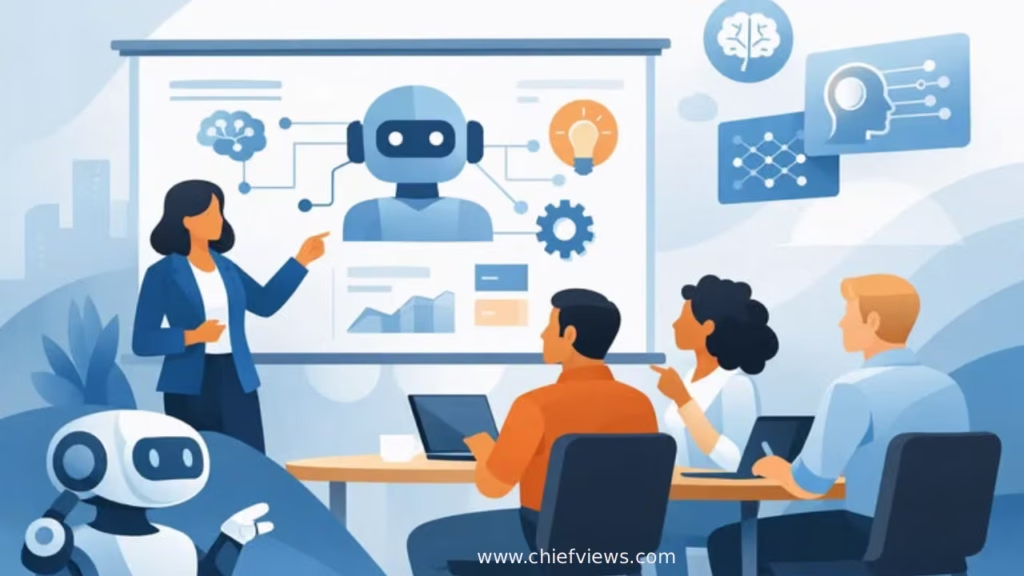
Step-by-Step Plan to Build AI Literacy Training Programs for Employees
If I were building this from scratch in a mid-to-large U.S. company, here is the sequence I would follow.
Step 1: Establish the baseline fast.
Give every employee a short shared foundation. Cover how generative AI works at a practical level, the most common failure modes, company data rules, and basic prompting. Keep it under four to six hours total. Make it required and trackable.
Step 2: Segment by role impact.
Identify which roles will change most. Customer service, marketing, operations, finance analysis, and knowledge work usually sit at the top. Create deeper, practical modules for those groups that use their actual daily tasks as practice material.
Step 3: Equip managers first.
Managers who cannot coach AI use become the bottleneck. Train them not only on the tools but on how to set new expectations, review AI-assisted work, and help employees reinvest time savings. This single step accelerates everything else.
Step 4: Create internal champions.
Select one person in every team or department who receives extra depth. These champions become the first line of support and the source of real use cases that feed back into the program.
Step 5: Embed practice into the flow of work.
One-off training fades. Build short practice loops, shared prompt libraries, and regular team reviews of AI-assisted outputs. Treat it like any other professional skill that needs maintenance.
Step 6: Measure what matters.
Track more than attendance. Look at frequency of responsible use, reduction in low-quality AI outputs reaching customers or decisions, manager confidence in reviewing AI work, and whether time savings are being redirected productively.
This approach supports the broader work of preparing the workforce for AI transformation as CHRO by creating the human capability layer that strategy alone cannot deliver.
Common Mistakes and How to Avoid Them
Mistake 1: Leading with tools instead of judgment.
People learn button-pushing without learning when the output is wrong. Fix it by making verification and critical evaluation the core of every module.
Mistake 2: Training executives and leaving the front line behind.
Recent data shows a clear gap: executives receive far more AI training than hourly or entry-level workers. The people doing the bulk of the work need the skills most. Start the baseline with the full workforce.
Mistake 3: Treating literacy as a project with an end date.
AI capabilities and company tools keep changing. Build a lightweight quarterly refresh into the program from day one.
Mistake 4: Measuring only activity.
High completion rates with low confidence or continued policy violations mean the program failed. Shift measurement toward observed behavior and risk reduction.
Mistake 5: Ignoring the time-reinvestment problem.
Employees who save hours with AI but receive no guidance on what to do with those hours often fill the time with lower-value work. Explicit coaching on this point is part of real literacy.
Making It Stick Across the Organization
AI literacy training programs for employees The strongest programs connect literacy training directly to performance expectations and career paths. When managers start asking in one-on-ones how people are using AI to improve their work, behavior changes faster than any certificate ever will.
Policy clarity helps. Employees need a simple, living set of rules on approved tools, data handling, and disclosure. Ambiguity drives shadow AI and risk.
For organizations already deep into AI strategy work, literacy training becomes the practical bridge between high-level plans and day-to-day execution. It is one of the highest-leverage investments a CHRO can make while preparing the workforce for AI transformation as CHRO.
Key Takeaways
- Most employees already use AI; the shortage is judgment and guidance.
- One generic course does not create literacy. Layered, role-relevant programs do.
- Managers must be trained as coaches, not just users.
- Measure behavior change and risk reduction, not just completion.
- Champions inside teams accelerate adoption more effectively than central training alone.
- Ongoing practice beats one-time events.
- Literacy is foundational infrastructure for any serious AI transformation effort.
- Start with a shared baseline, then deepen where the work is changing fastest.
AI literacy training programs for employees succeed when they treat people as the decision-makers who remain accountable for outcomes. The tools will keep improving. The organizations that win are the ones that make sure their people improve alongside them.
The practical next move is clear. Audit current training against the elements above, run a short baseline for the full workforce within the next 60 days, and build the first role-specific tracks for your highest-impact groups. Everything else becomes easier once that foundation is in place.
FAQs
How long should AI literacy training programs for employees take?
A solid shared baseline can be completed in four to six hours. Role-specific depth usually adds another eight to twenty hours depending on complexity. The real requirement is ongoing practice rather than a single large block of time.
Should AI literacy training be mandatory?
Yes for the baseline. Optional deeper tracks tend to attract the already-curious while leaving the broader workforce behind. Make the foundation required and the advanced paths available and encouraged.
How does this connect to larger workforce transformation efforts?
Strong AI literacy is the practical skill layer that makes broader strategies work. Without it, even well-designed plans for preparing the workforce for AI transformation as CHRO struggle to move from pilot to scale.

