







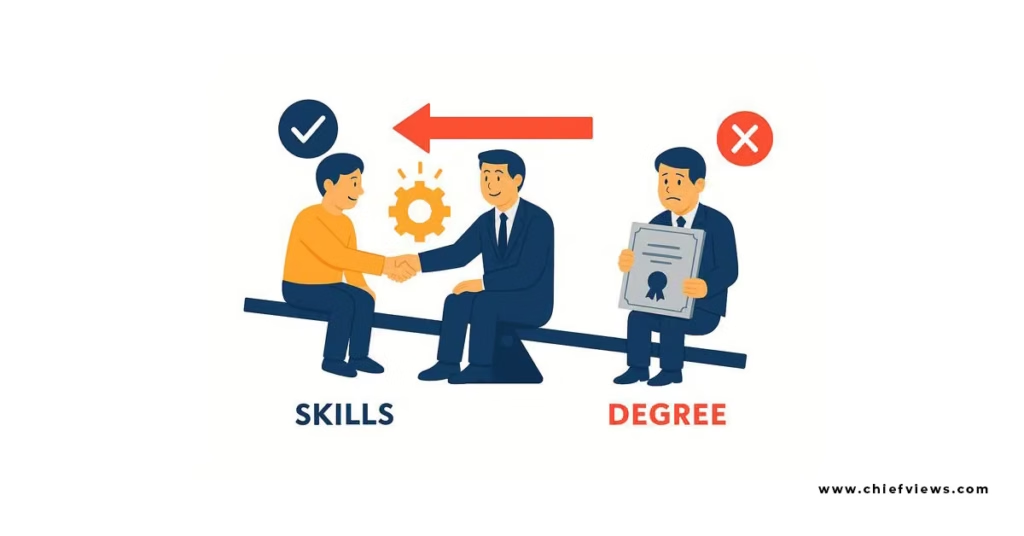
Skills-based hiring guide searches have exploded for a reason — degrees stopped predicting job performance years ago, and employers finally caught up. If you’re still writing job descriptions around “Bachelor’s required,” you’re filtering out people who could do the job better than half your current team.
Here’s the fast version before we go deep:
- Skills-based hiring means screening for demonstrated capability, not credentials or pedigree.
- NACE’s Job Outlook 2026 survey found 70% of employers now use skills-based hiring, up from 65% the year before.
- It works best when paired with a clear internal skills taxonomy — which is exactly where most CHROs get stuck.
- Done right, it widens your candidate pool and cuts mis-hires. Done sloppy, it’s just a buzzword stapled onto the same old process.
- The companies winning at this have tied skills-based hiring to a bigger workforce strategy — which is where CHRO strategies for skill architecture and automation 2026 come in.
Let’s get into the actual mechanics.
What Skills-Based Hiring Really Means
Skills-based hiring flips the traditional screening order. Instead of starting with “where did you go to school,” you start with “can you do this specific thing.”
Sounds simple. It isn’t, in practice.
Harvard Business School’s “Emerging Degree Reset” research documented how employers have steadily dropped degree requirements across millions of job postings, particularly in middle-skill roles where a bachelor’s degree never actually predicted performance in the first place. That research kicked off the movement years ago — 2026 is just the point where it’s finally mainstream instead of experimental.

Here’s the thing nobody says out loud enough: skills-based hiring isn’t a recruiting tactic. It’s a data problem. You can’t hire for skills you haven’t defined.
Why This Links Straight to Skill Architecture
This is where most “skills-based hiring” advice online falls apart — it talks about job postings and interview rubrics, but ignores the backend. If your organization doesn’t have a shared skills taxonomy, your recruiters are guessing at what “proficient in data analysis” even means from role to role.
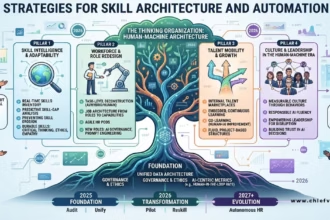
That backend work — building the taxonomy, mapping it against automation, redesigning jobs around it — is exactly what falls under CHRO strategies for skill architecture and automation 2026. Hiring is the front door. Architecture is the foundation holding the house up.
Skills-Based Hiring vs. Traditional Hiring: A Quick Comparison
| Dimension | Traditional (Credential-First) Hiring | Skills-Based Hiring |
|---|---|---|
| Primary screen | Degree, GPA, pedigree | Demonstrated skill proficiency |
| Candidate pool size | Narrower — excludes non-degree talent | Wider — includes self-taught, career-changers, veterans |
| GPA used in screening (NACE 2026 data) | 73% of employers in 2019 | Just 42% of employers today |
| Where it’s applied most | Resume screening stage only | Interviewing (87%) and screening (65%) |
| Risk if done poorly | Overlooks capable non-traditional candidates | Inconsistent evaluation without a shared skills taxonomy |
| Best paired with | N/A — standalone process | A documented skill architecture framework |
Notice that gap between 87% using skills-based evaluation during interviews but only 65% during initial screening. That’s a real crack in most companies’ process — they’re still filtering out good candidates on paper before giving skills a chance to shine in the room.
Step-by-Step Action Plan: Building Skills-Based Hiring From Scratch
If you’re a beginner HR leader or hiring manager, don’t try to overhaul everything at once. Here’s the order I’d actually run this in.
- Pick one role family to pilot. Something with clear, testable skills — engineering, sales, customer support.
- Strip the job description down to actual skills needed. Drop vague requirements like “5+ years experience” unless it’s truly non-negotiable.
- Build a short skills assessment. A work sample, a case study, a timed task — something that shows capability, not just talk.
- Train interviewers on structured rubrics. Unstructured “gut feel” interviews quietly reintroduce bias and credential-worship.
- Track outcomes. Compare performance of skills-hired candidates against your previous cohort at 90 days and 6 months.
- Expand to adjacent roles. Once the pilot proves out, scale the model — don’t rebuild from zero each time.
- Connect it to your skills taxonomy. This step is where hiring stops being isolated and starts feeding your broader skill architecture.
What I’d do if I were starting cold: run the pilot in a role where you’re currently struggling to fill seats. You’ll get leadership buy-in fast when the pain is already visible.
Common Mistakes & How to Fix Them
- Mistake: Dropping degree requirements without changing the screening process. The job posting says “skills-based,” but recruiters still filter by resume keywords out of habit. Fix: Audit actual screening behavior, not just the posted requirements.
- Mistake: No standardized skills assessment. Every interviewer tests for something different. Fix: Build one shared rubric per role family before the pilot launches.
- Mistake: Treating skills-based hiring as a one-time policy change. It fades without reinforcement. Fix: Bake it into interviewer training and performance reviews for hiring managers.
- Mistake: Ignoring internal mobility. Companies chase external skills-based hires while ignoring current employees with the same capabilities. Fix: Check your internal skills data before posting externally — here’s the thing, your best hire might already be on payroll.
- Mistake: Disconnecting hiring from workforce planning. Hiring teams run skills-based pilots while HR’s broader workforce strategy still runs on job titles. Fix: Tie hiring criteria directly to the organization’s skill taxonomy, not a standalone recruiting initiative.
Skills-Based Hiring as Part of a Bigger Workforce Strategy
Here’s a sharp question worth sitting with: what’s the point of hiring for skills if you can’t track what happens to those skills after someone’s hired?
That’s not rhetorical. It’s the actual gap in most “skills-based hiring guide” content floating around — it stops at the offer letter. Real CHRO strategies for skill architecture and automation 2026 extend the thinking past hiring into internal mobility, automation planning, and ongoing skills tracking across the whole employee lifecycle.
Think of skills-based hiring like planting a tree in good soil. The soil — your taxonomy, your tracking systems, your redeployment process — determines whether that hire actually grows into something, or just sits there until the next reorg uproots it.
Key Takeaways
- Skills-based hiring screens for demonstrated capability instead of degrees or pedigree.
- 70% of employers now use skills-based hiring, according to NACE’s Job Outlook 2026 survey, up from 65% the prior year.
- GPA screening has dropped sharply — from 73% of employers in 2019 to 42% today.
- Harvard Business School’s degree reset research shows this trend has been building for years, not a 2026 fad.
- Pilot in one role family before scaling organization-wide.
- Structured skills assessments beat gut-feel interviews every time.
- Skills-based hiring only works long-term when it’s connected to a broader skill architecture strategy.
- Check internal talent before posting externally — your taxonomy should surface hidden candidates already in-house.
Skills-based hiring isn’t a nice-to-have anymore — it’s table stakes. But hiring is just the entry point. If your organization isn’t connecting that hiring data to a real skills taxonomy and workforce plan, you’re leaving most of the value on the table. Start with one pilot role, build the rubric, track the outcomes — then plug the whole thing into your broader skill architecture strategy so it compounds instead of fading out after one hiring cycle.
FAQs
Does skills-based hiring mean degrees don’t matter at all?
No — it means degrees aren’t the default filter anymore. Many roles still benefit from formal education; skills-based hiring just stops using degree status as a proxy for capability when it isn’t relevant to the actual work.
How does skills-based hiring connect to CHRO strategies for skill architecture and automation 2026?
Hiring is the intake point for new skills data; without a skill architecture framework behind it, that data never informs internal mobility, automation planning, or workforce redesign — it just sits in an applicant tracking system.
What’s the biggest risk of switching to skills-based hiring too fast?
Inconsistent evaluation. Without a standardized rubric or shared skills taxonomy, different interviewers test for different things, which reintroduces the same bias skills-based hiring is supposed to eliminate.

