








Agentic AI vs traditional automation C-suite guide starts with a clear choice every executive faces right now: do you keep scripting fixed steps that break when the world shifts, or do you hand systems a goal and let them figure out the path?
Here’s the short version for busy leaders:
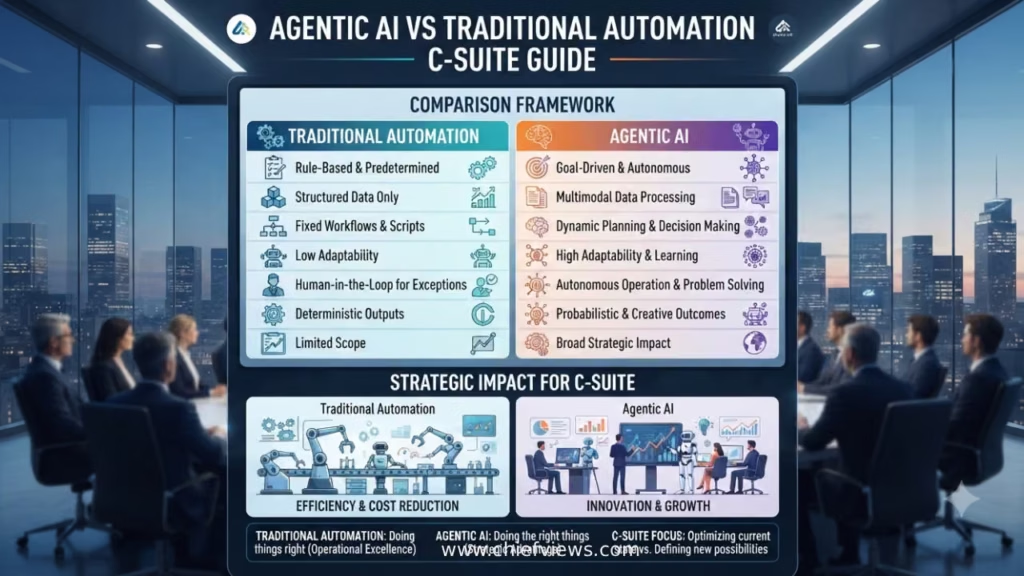
- Traditional automation (RPA, workflow engines, scheduled jobs) executes predetermined rules on structured data. It is reliable, cheap per run, and highly auditable—until the process or input changes.
- Agentic AI systems pursue defined outcomes. They reason over context, call tools, re-plan when conditions shift, and handle messy inputs that would stop a bot cold.
- The winning pattern in 2026 is hybrid: bots for the stable, high-volume core; agents for the exceptions, judgment calls, and cross-system work that used to land on people.
- C-suite risk is real—Gartner has flagged that more than 40% of agentic AI projects could be canceled by the end of 2027 over cost, unclear value, or weak controls.
- The real work is matching the technology to the process, setting governance, and redesigning how humans and systems hand work back and forth.
Most enterprises already run traditional automation. The question is where agentic capabilities actually move the needle without creating new fragility.
What traditional automation still does better
Robotic process automation and classic workflow tools follow a recorded or coded script. Same input shape, same path, same result. That predictability is gold for payroll postings, nightly reconciliations, standard approvals, and file transfers that never vary.
When the input is structured and the rules stay stable, these systems win on cost and control. Per-task run costs stay low. Audit trails are clean because every step is predetermined. Maintenance is mostly about keeping the scripts current when systems change.
The limitation is obvious. Change the layout of an invoice, move a field, or introduce an edge case the rules never anticipated, and the bot stops or writes bad data. Exception handling then falls back to people—the very work the automation was supposed to remove.

How agentic AI changes the equation
Agentic AI vs traditional automation C-suite guide Agentic systems receive a goal and available tools rather than a step-by-step script. They evaluate context, decide the next action, execute through APIs or interfaces, check the result, and adjust. AWS describes them as systems that “can act independently to achieve pre-determined goals” and make independent contextual decisions.
This architecture handles unstructured inputs—emails, PDFs with shifting layouts, chat transcripts, mixed data sources—far better than rule-based bots. It shines on processes that span multiple systems or require judgment that cannot be fully enumerated in advance.
Agentic AI vs traditional automation C-suite guide The trade-offs are equally clear. Cost per run becomes variable (tokens plus tool calls). Paths differ from one execution to the next, so auditability requires deliberate tracing and logging. Output can be plausible but wrong if guardrails are weak. Autonomy without tight scope and escalation rules creates new risk.
In practice, the strongest deployments treat agents as specialists for the variable layer while keeping deterministic automation for the stable core. Agents often call RPA bots or APIs as tools rather than replace them.
Agentic AI vs traditional automation C-suite guide: side-by-side comparison
| Dimension | Traditional Automation (RPA / Workflow) | Agentic AI |
|---|---|---|
| Core logic | Fixed rules and scripts | Goal + reasoning + tool use |
| Input type | Structured, predictable | Structured + unstructured, variable |
| Behavior on change | Breaks or escalates | Re-plans (sometimes incorrectly) |
| Cost per run | Low and relatively fixed | Variable (tokens + calls) |
| Auditability | High—same path every time | Requires explicit tracing and logging |
| Best fit | High-volume, stable, audited steps | Exceptions, judgment, multi-system work |
| Human role | High ongoing oversight for exceptions | Exception-based oversight + approval gates |
| Maintenance profile | Rule updates when process changes | Prompt/tool/guardrail updates + model drift |
This table is the practical decision filter. Match the process characteristics first; the technology choice follows.
Where C-suite decisions actually matter
Technology teams can stand up pilots. Scaling agentic systems requires choices only the CEO and executive committee can make. Ambition level, funding commitment, workforce redesign, clear ownership for turning capacity into results, and governance rules sit above the CIO’s toolkit.
Organizations that treat agentic AI as an IT project tend to stay stuck in pilots. Those that treat it as an operating-model shift—redesigning processes around human-agent handoffs—report stronger productivity outcomes. Data quality, process readiness, and trust controls consistently rank as the top barriers to scale.
One useful analogy: traditional automation is a well-built railway line. It moves freight efficiently along fixed tracks. Agentic AI is more like a fleet of delivery vans with smart routing. They can handle side streets, construction, and last-mile surprises, but only if you give them clear destinations, fuel limits, and rules about when to call a supervisor.
Step-by-step action plan for getting started
- Inventory processes by variability and volume. List high-volume stable work (keep or expand traditional automation) and high-exception or judgment-heavy work (candidates for agents).
- Pick one contained process with clear business value and measurable outcomes—invoice exceptions, complex support triage, or multi-system status reconciliation work well.
- Define the goal, allowed tools, data sources, confidence thresholds, and hard escalation rules before any build begins.
- Build the hybrid layer: agents for the variable steps, existing bots or APIs for the deterministic actions.
- Instrument heavily. Log inputs, reasoning traces, actions, and outcomes so you can audit and improve.
- Run a time-boxed pilot with real volume. Measure completion rate, exception rate, cost per successful outcome, and human time saved.
- Only after the pilot proves value and the governance holds, expand scope and refine the operating model around human-agent collaboration.
Start narrow. Prove the economics and the controls. Then scale what works.
Common mistakes and how to fix them
Agentic AI vs traditional automation C-suite guide Putting agents on stable, high-volume, fully structured work is the most expensive error. You pay more per task for variability you do not need. Fix: keep deterministic automation there and free the agent budget for true exceptions.
Launching without clear ownership of the freed capacity is another frequent miss. Productivity gains evaporate if no one is accountable for converting them into business results. Fix: name an executive owner before the pilot ends.
Weak guardrails and missing escalation paths create silent failures. Agents can produce confident wrong answers. Fix: define authority boundaries, confidence thresholds, and mandatory human checkpoints for high-impact decisions from day one.
Treating the project as pure technology rather than process and change work undercuts results. Most of the effort in successful deployments goes into data, process redesign, and operating-model shifts. Fix: budget and staff accordingly.
Ignoring maintenance and model drift is the quiet killer. Prompts, tools, and underlying models change. Fix: assign ongoing ownership and monitoring the same way you would for any production system.
Key Takeaways
- Traditional automation remains the right tool for stable, high-volume, rules-based work that demands exact repeatability and strong audit trails.
- Agentic AI earns its place on variable, unstructured, or judgment-heavy processes that used to require constant human intervention.
- Hybrid architectures—agents directing or escalating to deterministic bots—are the practical pattern most enterprises should pursue in 2026.
- C-suite decisions on ambition, funding, workforce redesign, accountability, and governance determine whether pilots become production value or expensive experiments.
- Clear goals, tight scope, explicit escalation rules, and heavy instrumentation separate successful deployments from the projects that get canceled.
- Match technology to process characteristics first; do not force every workflow into the newest tool.
- Human-agent collaboration, not pure autonomy, is where most leaders see durable advantage.
- Start with one high-value, measurable process, prove economics and controls, then expand.
Agentic AI vs traditional automation C-suite guide The organizations that will pull ahead treat agentic capability as an operating-model upgrade, not a software feature. They keep the railway lines running for the freight that belongs on tracks and give the smart vans clear destinations and rules for everything else.
Agentic AI vs traditional automation C-suite guide Pick one process this quarter that still burns too much human time on exceptions. Define the goal, the tools, the boundaries, and the success metrics. Run the pilot with eyes wide open on cost and control. That single disciplined step is the fastest way to move from curiosity to real operating leverage.
FAQs
What is the core difference in an agentic AI vs traditional automation C-suite guide?
Traditional automation follows fixed scripts on structured inputs and breaks when conditions change. Agentic AI is given a goal and tools, then reasons and adapts. The C-suite decision is which processes need which approach—and how to govern the combination.
When should a company choose traditional automation over agentic AI?
Use traditional automation for high-volume, stable processes with structured data and low variation—payroll, standard approvals, scheduled transfers. Adding agents there raises cost and reduces predictability without meaningful upside.
How does an agentic AI vs traditional automation C-suite guide address risk?
It stresses that agentic systems require deliberate guardrails, confidence thresholds, escalation paths, and audit logging because paths and outputs vary. Governance and ownership decisions belong at the executive level, not solely in IT.
