










Creator economy C-suite titles and brand rebuilding trends are rewriting how companies structure marketing leadership and spend. Brands no longer treat creators as campaign add-ons. They are installing dedicated executives with real budgets, direct reporting lines, and mandates that reach product, commerce, and revenue teams.
Here’s the quick overview:
- Creator-focused C-suite and VP roles have moved from novelty to standard infrastructure at many consumer brands and agencies.
- Organizations are shifting creator work out from under social media managers and into permanent, cross-functional teams.
- Budget ownership and performance accountability now sit higher on the org chart.
- The change reflects where attention and conversion dollars actually flow in 2026.
- Companies that delay this rebuild risk slower content velocity and weaker measurement.
In my experience working with marketing leaders, the ones who treat creator strategy as a permanent function pull ahead faster than those still running it as a side project. The difference shows up in both speed and clarity of results.
Why Creator Economy C-Suite Titles and Brand Rebuilding Trends Matter Right Now
Brands spent an estimated $116 billion on creators and influencers in 2026, according to Madison & Wall data. That money used to sit inside fragmented budgets. Now it is large enough to demand dedicated ownership. When one person or team controls the full creator P&L, decisions get faster and attribution improves.
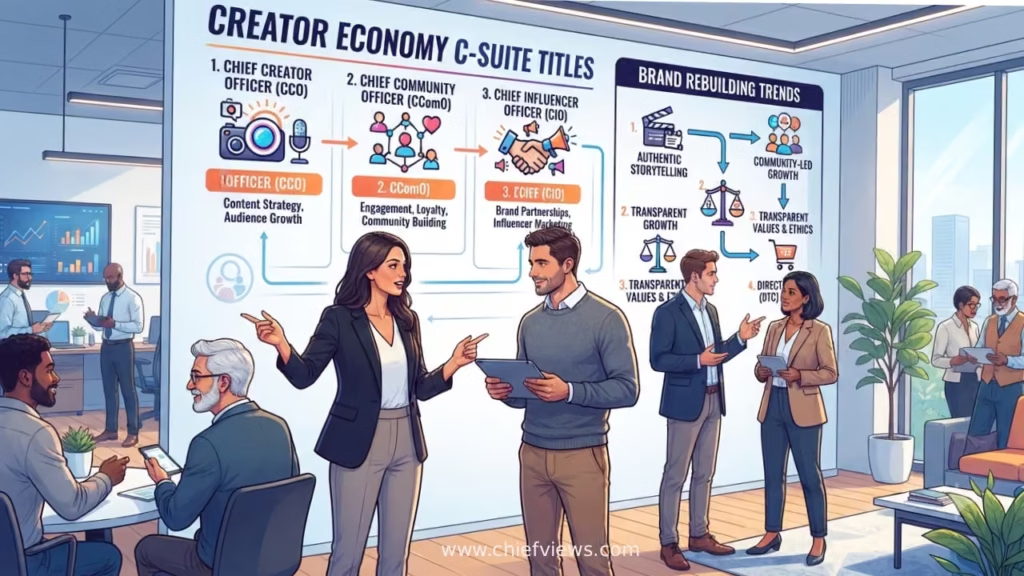
Look at the hiring pattern. Agencies and brands are installing titles such as Global Chief Creator Officer, Chief Content Officer held by creators themselves, and VP of Creator Strategy. Edelman named Kenny Gold its first Global Chief Creator Officer to lead a 200-person team. Eyewear brand Blenders gave creator Jordan Howlett a Chief Content Officer role. Soft-drink chain Cool Sips appointed reality-star-turned-creator Whitney Leavitt as chief creative and brand officer. These are not ceremonial titles. They come with headcount, budget authority, and seats in leadership meetings.
The deeper shift is structural. Creator work is leaving the social media silo. Job postings now emphasize acquisition, partnerships infrastructure, compliance, and revenue attribution. Content and growth functions are merging. What used to be two separate teams now often reports into one leader who understands both creative relationships and performance numbers.


How Creator Economy C-Suite Titles and Brand Rebuilding Trends Are Changing Org Charts
Traditional marketing org charts put influencer work three layers down. That model breaks when creator spend hits seven or eight figures and when paid amplification of creator content becomes the largest slice of the budget. One in four Fortune 500 companies now has an executive focused solely on creator strategy. Many of those roles report to the CMO or, in some cases, directly to the CEO.
Here’s a practical comparison of the old model versus the rebuilt model:
| Aspect | Old Model (Pre-2024) | Rebuilt Model (2026) |
|---|---|---|
| Reporting Line | Social media director or brand manager | CMO, Chief Growth Officer, or CEO |
| Budget Control | Project-based, shared across teams | Dedicated creator P&L with multi-year planning |
| Scope | Campaign briefs and posting schedules | Talent strategy, licensing, compliance, commerce integration |
| Measurement | Reach and engagement | Revenue attribution, cost-per-acquisition, retention |
| Talent Type | External agency or freelance | Mix of permanent staff + long-term creator partners |
| Risk Management | Ad-hoc legal review | Dedicated compliance and disclosure ownership |
The rebuilt version treats creators more like a media channel with proprietary relationships. Brands stop renting attention for a single campaign and start building owned capability. That change shows up in longer contracts, shared product development input, and creator equity or advisory roles in some cases.
Practical Steps: Building a Creator Leadership Function
If you are starting from a basic influencer program, here is the sequence I recommend.
- Audit current spend and reporting lines. Pull every dollar currently going to creators, agencies, and production. Map who owns the relationships and who owns the numbers. Most teams discover the work is split across three or four people with no single owner.
- Decide the altitude of the role. For brands spending under a few million, a strong Director or Head of Creator Strategy may be enough. Once spend or strategic importance grows, the title and reporting line need to rise. Match the title to the actual decision rights you plan to give.
- Write the mandate in business language. The job description should include budget ownership, performance targets tied to revenue or pipeline, compliance accountability, and cross-functional authority with product and commerce. Avoid vague “drive engagement” language.
- Hire or promote for hybrid skills. The strongest candidates understand platform dynamics, contract negotiation, and basic financial reporting. Pure creative backgrounds or pure performance backgrounds both leave gaps.
- Rebuild the team underneath. Move creator operations, payments, rights management, and measurement into the same reporting structure. Siloed execution kills velocity.
- Set measurement that leadership actually uses. Track incremental revenue, content reuse rates across channels, and creator retention. Vanity metrics lose funding over time.
What I’d do if I were rebuilding a mid-market brand’s program tomorrow: start with a six-month pilot under a newly titled Head of Creator Strategy reporting to the CMO, give that person full budget control for the pilot, and require a clear ROI narrative before expanding headcount.
Common Mistakes and How to Fix Them
Mistake 1: Title inflation without authority.
Giving someone a Chief Creator Officer title while leaving budget and headcount decisions elsewhere creates confusion and burnout. Fix it by aligning the title with real decision rights and a clear reporting line.
Mistake 2: Keeping creator work under the social media team.
Social teams optimize for community and platform algorithms. Creator strategy now includes commerce, licensing, and paid amplification. Move the function or expand the mandate.
Mistake 3: Measuring only creator-owned reach.
Paid amplification of creator content now accounts for a large share of total spend. Track performance the same way you track other media. Use the same attribution systems where possible.
Mistake 4: Short-term campaign thinking.
One-off deals produce higher costs and weaker results over time. Shift a meaningful percentage of budget into longer retainers and always-on relationships.
Mistake 5: Ignoring compliance infrastructure.
As spend scales, disclosure, usage rights, and FTC risk grow. Build or buy the operational capacity before the problems appear.
Creator Economy C-Suite Titles and Brand Rebuilding Trends in Action
Creator economy C-suite titles and brand rebuilding trends The companies moving fastest treat creator relationships as a core growth asset rather than a marketing tactic. They bring creators into product conversations earlier. They give internal teams the tools and authority to move quickly. They stop treating every partnership as a one-time media buy.
For agencies the pressure is even clearer. Holding companies that install senior creator leadership are signaling they expect client budgets to keep flowing in this direction. Brands that still rely entirely on external agencies for strategy risk losing institutional knowledge and speed.
The kicker is simple. Attention has shifted. Money has followed. Org charts are the last piece to catch up. Brands that rebuild now will operate with clearer ownership and better data. Those that wait will keep explaining why their creator results feel fragmented.
Key Takeaways
- Creator-focused executive titles are becoming permanent fixtures, not experiments.
- Real authority (budget, headcount, reporting line) matters more than the title itself.
- Org charts are shifting creator work out of pure social media silos.
- Measurement must move from vanity metrics to revenue and efficiency metrics.
- Longer-term creator relationships outperform constant short-term deals.
- Compliance and operational capacity need to scale with spend.
- Hybrid skill sets (creative relationships + business literacy) win the senior roles.
- Start with a clear audit of current spend and ownership before rewriting titles.
Creator economy C-suite titles and brand rebuilding trends The brands that treat creator strategy as infrastructure rather than campaigns will move faster and waste less money. If your current structure still routes major creator decisions through three layers of approval, the rebuild starts with clarifying ownership. Map the dollars, raise the altitude of the role, and give that person the tools to run it like a real business function.
FAQs
What exactly falls under creator economy C-suite titles and brand rebuilding trends?
These titles (Chief Creator Officer, VP of Creator Strategy, and similar) signal that brands are elevating creator work from a campaign tactic to a permanent leadership function with budget authority and cross-team influence.
How do I know if my brand is ready for a dedicated creator executive?
Look at total annual creator spend, the number of active partners, and whether performance data currently lives in multiple disconnected systems. When coordination costs exceed the value of the work, the role is overdue.
Are creator economy C-suite titles and brand rebuilding trends limited to large consumer brands?
No. Mid-market and B2B companies are adopting scaled-down versions of the same structure, often starting with a Head of Creator or Director-level role that reports higher than traditional social media leadership.
