








Finance team upskilling strategies that actually stick in 2026 start with one clear reality: most finance teams are still under-prepared for the data and AI demands already sitting on their desks. The gap is not theoretical. Boards expect faster insights, tighter controls, and smarter capital allocation. Teams that keep relying on the same skill mix from five years ago fall behind.
Here’s the practical snapshot:
- Finance team upskilling strategies must prioritize data literacy, AI fluency, and analytical storytelling over generic “digital transformation” training.
- The highest ROI comes from applied learning tied to real processes, not one-off courses.
- Successful programs blend internal projects, external expertise, and clear accountability for managers.
- Measuring progress by capability demonstrated on the job beats tracking course completions.
- Linking skill development to the specific demands of modern CFO roles creates urgency and relevance.
Finance team upskilling strategies The old approach of sending people to a two-day workshop and hoping something sticks no longer works. Finance work has shifted. Routine tasks continue to automate. What remains requires people who can interrogate AI outputs, redesign workflows, and turn data into decisions the business will actually act on.
Why Finance Team Upskilling Strategies Need a Reset
Many organizations still treat upskilling as a side project. They buy licenses for online platforms, announce a “digital academy,” and then wonder why adoption stays low. The problem is structural. Training sits outside the real work. Managers are not held accountable for capability growth. And the content often fails to connect to the actual decisions finance teams face every week.
Research and practitioner experience point to the same pattern. Teams that embed learning into live processes—forecasting cycles, close improvements, cash-flow scenario work—see faster skill transfer. Those that treat learning as an HR program see limited change.
This is especially true when the target capabilities include the data analytics and AI competencies for modern CFOs. Those skills are not abstract. They show up in how a team challenges a model’s forecast, documents assumptions, or redesigns a reconciliation process around automation. Upskilling that ignores this context wastes time and budget.


Core Principles for Effective Finance Team Upskilling Strategies
Strong programs share a few non-negotiable traits.
They start with a capability map, not a course catalog. Identify the 6–8 skills that matter most for your current and near-term work. Typical priorities include critical data evaluation, AI tool use with judgment, scenario modeling, clear recommendation writing, and basic process redesign.
They mix learning modes. Pure self-paced content has a place for foundations. Applied projects, peer coaching, and manager-led practice drive real change. The best programs require people to demonstrate the skill on a live deliverable.
They make managers responsible. Capability growth should appear in performance conversations and team goals. When only the individual owns their learning, progress stalls the moment daily work intensifies.
They protect time. Upskilling that competes with the close calendar or board pack deadline loses. Successful teams carve protected windows or redesign roles so learning is part of the job, not an extra.
Practical Finance Team Upskilling Strategies That Work
Here is a structured approach that scales from small teams to larger finance functions.
1. Diagnose before you design
Run a lightweight skills assessment tied to real tasks. Ask people to evaluate an AI-generated forecast, clean a messy data set, or turn a variance analysis into a one-page recommendation. The results reveal gaps far better than self-ratings.
2. Anchor learning to high-impact processes
Choose two or three processes that matter (rolling forecast, cash forecasting, anomaly detection, board reporting). Redesign how the work is done while people learn the supporting skills. The process improvement becomes the curriculum.
3. Create tiered pathways
Not everyone needs the same depth.
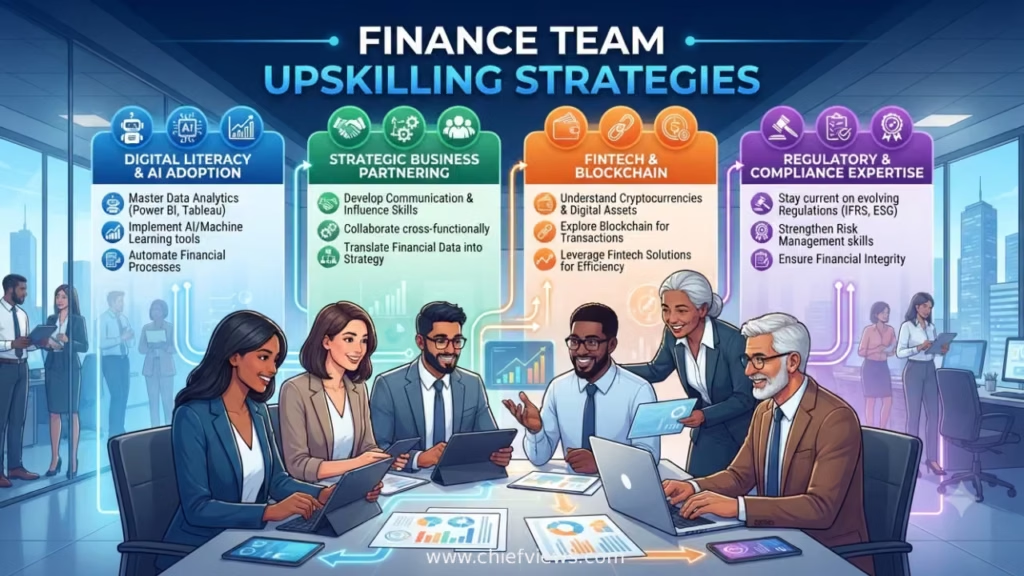
- Foundational: data literacy and responsible AI use for the whole team.
- Applied: deeper analytics and tool fluency for FP&A and controllership.
- Advanced: solution design and governance for a smaller group of specialists and leaders.
4. Use internal projects as the main classroom
Form short, cross-functional squads that tackle a real problem. Pair finance talent with data or technology colleagues. Require a working output and a short retrospective on what skills were used or still missing.
5. Bring in targeted external input
Use specialists for the parts your team cannot yet teach itself—advanced prompt techniques, model risk concepts, or sophisticated visualization. Keep external sessions short and immediately applied.
6. Build feedback loops
Review progress every 6–8 weeks. Look at demonstrated capability on live work, not just training hours. Adjust the program based on what is actually transferring.
Comparison of Upskilling Approaches
| Approach | Strengths | Weaknesses | Best Used For |
|---|---|---|---|
| Self-paced online courses | Scalable, low cost, flexible timing | Low completion and weak application | Foundational concepts |
| Live workshops | Energy, networking, focused attention | Expensive, limited follow-through | Kickoffs and complex topics |
| Project-based learning | High retention, direct business value | Requires strong facilitation | Core skill development |
| Manager-led coaching | Context-specific, builds accountability | Depends on manager capability | Sustaining and deepening skills |
| External specialist support | Access to current expertise | Cost and potential dependency | Accelerating advanced capabilities |
Most effective programs combine several of these rather than relying on one.
Common Mistakes in Finance Team Upskilling Strategies
Mistake: Measuring activity instead of capability
Tracking course completions or hours trained feels productive. It rarely predicts better work.
Fix: Define observable behaviors and review them on real deliverables.
Mistake: Treating everyone the same
One curriculum for the entire finance function wastes advanced talent and overwhelms others.
Fix: Create clear tiers and let people move based on demonstrated readiness.
Mistake: Ignoring the manager layer
If managers do not reinforce and model the new skills, the investment leaks away.
Fix: Give managers simple tools and hold them accountable for team capability growth.
Mistake: Separating learning from the work
Training that happens “when we have time” never gets priority.
Fix: Embed skill practice into existing processes and protect calendar space.
Mistake: Over-focusing on tools
Learning a specific platform without the underlying judgment skills produces shallow gains.
Fix: Teach the thinking first, then the tools that support it.
Action Plan for the Next 90 Days
Week 1–2: Run a practical skills diagnostic on 2–3 key processes.
Week 3–4: Select priority capabilities and design the first project-based learning cycle.
Week 5–8: Launch two squads working on live improvements while practicing the target skills.
Week 9–12: Review demonstrated progress, gather feedback, and plan the next wave.
Keep the first cycle small enough to control quality. Expand only after you see evidence of skill transfer.
Key Takeaways
- Effective finance team upskilling strategies focus on applied capability, not course volume.
- Anchor learning to real processes so skill development and business improvement happen together.
- Create tiered pathways and make managers accountable for progress.
- Measure what people can actually do on the job.
- Protect time and redesign work so learning is not an add-on.
- Connect skill development to the concrete demands of modern finance leadership, including data analytics and AI competencies for modern CFOs.
- Start small, prove transfer, then scale.
- Continuous adjustment beats a perfect annual plan.
The finance teams that pull ahead treat capability building as a core operating discipline. They diagnose honestly, learn by doing, and hold themselves accountable for results on the work that matters. That approach turns upskilling from a cost center into a genuine source of competitive advantage.
Begin with a clear-eyed look at the skills your team uses today versus the ones your strategy will require in the next 12–18 months. The gap is almost always larger—and more actionable—than people expect.
FAQs
What are the highest-ROI finance team upskilling strategies in 2026?
Project-based learning tied to live processes, combined with manager accountability and tiered pathways, consistently outperforms standalone courses or generic digital academies.
How do finance team upskilling strategies support data analytics and AI competencies for modern CFOs?
They create the practical environment where people develop the judgment, data evaluation, and AI fluency those competencies require, rather than treating them as abstract knowledge.
How long does it take to see results from focused finance team upskilling?
Teams that embed learning into real work typically see measurable improvement in capability and process outcomes within one to two quarters when the program is tightly scoped and well facilitated.
