









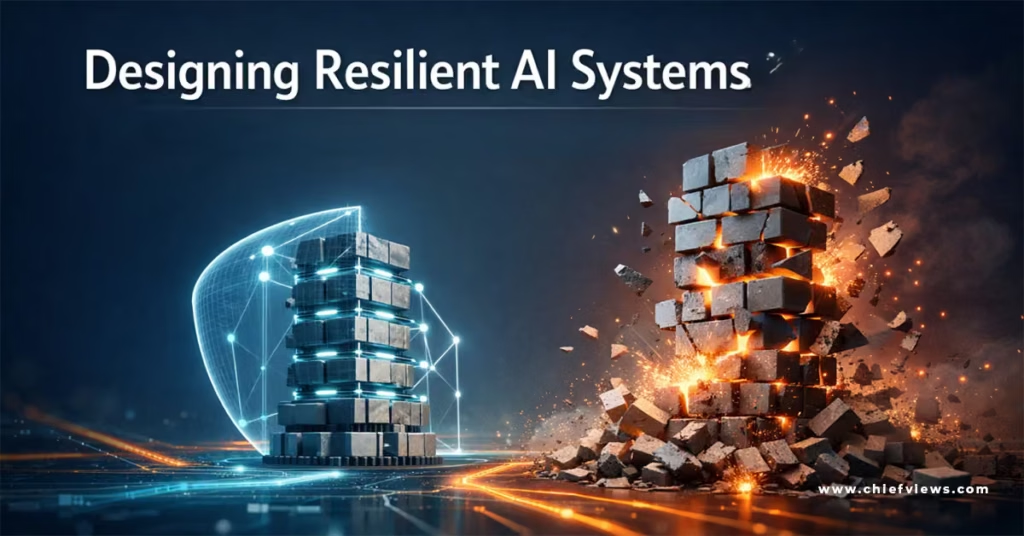
How CTO can build resilient AI systems for scale 2026 comes down to one idea: design for failure first, growth second. Here’s the quick version.
- What it is: A way of engineering AI so it keeps working when models drift, vendors go down, data turns messy, or traffic spikes.
- Why it matters: AI features now sit inside revenue paths, so an outage hits customers directly.
- Where to start: Map your failure points, set service-level objectives, and add fallbacks before adding features.
- Who owns it: The CTO sets the standards. Platform, security, and product teams carry them out.
Why Resilience Beats Raw Model Power
Most teams I talk to chase the smartest model. Wrong priority.
A brilliant model that times out at 9 a.m. on a Monday is a liability. What usually happens is a pilot works beautifully, leadership gets excited, and then real traffic arrives. Latency climbs. Costs balloon. Someone discovers the vendor API has a rate limit nobody read.
Think of your AI stack like a city’s power grid. Nobody admires the grid when it works. Everyone notices the second it fails, and the grid survives because it has redundancy, load balancing, and a plan for the worst day, not because one generator is spectacular.
So what separates a demo from a system? Operational discipline. That’s the whole game.



How CTO Can Build Resilient AI Systems for Scale 2026: The Core Layers
Resilience isn’t one decision. It’s a stack of them. Here’s how I’d break it down for a team that’s new to production AI or a few deployments in.
Layer 1: Data You Can Trust
Bad inputs wreck good models. Validate data at the door, version your datasets, and track where every training and retrieval source comes from. If you run retrieval-augmented generation (RAG), treat your knowledge base like production code, with owners, reviews, and rollback.
Layer 2: Model and Vendor Flexibility
Don’t marry one provider. Put a thin abstraction layer between your app and any model API so you can swap vendors, route by cost, or fail over when one goes dark. The kicker is that this layer also gives you leverage in contract negotiations.
Layer 3: Infrastructure That Bends
Autoscaling, queueing, caching, and graceful degradation. When the premium model is unavailable, can your product fall back to a smaller model or a rules-based answer? If not, build that path before you build anything fancy.
Layer 4: Observability and Evaluation
You can’t fix what you can’t see. Log prompts, outputs, latency, token spend, and error rates. Then run automated evaluations against a fixed test set every time something changes: model version, prompt, retrieval index, anything.
Layer 5: Security and Governance
AI adds new attack surfaces, such as prompt injection, data leakage, and insecure output handling. The OWASP Top 10 for Large Language Model Applications is a solid checklist for your security team. Pair it with a governance framework so risk decisions aren’t made ad hoc.
Resilience Patterns Compared
Here’s a quick reference I’d hand to a new engineering lead. Costs and effort are relative, based on my own experience, not hard benchmarks.
| Pattern | What It Protects Against | Relative Effort | Best For |
|---|---|---|---|
| Multi-model routing | Vendor outages, price changes | Medium | Customer-facing features |
| Response caching | Latency spikes, runaway costs | Low | Repeated or similar queries |
| Graceful degradation | Total feature failure | Medium | Any revenue-linked workflow |
| Automated evaluation suites | Silent quality regression | Medium to High | Teams shipping weekly |
| Human-in-the-loop review | High-stakes errors | High | Finance, health, legal use cases |
| Circuit breakers and rate limits | Cascading failures | Low | Every production API call |
Step-by-Step Action Plan for Beginners
Brand new to this? Start here. Don’t try everything at once.
- Inventory your AI touchpoints. List every place a model touches a customer or a business decision. Most CTOs find more than they expected.
- Rank by blast radius. Ask what breaks, and for whom, if each one fails. Fix the scary ones first.
- Set service-level objectives. Pick targets for latency, availability, and answer quality. The Google SRE Book remains the best free primer on SLOs and error budgets, and the ideas transfer cleanly to AI workloads.
- Add fallbacks. Every critical feature needs a plan B, whether that’s a cheaper model, a cached answer, or a plain “we’ll get back to you.”
- Instrument everything. Logging and tracing come before optimization.
- Build an evaluation set. Collect real examples with known good answers, and run them on every release.
- Run a failure drill. Kill a dependency in staging and watch what happens. It’s humbling, and it’s the cheapest education you’ll get.
- Document ownership. Every model, pipeline, and prompt needs a named human.
How CTO Can Build Resilient AI Systems for Scale 2026 Without Blowing the Budget
Resilience costs money. So does an outage. The trick is spending where it counts.
Cap token spend per user and per feature. Cache aggressively. Route simple requests to small models and save the heavyweight models for hard problems. In my experience, a routing layer pays for itself faster than almost any other optimization, because most traffic doesn’t need your most expensive model.
Here’s what I’d do if I had a lean team: put money into observability and fallbacks first, then evaluation, then multi-vendor routing. That order gives you the biggest risk reduction per dollar.
Governance: The Part Everyone Postpones
Boring? Yes. Skippable? No.
In the USA, the NIST AI Risk Management Framework is the most widely referenced starting point. It’s voluntary, and it gives you shared language for mapping, measuring, and managing AI risk across teams. Regulations also keep shifting at the state and federal level, so confirm current requirements with your legal counsel rather than assuming last year’s rules still apply.
That’s my professional opinion, not legal advice. But I’d rather see a CTO adopt a framework early than retrofit one after an incident.
Common Mistakes and How to Fix Them
Mistake 1: Treating the pilot as the product.
A demo has no failure modes. Fix it by running load tests and adversarial tests before launch, not after.
Mistake 2: Single-vendor dependency.
One provider, one outage, one very bad day. Fix it with a model abstraction layer and at least one tested fallback.
Mistake 3: No evaluation after launch.
Models drift, prompts get edited, data changes. Fix it with a fixed test set that runs automatically on every change.
Mistake 4: Ignoring cost until the invoice arrives.
Fix it with per-feature budgets, alerts, and dashboards the finance team can read.
Mistake 5: Security as an afterthought.
Prompt injection isn’t theoretical. Fix it by involving security during design, not during launch week.
Mistake 6: Nobody owns the model.
When everyone’s responsible, no one is. Fix it by assigning a named owner to every AI component.
Building the Team Behind Resilient AI at Scale
Tools won’t save you without the right people and habits. How CTO can build resilient AI systems for scale 2026 is as much about culture as architecture.
Run blameless postmortems. Rotate on-call across ML and platform engineers so neither group lives in a silo. Give product managers a basic grasp of model limitations so they stop promising 100% accuracy to customers.
And ask yourself a blunt question: if your lead ML engineer quit tomorrow, would the system keep running? If the answer’s no, you’ve found your next project.
Key Takeaways
- Resilience beats raw model power. A reliable good model outperforms an unreliable great one.
- Design for failure first: fallbacks, circuit breakers, and graceful degradation come before new features.
- Avoid single-vendor lock-in with a thin model abstraction layer.
- Observability and automated evaluation catch silent quality drops before customers do.
- Set service-level objectives for latency, availability, and answer quality, and track error budgets.
- Adopt a risk framework such as NIST’s AI RMF and use the OWASP LLM list for security reviews.
- Assign a named owner to every model, pipeline, and prompt.
- Run failure drills regularly. Practice beats theory.
Final Thoughts
How CTO can build resilient AI systems for scale 2026 isn’t a mystery. It’s a set of unglamorous habits: know your failure points, plan fallbacks, measure constantly, and keep ownership clear. Do that, and your AI keeps earning trust while competitors scramble through outages.
Your next step is simple. This week, list every AI feature in production and rank each by what breaks if it goes down. That one-page audit will tell you exactly where to spend your next sprint.
FAQs
What’s the first thing a CTO should do to make AI systems more resilient?
Run a blast-radius audit. List each AI-powered feature, note who’s affected if it fails, and prioritize fallbacks for the highest-impact ones. It takes a day and shapes your whole roadmap.
Do small teams need multi-model routing to scale AI reliably?
Not on day one. If you’re working out how CTO can build resilient AI systems for scale 2026 on a tight budget, start with caching, rate limits, and one tested fallback. Add routing once traffic and spend justify it.
How often should AI systems be re-evaluated in production?
Run automated evaluations on every change to the model, prompt, or retrieval data, and review results on a regular schedule, such as weekly. Quality can slip quietly, so don’t wait for customer complaints to find out.

