








Multi-Agent System Architecture is how you design several specialized AI agents so they divide work, share context, and deliver a reliable outcome instead of stepping on each other. In 2026 this is no longer experimental. It is the practical way teams handle research, document processing, incident response, and complex workflows that exceed what one agent can manage cleanly.
- Multiple specialized agents, each with its own role, tools, and context
- A coordination layer (orchestrator, graph, or handoff rules) that decides who acts next
- Clear communication and shared state so results do not get lost or duplicated
- Built-in verification, cost controls, and failure recovery
- Higher token cost and complexity in exchange for better specialization and parallelism
One agent can feel elegant until the task grows. Then context windows fill, tools collide, and quality drops. Multi-agent design solves that by giving each piece of work a focused owner.
Core Building Blocks of Multi-Agent System Architecture
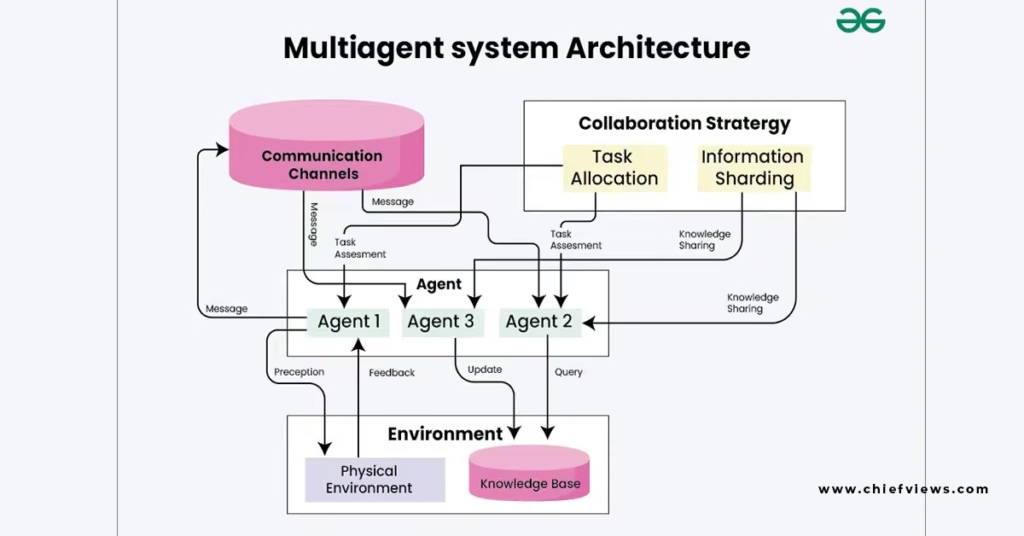
Every solid multi-agent system rests on a few primitives:
Agents
Each agent owns a narrow job, a clear system prompt, a limited tool set, and its own context. Specialists beat generalists when the work truly differs.
Orchestration layer
This decides the flow. It can be a lead agent, a fixed graph, or a combination. Without it you get chaos.
Communication
Agents exchange structured messages, hand off control, or write to a shared store. Protocols such as Agent-to-Agent (A2A) and Model Context Protocol (MCP) are becoming the standard ways agents discover each other and access tools.


Shared state and memory
A task ledger, short-term scratchpad, or longer-term memory keeps the system coherent so one agent’s output is usable by the next.
Observability and guardrails
Logging every handoff, setting iteration and cost ceilings, and adding human escalation paths turn a demo into something production teams can trust.
For CTOs who need the full strategic picture of how these pieces fit into enterprise agentic systems, the CTO guide to autonomous agentic AI orchestration remains the clearest high-level map.
Common Multi-Agent Architecture Patterns
Most production systems use one or a hybrid of these patterns:
| Pattern | How It Works | Best For | Main Trade-off |
|---|---|---|---|
| Orchestrator-Worker | Lead agent plans, assigns parallel workers, merges results | Research, multi-source analysis, document review | Higher token cost, need for clear briefs |
| Sequential Pipeline | Output of one agent feeds the next in fixed order | Intake → extraction → validation → posting | Fragile if any stage fails |
| Hierarchical / Teams | Manager agents direct sub-teams | Large, multi-department programs | Added latency and coordination overhead |
| Handoffs | Control and conversation pass to a specialist | Customer-facing triage, domain routing | Harder to keep global context |
| Router / Classifier | Lightweight agent routes to the right specialist | High-volume requests with clear categories | Routing accuracy is critical |
| Generator-Critic | One agent produces, another evaluates and refines | High-stakes content, compliance, code | Extra latency and cost |
Start simple. The orchestrator-worker pattern solves most early use cases. Only add hierarchy or peer-to-peer when the simpler version clearly fails.
When Multi-Agent Architecture Pays Off
Use multiple agents when:
- Sub-tasks are genuinely independent and can run in parallel
- Different tools or permissions are required
- A second opinion or verification step improves quality
- Context would otherwise overflow a single window
Skip multi-agent when a single well-prompted agent or a deterministic workflow already meets the quality and cost targets. Extra agents multiply tokens, latency, and failure modes.
Practical Design Steps
- Define the business outcome and success metric first.
- Decompose the work into the smallest independent pieces that still make sense.
- Assign one clear role, tool list, and success criteria to each agent.
- Choose the lightest coordination pattern that fits (usually orchestrator-worker).
- Design the handoff contract: what each agent receives and what it must return.
- Add cost ceilings, iteration limits, and human escalation points.
- Instrument every handoff and decision so you can debug later.
- Test each agent in isolation, then the full flow, with real data and adversarial inputs.
In my experience the teams that win treat agent design like API design: clear contracts, versioned prompts, and measurable interfaces.
Common Pitfalls and How to Avoid Them
Vague agent briefs produce duplicated or missing work. Write role cards that include objective, tools, output format, and stop conditions.
Unbounded loops burn tokens and budgets. Cap iterations and total cost per run.
Context bloat kills performance. Workers should return condensed findings, not raw dumps.
Missing verification lets errors cascade. Separate generation from evaluation whenever quality matters.
No observability turns production incidents into mystery novels. Log the full chain of decisions and payloads.
Key Takeaways
- Multi-agent system architecture is about specialized agents plus deliberate coordination, not just “more models.”
- Orchestrator-worker is the safest default starting pattern.
- Communication standards (A2A, MCP) and shared state are now table stakes.
- Cost and failure modes scale faster than capability—design for both from day one.
- Start with two agents (worker + reviewer) before adding more.
- Clear role cards and handoff contracts prevent most chaos.
- Observability and human escalation turn experiments into systems you can operate.
- Only add agents when a single agent demonstrably hits a limit.
The real test of multi-agent system architecture is not how clever the diagram looks. It is whether the system finishes the job faster, more accurately, or more cheaply than the simpler alternative—and whether your team can still understand and fix it at 2 a.m. Begin with the narrowest useful set of specialists, instrument everything, and expand only when the numbers justify it.
FAQs
What is the difference between multi-agent system architecture and a single agent with tools?
A single agent keeps everything in one context loop. Multi-agent architecture splits the work across specialized agents with separate contexts and an explicit coordination layer so each piece can use different tools, models, or permissions without overload.
How does multi-agent architecture relate to the CTO guide to autonomous agentic AI orchestration?
The architecture patterns described here form the technical foundation. The CTO guide focuses on the strategic, organizational, and governance decisions required to run these systems at enterprise scale.
Should I start with peer-to-peer or hierarchical coordination?
Most teams should start hierarchical (orchestrator-worker). Peer-to-peer is more flexible for emergent work but significantly harder to debug and control in production.

