



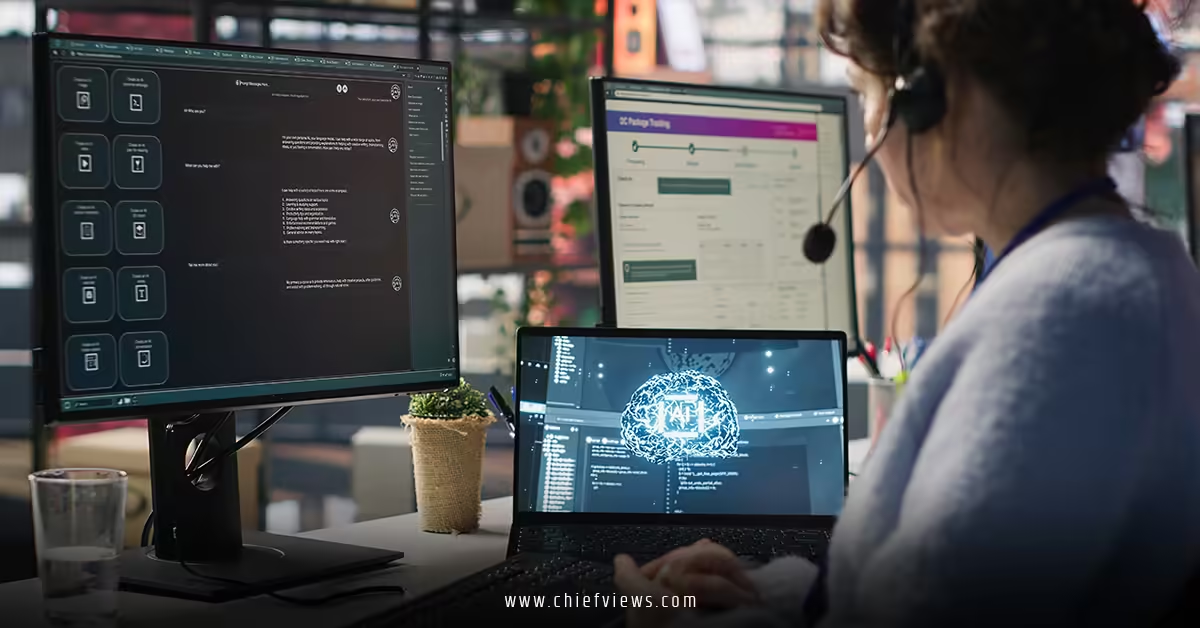
AI-native development platforms 2026 are exploding onto the scene, and if you’re still building software the old-fashioned way, you’re basically racing with one hand tied behind your back. These platforms don’t just sprinkle AI on top of traditional coding—they’re built from the ground up with intelligence woven into every layer. Think of them as living ecosystems where generative AI handles code generation, agents orchestrate workflows, and the entire software lifecycle runs smarter, faster, and more autonomously.
In 2026, Gartner has spotlighted AI-native development platforms as a top strategic trend, empowering small teams to crank out enterprise-grade software at speeds that were science fiction just a couple of years ago. No more endless sprints bogged down by manual debugging or rigid architectures. Instead, developers (and even non-coders) express intent—”Build me a predictive analytics dashboard for supply chain”—and AI assembles, tests, deploys, and evolves the application. Curious yet? Let’s dive in and see why this shift matters so much right now.
What Exactly Are AI-Native Development Platforms in 2026?
Forget bolt-on AI tools like basic code completers. AI-native development platforms 2026 treat artificial intelligence as the core architectural principle. From day one, the platform is designed around AI agents, multi-model orchestration, and intent-driven workflows rather than line-by-line programming.
Picture a traditional app as a house built brick by brick. An AI-native platform? It’s more like a self-assembling smart home that anticipates your needs, repairs itself, and upgrades automatically. Key characteristics include:
- Intent over instructions — You describe outcomes in natural language, and AI translates them into functional code, architecture, and infrastructure.
- Agentic orchestration — Multiple AI agents collaborate: one designs, another codes, a third tests, and yet another monitors in production.
- Self-healing and adaptive — Systems evolve continuously, learning from usage to optimize performance without human intervention.
- Multi-modal and context-rich — Platforms handle code, data, designs, and even business logic seamlessly across text, images, and real-time events.
Gartner notes these platforms accelerate development dramatically, letting nimble teams replace off-the-shelf SaaS with custom, high-performance alternatives. The result? Faster time-to-market, lower costs, and innovation that actually sticks.

Why 2026 Is the Breakthrough Year for AI-Native Platforms
We’re not in pilot mode anymore. 2026 marks the shift from experimentation to production-scale reality. Agentic AI has matured—think autonomous agents handling entire workflows instead of just suggesting snippets. Multi-agent systems (like those powered by frameworks such as LangGraph or AutoGen) create “agent meshes” where specialized AIs talk to each other, making complex apps feasible without massive teams.
Development cycles that once took months now shrink to weeks or days. Companies report 10-30% velocity gains in coding and 30-60% reductions in testing overhead. Plus, with AI eating software (as some experts put it), the focus moves from writing code to orchestrating intelligent systems. If your competitors adopt these platforms first, they’ll out-innovate you while you’re still debugging legacy code.
And here’s the kicker: businesses that master AI-native development platforms 2026 gain a structural edge. Flatter teams, real-time decisions, and software that behaves like a living organism become the new normal.

Core Features Driving AI-Native Development Platforms 2026
What sets the winners apart in this crowded space?
Agentic AI and Multi-Agent Orchestration
The heart of 2026 platforms. Single agents are old news—now it’s about teams of agents collaborating via protocols like MCP (Model Context Protocol) or A2A (Agent-to-Agent). They discover actions dynamically, handle failures gracefully, and scale complexity without exploding costs.
Intent-Driven and Generative Workflows
Developers specify “what” (outcomes), not “how” (code details). Platforms auto-generate architecture diagrams, synthetic tests, documentation, and even refactor legacy systems. Tools convert Figma designs or spoken requirements directly into deployable apps.
AI-Native Architecture and AutoOps
From DevOps to AutoOps: pipelines become self-managing. AI monitors logs, predicts outages, auto-scales resources, and applies fixes. Security, governance, and compliance embed natively—no afterthought add-ons.
Deep Context Awareness and Hybrid Integration
Platforms understand entire codebases, business domains, and external data. They blend on-device SLMs (small language models) for privacy with cloud-scale power, supporting hybrid/multi-cloud setups effortlessly.
Top Examples and Emerging Platforms in 2026
The landscape is buzzing. Here are standout players:
- Cursor — An AI-native IDE (VS Code fork) with deep repository understanding and multi-model support. Developers rave about its conversational coding for large projects.
- Lovable and similar full-stack builders — Turn natural language into complete apps, with Figma-to-code sync and logic-based prompting.
- Path Systems — Focuses on evolving custom software via intelligent agents on shared infrastructure.
- Replit and FlutterFlow — Blend no-code/low-code with AI for rapid prototyping and complex apps.
- Enterprise favorites like GitHub Copilot in agent mode, Claude Code, or custom orchestration on LangGraph/CrewAI.
Many organizations lean on specialized platforms for cloud-native AI, ensuring workloads stay optimized and secure.
Benefits and Real-World Impact
Adopting AI-native development platforms 2026 isn’t hype—it’s measurable advantage:
- Speed — Slash development time by generating features end-to-end.
- Cost efficiency — Smaller teams deliver more; reduce reliance on expensive SaaS.
- Innovation edge — Prototype wild ideas quickly, iterate based on real usage.
- Resilience — Self-healing systems cut downtime and maintenance headaches.
Enterprises scaling these see revenue growth from new AI-driven models, not just optimization.
But success demands the right leadership. To truly harness AI-native development platforms 2026, many companies turn to experts who can architect the transition. If you’re ready to embed these capabilities deeply, consider strategies to hire CTO with AI and cloud transformation experience 2026 — someone who bridges vision with execution, ensuring your stack stays future-proof.
Challenges to Watch and How to Overcome Them
It’s not all smooth sailing. Governance remains critical—hallucinations, bias, and security risks don’t vanish. Talent gaps persist; not every developer is AI-fluent yet. Integration with legacy systems can get messy.
Smart moves? Start with governed pilots, invest in context engineering, enforce verification loops, and prioritize platforms with strong audit trails. Build internal upskilling programs so your team owns the orchestration layer.
The Road Ahead: Becoming Truly AI-Native
By the end of 2026, the gap between AI-assisted and AI-native organizations will be stark. The former tweaks; the latter rebuilds from first principles, turning software into a dynamic, intelligent asset.
If you’re serious about staying competitive, explore these platforms now. Experiment, measure ROI, and scale what works. The future isn’t about coding faster—it’s about building smarter systems that evolve with your business.
Ready to lead the charge? Dive into resources from Gartner on top trends or Deloitte’s Tech Trends 2026 for deeper insights. Your next breakthrough might just be one intent prompt away.
Ready to take action? Explore resources from trusted authorities like Gartner’s Top Strategic Technology Trends for 2026, Deloitte’s Tech Trends 2026, and CIO.com’s insights on digital transformation to deepen your understanding.
FAQs
1. What defines AI-native development platforms 2026 compared to traditional tools?
AI-native platforms build intelligence into the core architecture from the start, using agentic workflows and intent-driven generation, unlike add-on tools that assist manual coding.
2. Which skills does a leader need to implement AI-native development platforms 2026 successfully?
A visionary who understands agent orchestration, governance, multi-cloud AI, and business alignment—often why companies seek to hire CTO with AI and cloud transformation experience 2026.
3. Are AI-native development platforms 2026 suitable for non-technical teams?
Absolutely—intent-based interfaces let product managers or domain experts drive creation, though technical oversight ensures enterprise readiness.
4. What are the biggest risks with adopting AI-native development platforms 2026?
Security vulnerabilities, over-reliance on AI outputs, and integration challenges with legacy systems. Mitigate with strong governance and phased rollouts.
5. How can businesses measure success with AI-native development platforms 2026?
Track velocity gains, reduced defects, faster releases, cost savings, and business outcomes like new features driving revenue—real metrics beat vanity stats.