




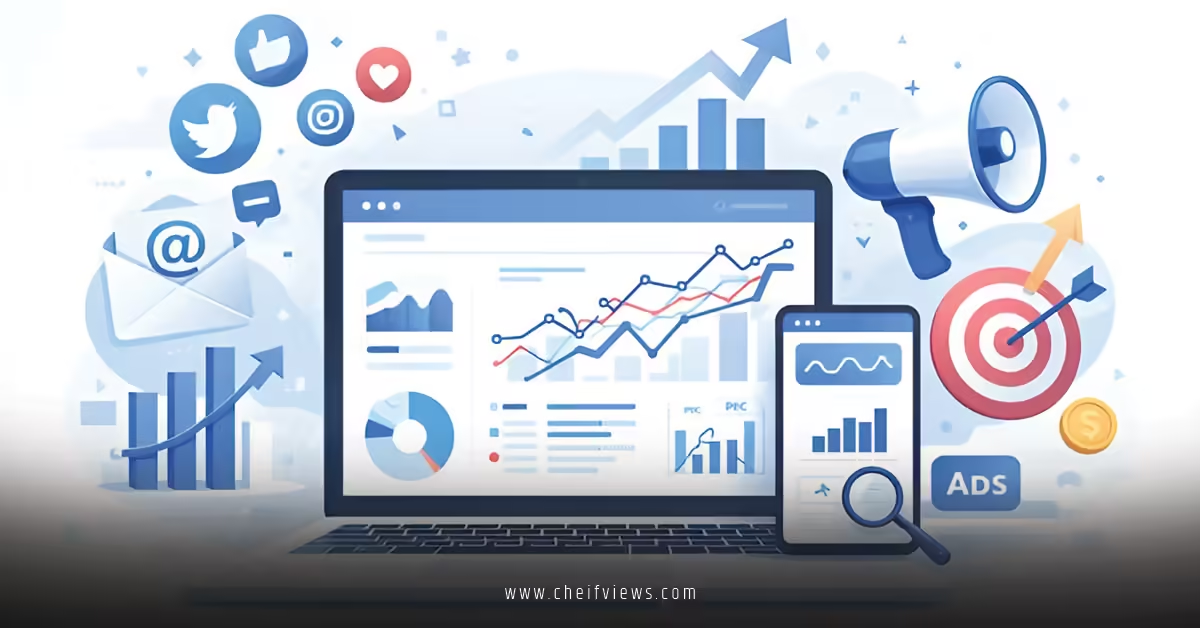
Data-driven marketing strategies turn raw numbers into revenue. They replace guesswork with clear signals on what works, who responds, and where to spend next. In 2026, these strategies blend first-party data, AI agents, and tight attribution to deliver measurable growth while respecting privacy.
- Core idea: Collect, unify, and act on customer data across the full journey.
- Big payoff: Companies mastering personalization see 5-8x ROI on marketing spend.
- 2026 reality: AI handles routine analysis while humans steer strategy and creativity.
- Focus on incrementality, first-party data, and behavioral triggers over vanity metrics.
- Beginners and intermediates who implement these see faster pivots and stronger budget justification.
The shift feels brutal if you’re still relying on last-click attribution. But get it right and every campaign sharpens itself.
Data-driven marketing strategies connect directly to the modern CMO skills data analytics and martech that separate leaders from the pack.
Why Data-Driven Marketing Strategies Matter More Than Ever
Budgets face scrutiny. Channels multiply. Customers expect relevance without creepiness. Data-driven approaches solve this by grounding decisions in evidence.
What usually happens? Teams drown in dashboards yet miss the signals that move revenue. Strong strategies fix that with clean data pipelines and actionable insights.
One analogy hits home: Think of data as the GPS and your strategy as the route. Without both, you’re burning fuel on dead-end roads.

In my experience, organizations that tie every tactic to business outcomes win bigger roles in the C-suite. What I’d do? Start by auditing one campaign end-to-end.
Key Components of Effective Data-Driven Marketing Strategies
Success rests on four pillars:
- Unified customer data from CRM, web, ads, and offline sources.
- Advanced attribution that accounts for the full journey, not just the last click.
- Predictive and prescriptive analytics powered by AI.
- Continuous testing and optimization loops.
Focus first on data quality. Poor inputs kill even the smartest models.
Comparison of Data-Driven Marketing Tactics in 2026
| Tactic | Best For | Expected Impact | Implementation Difficulty | Tools to Start With |
|---|---|---|---|---|
| Behavioral Triggering | Retention & Activation | Up to 29% of personalization ROI | Medium | Customer.io, Klaviyo |
| Predictive Personalization | Ecommerce & Lead Gen | 10%+ sales lift | High | Salesforce, Braze |
| Incrementality Testing | Budget Allocation | 10-15% efficiency gains | Medium-High | Google, Experiment platforms |
| Multi-Touch Attribution | Complex Journeys | Better ROI visibility | Medium | GA4, Improvado |
| AI Agent Optimization | Scale & Automation | 20%+ cost reduction | High | Agentic AI platforms |
Pick tactics that match your maturity level and scale from there.

Step-by-Step Action Plan to Build Data-Driven Marketing Strategies
Ready to move from theory to results? Follow this practical sequence.
- Assess your data foundation. Map all sources. Identify gaps and quality issues. Fix basics before adding complexity.
- Set clear, measurable goals. Tie them to revenue metrics like CAC, CLTV, and conversion rates. Avoid vague vanity targets.
- Unify and clean your data. Implement a CDP or central warehouse. Prioritize first-party collection.
- Choose attribution wisely. Move beyond last-click. Test data-driven models.
- Launch small tests. Run A/B or incrementality experiments on one channel or segment.
- Build reporting that drives action. Create dashboards answering “So what?” and “Now what?”
- Layer in AI. Once foundations are solid, add predictive tools and automation.
- Review and iterate weekly. Make decisions fast based on fresh signals.
What I’d do if mentoring a team: Block dedicated analysis time and celebrate learnings from failed tests. That builds the right culture.
Common Mistakes & How to Fix Them
Mistake one: Chasing every shiny metric. Fix: Ruthlessly focus on 5-7 KPIs linked to business results.
Mistake two: Ignoring data silos. Fix: Invest in integration early. Tools like Improvado or native connectors help.
Mistake three: Over-relying on AI without oversight. Fix: Keep humans in the loop for brand voice and ethical decisions.
Mistake four: Static strategies. Fix: Build always-on optimization loops with real-time signals.
Another trap: Collecting data without activation. Turn insights into campaigns fast.
Advanced Data-Driven Marketing Strategies for 2026
Agentic AI changes the game. These systems don’t just report — they recommend and sometimes execute next-best actions.
Combine behavioral triggers with hyper-personalization. Use first-party data for trust and relevance.
Rhetorical question: How much budget are you wasting on channels that look good in reports but deliver zero incremental lift?
Experiment with synthetic data for testing where real data is limited. Privacy-first approaches win loyalty.
Key Takeaways
- Data-driven marketing strategies deliver superior ROI when built on clean first-party data and smart attribution.
- Prioritize quality and unification over volume.
- AI amplifies results but demands strong human strategy.
- Test relentlessly and optimize in short cycles.
- Focus on incrementality to prove real impact.
- Behavioral triggers and personalization drive outsized returns.
- Integrate with modern CMO skills data analytics and martech for maximum effect.
- Start small, measure everything, and scale what works.
Nail these and your marketing becomes a predictable growth engine.
Next step: Pick one underperforming campaign this week. Audit its data story and run a simple test. Small wins compound fast.
FAQs
What makes data-driven marketing strategies different in 2026?
They rely heavily on first-party data, AI agents for real-time decisions, and incrementality testing instead of third-party cookies or basic reporting.
How do beginners implement data-driven marketing strategies?
Start with Google Analytics 4 for insights, set clear KPIs, run A/B tests, and gradually add automation tools. Focus on learning from one channel first.
Can small teams succeed with data-driven marketing strategies?
Absolutely. Tools like GA4, HubSpot free tiers, and no-code platforms level the field. Consistency and focus on high-impact tests matter more than big budgets.