








IPO readiness and capital raise strategies with AI now sit at the center of every serious late-stage conversation in the United States. Boards no longer treat artificial intelligence as a slide in the pitch deck. They treat it as operational infrastructure that compresses timelines, sharpens disclosure, and raises the bar for what investors will accept.
- AI accelerates financial modeling, risk mapping, and S-1 drafting while exposing gaps earlier.
- Strong AI-native companies still command capital, but markets demand proof of durable margins and recurring revenue.
- Readiness now includes governance of the AI tools themselves, not just the business story.
- Private capital remains deep for high-quality names, giving teams more control over timing.
- The winners combine traditional IPO hygiene with machine-speed diligence and narrative precision.
The 2026 IPO window opened wider for AI-linked issuers than many expected. AI-related companies accounted for more than half of IPO capital raised even while representing a smaller share of total deals. That concentration creates both opportunity and pressure. Investors have seen enough hype cycles. They want substance.
Why IPO readiness and capital raise strategies with AI changed the playbook
Traditional IPO readiness focused on audited financials, clean cap tables, SOX controls, and a coherent equity story. Those pillars still matter. What changed is the speed and depth of scrutiny.
AI tools now scan data rooms in hours instead of weeks. They extract risk factors, normalize multi-year financials, and flag inconsistencies that used to surface only in the comment letter process. Law firms have built specialized agents for registration statements. Investment banks run comparable-company analysis and precedent transaction screens through models trained on years of filings.
The practical result? Companies that treat AI as a force multiplier reach the starting line faster and with fewer surprises. Companies that treat it as a marketing claim get exposed quickly.
In my experience working with teams preparing to go public, the difference shows up in two places: the quality of the first S-1 draft and the sharpness of the roadshow Q&A. Teams that feed clean source documents into purpose-built AI systems produce tighter narratives and spot margin leverage or customer concentration issues months earlier.

What usually happens is that management discovers the real readiness gaps only after the bankers and counsel start asking hard questions. AI compresses that discovery cycle.
Building the foundation: financial and operational readiness
Start with the numbers. Public investors in 2026 price growth against profitability and capital efficiency more ruthlessly than they did in 2021. AI helps here in three concrete ways.
First, continuous forecasting. Models trained on your historical cohorts and external market data generate scenario ranges that update as new bookings land. Second, unit economics clarity. AI can isolate contribution margins by product, customer segment, and cohort faster than most internal finance teams. Third, anomaly detection. Outliers in revenue recognition, deferred revenue, or customer churn surface early.
Governance matters just as much. Boards need documented oversight of any AI system that touches financial reporting or material disclosures. The SEC has made clear that AI use falls under existing disclosure controls and procedures. Treat the models the same way you treat spreadsheets that feed the 10-K.
I would run a parallel readiness workstream: one traditional, one AI-augmented. The traditional track covers audits, legal entity cleanup, and equity administration. The AI track focuses on data hygiene, model validation, and disclosure language testing.
IPO readiness and capital raise strategies with AI in the diligence and filing process
This is where the tools deliver the biggest time savings.
Virtual data rooms now come with native AI search and extraction. Instead of junior associates reading every contract for change-of-control clauses, an agent surfaces the relevant language with source citations. Financial models get stress-tested against the source documents automatically. Risk factors get drafted from the actual risk inventory rather than recycled boilerplate.
Cooley’s GO Public tool, built with OpenAI, is one example of specialized agents designed to accelerate S-1 drafting. Similar systems exist for prospectus generation and comment-letter response. The human lawyers still own the final judgment and the liability. The machines handle the first heavy lift.
For capital raising itself, AI improves targeting and messaging. Models trained on institutional holdings and past IPO participation help identify the right long-only accounts and crossover funds. Roadshow materials get stress-tested against the questions those investors asked in prior AI and software IPOs.
One fresh analogy: think of traditional IPO preparation as building a house by hand. AI-augmented preparation is like bringing in a skilled framing crew that still requires the architect and the inspector. You get the structure up faster, but the load-bearing decisions remain human.
Comparing traditional versus AI-augmented IPO readiness approaches
| Aspect | Traditional Approach | AI-Augmented Approach | Practical Edge |
|---|---|---|---|
| Data room review | Manual reading by teams | Automated extraction + citation | Weeks to days |
| Financial modeling & scenarios | Spreadsheet-driven, periodic | Continuous, multi-scenario | Earlier gap detection |
| S-1 / prospectus drafting | Precedent + partner review | First-draft generation + human edit | Faster iteration cycles |
| Risk factor identification | Counsel judgment + checklists | Pattern matching across filings + internal data | Broader coverage |
| Investor Q&A prep | Mock sessions + historical notes | Simulated hard questions from prior deals | Higher readiness |
| Timeline to first complete draft | 4–8 weeks typical | Often 1–3 weeks with clean inputs | Window flexibility |
The table above reflects patterns observed across 2025–2026 processes. Results vary with data quality. Garbage in still produces garbage out.
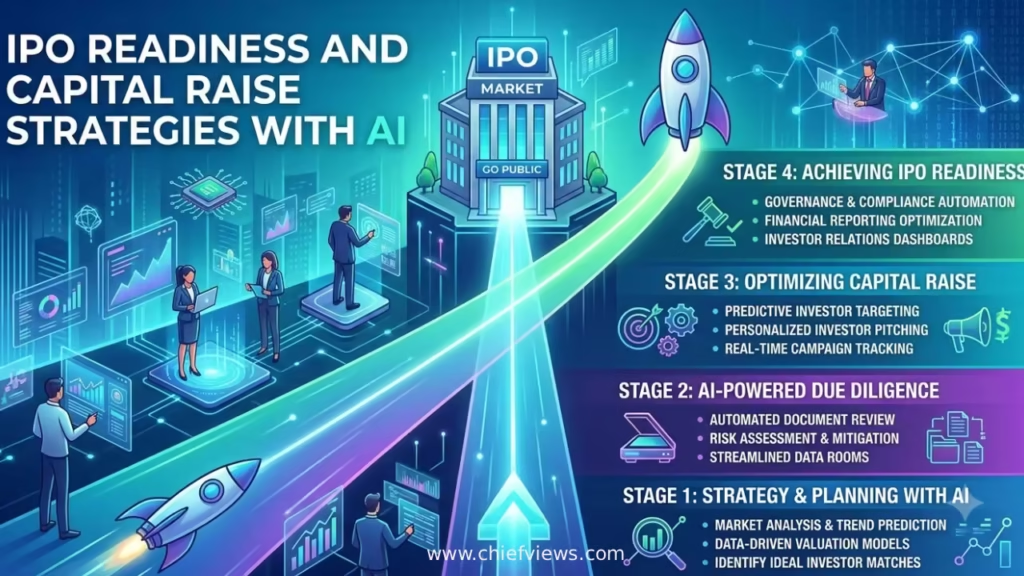
Step-by-step action plan for beginners
If you are a founder or CFO starting from intermediate readiness, here is the sequence I would follow.
- Clean the data foundation. Inventory every system that feeds financials, customer metrics, and contracts. Fix the gaps before any model touches them.
- Stand up an AI governance policy. Document which tools are approved, what data can be uploaded, and who reviews outputs that reach investors or the SEC.
- Run a full AI-assisted diligence dry run. Load a mock data room. Ask the system for gap analysis, risk extraction, and a first-pass investment thesis. Compare the output to what your counsel and bankers produce.
- Build the equity story with measurable AI contribution. Show how AI improves margins, shortens sales cycles, or expands addressable markets with real numbers, not claims.
- Pressure-test valuation expectations. Use current public AI and AI-adjacent comps. Model downside cases where growth slows or capital intensity rises.
- Align the board and key shareholders early. Secondary liquidity options and employee tender offers have become more common. Decide the path before the window opens.
- Engage counsel and bankers who already run AI-augmented processes. The firms that have internal agents and validated workflows move faster.
- Prepare for ongoing public-company AI disclosure. Material AI risks and board oversight will face increasing attention in filings and exams.
IPO readiness and capital raise strategies with AI Execute steps 1–3 before you formally kick off the IPO process. Everything after that becomes smoother.
Common mistakes and how to fix them
Mistake one: treating AI as a narrative overlay instead of an operational system. Investors now ask for the roadmap and the unit economics impact. Fix: quantify the contribution in the financial model and the MD&A.
Mistake two: uploading sensitive or material nonpublic information into consumer-grade tools. That creates Regulation FD and privilege risks. Fix: restrict to enterprise instances with contractual protections and log every upload.
Mistake three: waiting for perfect readiness. The best teams reach 80 percent readiness and then use the process itself to close the final gaps. Fix: set staged milestones with clear go/no-go criteria.
Mistake four: ignoring the higher bar for pure software stories in an AI-heavy market. Growth rates that looked strong in 2021 now look ordinary. Fix: demonstrate leverage in the cost structure and durability of the revenue base.
Mistake five: under-investing in the post-IPO operating model. Public markets punish companies that cannot maintain the same narrative after the quiet period ends. Fix: build the investor relations and disclosure muscle during the readiness phase.
Key Takeaways
- IPO readiness and capital raise strategies with AI reward teams that treat the technology as infrastructure rather than marketing.
- Clean data and documented AI governance are non-negotiable starting points.
- Specialized agents now compress diligence and drafting cycles without removing human accountability.
- Investors demand proof of sustainable growth and margin improvement, especially from AI-exposed businesses.
- Private capital availability gives strong companies more timing control than in previous cycles.
- The SEC focuses on existing controls and materiality rather than new AI-specific rules in most cases.
- Early dry runs with AI tools surface the real gaps before bankers and counsel do.
- The companies that combine traditional discipline with machine speed enter the window ready to move.
IPO readiness and capital raise strategies with AI The companies that treat IPO readiness and capital raise strategies with AI as a serious operational upgrade will raise capital on better terms and face fewer surprises after the listing. The ones that treat it as theater will discover the market’s skepticism the hard way.
Start with the data. Add the governance. Run the dry runs. Then decide whether the public markets are the right next chapter.
FAQs
How does AI specifically improve IPO readiness and capital raise strategies with AI for mid-stage companies?
It shortens the time required to produce clean financial models, risk inventories, and registration statement drafts while highlighting inconsistencies that previously emerged only under banker or SEC scrutiny.
What governance steps should boards take around AI tools during the IPO process?
Approve only enterprise-grade platforms, restrict material nonpublic information, require human review of any output that reaches investors or regulators, and document the oversight process in board minutes.
Can smaller companies without large legal budgets still benefit from IPO readiness and capital raise strategies with AI?
Yes. Many of the highest-ROI uses—data room gap analysis, financial anomaly detection, and Q&A simulation—are available through commercial tools that do not require custom development.
