








Building an Internal Developer Platform for AI Agents :
An internal developer platform for AI agents turns scattered experiments into governed, reusable capabilities that teams can actually trust. In 2026, most organizations already run some form of internal developer platform. The next step is extending it so that AI agents become first-class users and workloads—without sacrificing security, cost control, or operational reliability.
Platform teams that get this right give developers and agents the same golden paths, the same identity model, and the same observability. The result is faster delivery of agentic workflows and far fewer production surprises.
Why a Dedicated Platform Layer Matters for Agents
Individual agents are easy to prototype. Scaling them across teams is where things break. Shared credentials, missing audit trails, unconstrained tool access, and inconsistent evaluation quickly turn promising pilots into risk.
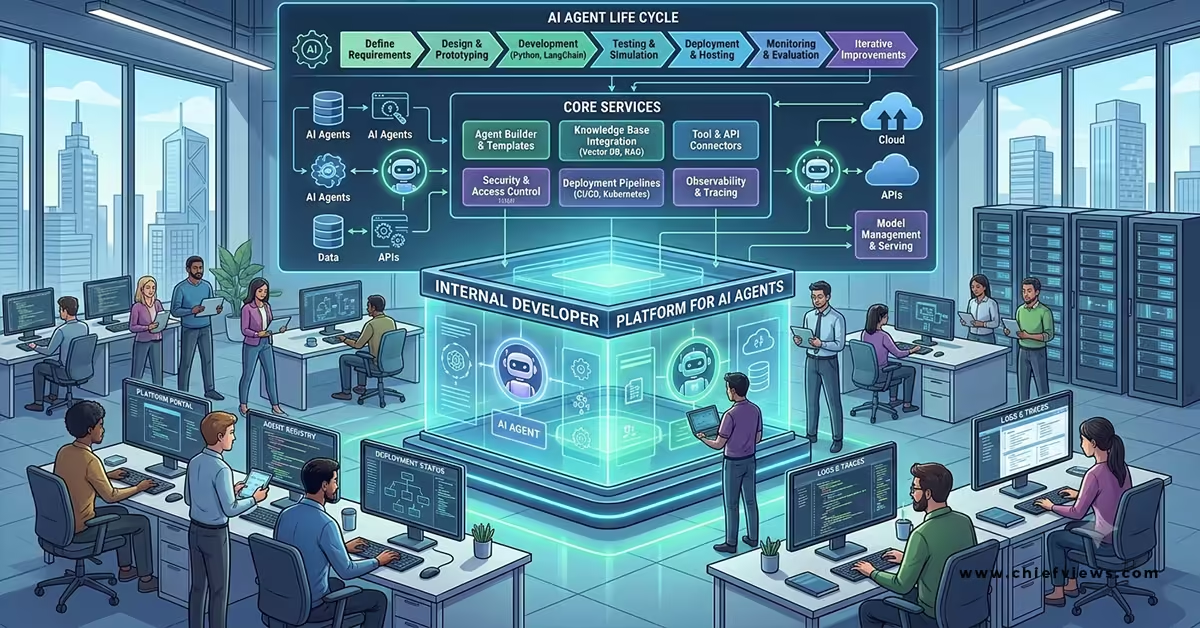
A proper internal developer platform for AI agents solves the shared problems once:
- Identity and least-privilege access for every agent run
- Approved tool registries and gated execution
- Memory and context management with clear retention rules
- Policy-as-code and human-in-the-loop checkpoints for sensitive actions
- Evaluation gates before promotion to production
- Cost attribution and observability at agent and workflow level
Without this foundation, every new agent becomes a one-off security and reliability project.


Core Components of an Agent-Ready Internal Developer Platform
Start from the existing IDP and extend it rather than building a parallel stack.
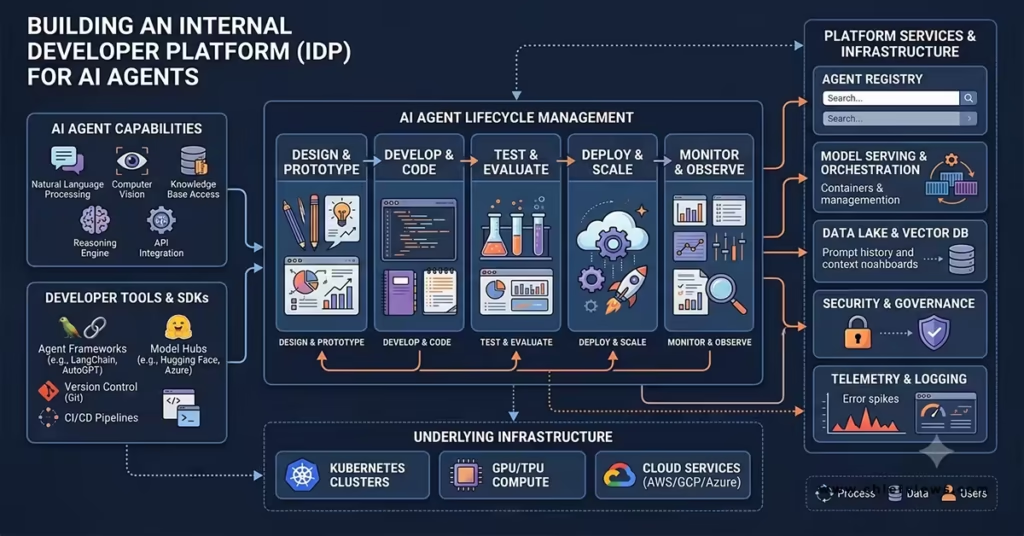
1. Agent Identity and Access Control
Every agent needs its own verifiable identity, short-lived credentials, and scoped permissions. Shared service accounts destroy accountability. Treat agent identities the same way you treat service accounts for microservices—owned, reviewable, and revocable.
2. Tool and Capability Registry
Agents discover and call tools through a governed catalog. The registry describes what each tool does, required inputs, side effects, and approval requirements. Machine-readable contracts (including emerging standards such as MCP) let agents query capabilities instead of relying on tribal knowledge or static documentation.
3. Golden Paths That Serve Both Humans and Agents
Templates for service creation, environment provisioning, CI/CD, and common workflows must work for developers clicking through a portal and for agents calling the same APIs. Policy enforcement happens at the path level so agents cannot bypass standards.
4. Runtime, Memory, and Orchestration
Provide sandboxed runtimes, durable workflow state, and controlled memory stores. Separate inference gateways from tool gateways so model calls and external actions can be observed and rate-limited independently.
5. Evaluation, Observability, and Governance
Every agent promotion should pass automated evaluation suites. Full traces, cost tags, and audit logs must attribute actions to a specific agent identity and owner. Kill switches and spend caps complete the control plane.
These components turn the platform into the control plane that both humans and agents use.
Practical Steps to Build It
Most teams already have pieces of an IDP. The work is to make those pieces agent-consumable and to close the gaps.
- Inventory existing agents and the credentials they currently use. Replace shared tokens with scoped identities.
- Publish a small set of high-value golden paths as both human-facing templates and machine-readable interfaces.
- Stand up a tool registry with ownership and deprecation rules.
- Add evaluation gates to the delivery pipeline so agents cannot reach production without passing defined checks.
- Instrument cost and activity at the agent level from day one.
- Define clear ownership: platform team owns the shared infrastructure and contracts; domain teams own the agents and their business logic.
Organizations that treat the platform as a product—with a backlog, SLOs, and real user feedback from both developers and agent operators—move faster and accumulate less technical debt.
Common Pitfalls and How to Avoid Them
The biggest mistake is giving agents the same broad access humans have “for convenience.” Agents act at higher volume and lack human judgment. Least privilege and deterministic guardrails are non-negotiable.
Another frequent failure is building agent infrastructure in isolation from the existing IDP. Parallel stacks create duplicated effort and inconsistent governance. Extend the platform you already have.
Finally, skipping evaluation and observability until “later” means you discover problems only after agents are in production. Bake measurement and promotion gates in from the first production agent.
Linking Platform Work to Broader Leadership Goals
Building an internal developer platform for AI agents is infrastructure work, but its value shows up in business outcomes: safer scaling of agentic workflows, lower cognitive load on engineering teams, and measurable productivity gains. Platform leaders who can clearly explain how the platform reduces risk while increasing throughput will find stronger support from the executive team.
For a deeper look at the leadership and organizational side of this transition, see how CTO can accelerate agentic AI deployment safely. The technical platform and the executive approach reinforce each other.
Getting Started This Quarter
Pick one high-value workflow that multiple teams keep reinventing. Build the minimum agent-ready path for it—identity, approved tools, evaluation, and observability. Measure adoption and incident rate. Use the results to justify the next set of golden paths.
The organizations that treat their internal developer platform as the foundation for agentic work will move from isolated pilots to reliable, governed capability far faster than those still treating each agent as a standalone project. The platform is the difference between experimentation and production-grade agentic systems.
Key Takeaways
- An internal developer platform for AI agents turns one-off experiments into governed, reusable capabilities.
- Agents require their own identities, scoped permissions, and attributable audit trails—shared credentials create unmanageable risk.
- Golden paths and tool registries must serve both human developers and agents through machine-readable interfaces.
- Evaluation gates, observability, and cost controls should be built into the platform before agents reach production.
- Extend the existing IDP rather than creating a parallel stack.
- Platform teams own the shared infrastructure and contracts; domain teams own the agents and business logic.
- Least-privilege access and deterministic guardrails are non-negotiable when agents act at scale.
- Start with one high-value workflow, measure adoption and incidents, then expand.
Building an internal developer platform for AI agents is the practical foundation that lets organizations move from scattered pilots to reliable, production-grade agentic systems. Teams that invest in identity, golden paths, evaluation, and observability now will scale agent capabilities with far less risk and rework later.
FAQs
Why do AI agents need a dedicated internal developer platform instead of using existing tools?
Agents operate at higher volume and lack human judgment. A dedicated platform layer supplies scoped identity, approved tools, evaluation gates, and audit trails that existing ad-hoc setups rarely provide consistently.
What is the biggest risk when building an internal developer platform for AI agents?
Giving agents broad or shared credentials. Without least-privilege identities and enforceable guardrails, failures become hard to attribute and contain.
How should platform teams start building an internal developer platform for AI agents?
Begin by inventorying current agents and credentials, then publish a small set of agent-ready golden paths with identity, tools, evaluation, and observability. Expand from measured results rather than trying to build everything at once.
