









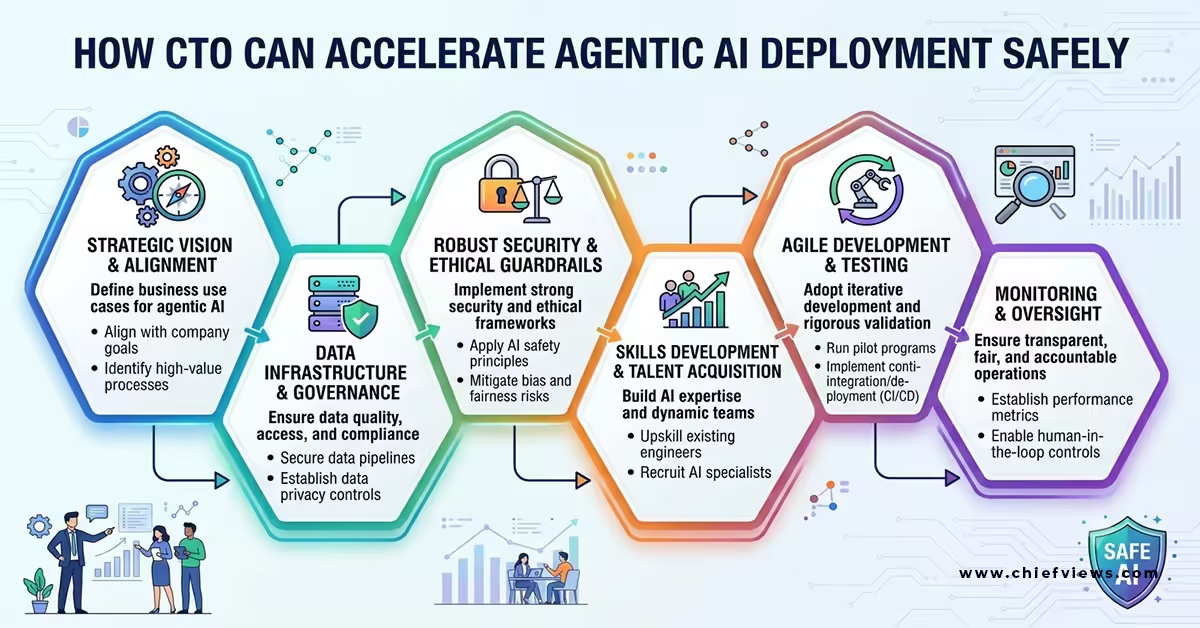
How CTO can accelerate agentic AI deployment safely starts with treating agents like non-human employees who need clear job descriptions, limited keys, and a kill switch—not as magic that somehow self-governs.
Here’s the quick overview most CTOs need right now:
- Agentic AI moves beyond chatbots. These systems plan, call tools, and take multi-step actions with limited human input.
- Speed without guardrails creates fast, expensive messes: unowned agents, privilege creep, and decisions nobody can reconstruct later.
- The winning pattern in 2026 is graduated autonomy—shadow mode first, then supervised, then limited production—paired with identity, inventory, and circuit breakers.
- CTOs who treat governance as architecture (not a policy document) ship faster and survive audits.
- The real accelerator is reuse: one solid control plane lets every new agent inherit the same boundaries instead of reinventing them.
In my experience working with engineering leaders who actually ship these systems, the ones who move quickest share one habit. They refuse to let pilots live outside the same identity, logging, and approval rails that production will demand. Everything else is theater.
Why Most Agentic Rollouts Stall (and How CTOs Break Through)
Agentic systems change the blast radius. A traditional model answers a question. An agent can open tickets, update records, trigger deployments, or email customers. That power is the point. It is also why many programs freeze after the first impressive demo.
What usually happens is simple. Teams build cool agents in sandboxes. They skip formal ownership. Permissions drift. Logging is incomplete. When the first real incident hits—or the auditor asks “who authorized that action?”—everything stops. The CTO then spends months rebuilding trust that never had to be lost.
The fix is architectural, not cultural pep talks. You treat every agent as a first-class digital worker with its own identity, scoped credentials, written autonomy boundary, and named human owner. That single decision removes most of the later drama.



How CTO can accelerate agentic AI deployment safely with a practical 90-day action plan
Here is the sequence I recommend when a CTO asks me where to begin. It works for both beginners and teams that already have a few agents floating around.
- Inventory everything that already acts like an agent.
Pull from identity providers, API keys, SaaS admin consoles, and AI gateway logs. You cannot govern what you cannot see. Many organizations discover shadow agents they never approved. - Pick one high-volume, low-risk workflow.
Service desk triage, invoice matching, or internal knowledge retrieval are common starters. Score candidates on volume, data readiness, and reversibility. Avoid anything that touches regulated decisions or irreversible money movement in the first wave. - Define the autonomy boundary in writing before any code runs.
What can the agent decide alone? What requires human approval? What is hard-blocked? Include confidence thresholds, dollar limits, and data categories. Make it short enough that a new engineer understands it in five minutes. - Give the agent its own identity and least-privilege access.
Short-lived credentials. Separate read from write. Tool access limited to the exact functions required. Zero trust is non-negotiable here. - Build observability and a kill switch into the first version.
Log every tool call, intermediate decision, and outcome. Design the off switch and test it. Teams that add logging after the first incident are doing forensics without evidence. - Run shadow mode, then limited production.
Let the agent propose actions while humans still execute them. Measure against the original baseline. Only then allow limited autonomous execution with human checkpoints on higher-risk steps. - Extract the reusable platform pieces.
Agent registry, identity service, policy gateway, cost tracking, and review capacity. New agents inherit the controls instead of reinventing them. This is how you actually accelerate.
This sequence keeps the first pilot small enough to control while building the muscle that lets the second and third agents move faster.
The Control Stack That Actually Matters
Not every control is equal. Focus first on the ones that shrink blast radius.
| Control | What It Does | Why It Accelerates Safe Deployment |
|---|---|---|
| Unique agent identity | Distinct non-human identity with short-lived credentials | Stops shared-key nightmares and makes audit trails usable |
| Written autonomy tiers | Explicit levels: shadow → supervised → guided → full (rare) | Removes ambiguity; teams know when to escalate |
| Least-privilege tool access | Scoped permissions, separate read/write, blocked high-risk actions | Contains damage even if the agent is compromised or hallucinates |
| Full action logging | Every tool call, decision branch, and outcome recorded | Enables reconstruction and continuous improvement |
| Human checkpoints by risk | Approval required for irreversible or high-impact steps | Keeps people in the loop where it actually matters |
| Kill switch + rollback | Immediate stop and tested recovery path | Turns potential disasters into recoverable incidents |
These six form the minimum viable control plane. Everything else can layer on later.
For a recognized foundation, many U.S. teams anchor their program in the NIST AI Risk Management Framework. It gives boards and auditors a common language without forcing you to invent one from scratch.
Common Mistakes & How to Fix Them
Mistake 1: Treating the pilot as “just a experiment.”
Pilots that live outside production controls almost never graduate cleanly. Fix: force every pilot to use the same identity, logging, and approval rails from day one. The extra week of setup pays for itself immediately.
Mistake 2: Giving agents broad credentials “for convenience.”
Convenience is the enemy of containment. Fix: start with the absolute minimum permissions and expand only when measured value justifies the added risk.
Mistake 3: Measuring success by number of agents launched.
Volume without outcomes is vanity. Fix: track cycle-time reduction, exception rates, human effort saved, and incident rate relative to the original baseline. If those numbers do not improve, pause and redesign.
Mistake 4: Leaving ownership fuzzy.
“The AI team owns it” is not ownership. Fix: every agent needs a named business owner and a technical owner. No owner, no production.
Mistake 5: Waiting for perfect data before starting.
Agents need trustworthy data more than perfect data. Fix: start with the cleanest, highest-value data slice you already have. Expand the data perimeter only after the control plane is proven.
McKinsey’s work on scaling agentic systems repeatedly shows that programs which redesign the workflow first and then apply agents outperform those that simply bolt agents onto unbroken processes. The difference shows up in both speed and value realized.
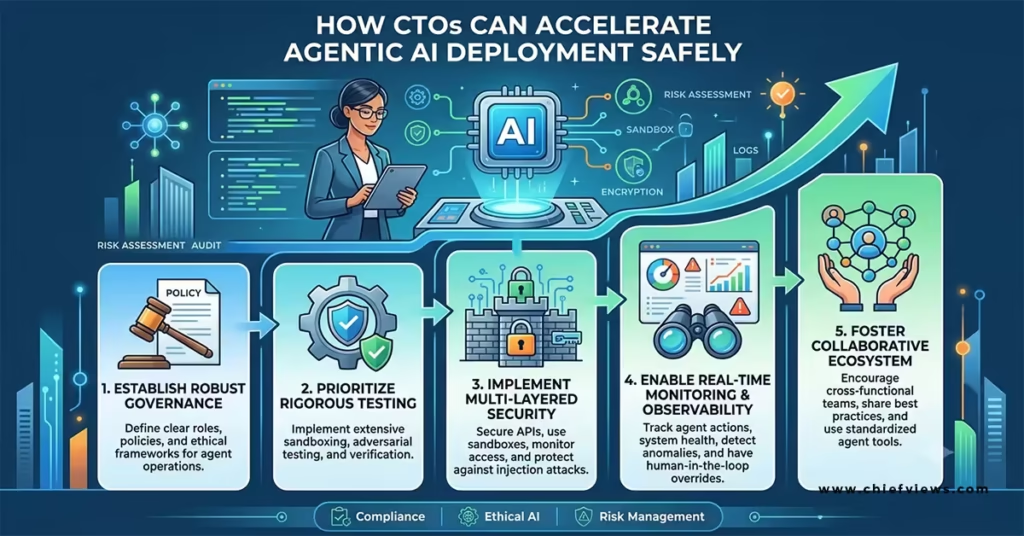
How CTO can accelerate agentic AI deployment safely through platform thinking
Once the first workflow is stable, the real acceleration begins. Stop building one-off agents. Start building a thin platform that every new agent plugs into:
- Central agent registry with ownership and risk tier
- Shared identity and credential service
- Policy gateway that enforces autonomy boundaries
- Observability and cost instrumentation per workflow
- Review capacity that scales with agent output
This is the difference between linear progress and compounding progress. New agents inherit the hard-won controls. Teams stop debating the same governance questions every time. Delivery velocity rises while residual risk stays bounded.
Oliver Wyman’s recent guidance for CIOs and CTOs lands in the same place: the agentic platform is not a separate product you buy. It is six capabilities your internal developer platform must add. Teams that treat it that way move from pilot to scale without the usual governance crisis.
The Leadership Moves That Keep Momentum
Technical controls are necessary but not sufficient. Three leadership habits separate the CTOs who accelerate from those who stall:
- Fund the temporary productivity dip. Teams need time to redesign processes and learn the tools. Pretending that dip does not exist just creates quiet resistance.
- Engage middle management early. They own the workflows the agents will change. Leave them out and you get passive obstruction.
- Make the CEO the sponsor of the control plane, not just the innovation story. When the board asks about risk, the CEO should already know the answer.
Agentic AI is less like adding a new tool and more like onboarding a high-volume contractor who never sleeps. You would never hand a human contractor the master keys and walk away. Do not do it with agents either.
Key Takeaways
- Start with inventory and one constrained workflow. Prove the control plane before you scale.
- Every agent needs a unique identity, written autonomy boundary, least-privilege access, and a named owner.
- Build observability and a tested kill switch into version one.
- Measure business outcomes (cycle time, exceptions, effort) more than agent count.
- Extract reusable platform capabilities early so later agents inherit the guardrails.
- Treat governance as architecture, not a policy binder that sits on a shelf.
- Graduated autonomy (shadow → supervised → limited production) is the fastest safe path.
- The organizations that win in 2026 will be the ones that can reconstruct any agent decision and still move faster than their peers.
The CTOs who treat agentic AI as a new class of worker with clear boundaries, identity, and accountability are already pulling ahead. The ones still treating it as a clever chatbot experiment are about to discover how expensive “move fast and hope” becomes when the agents can act.
Your next step is straightforward. Pull the inventory of everything that currently acts with any degree of autonomy. Pick the single highest-volume, lowest-risk workflow. Write the autonomy boundary for that workflow this week. Everything else builds from there.
FAQs
How can a CTO accelerate agentic AI deployment safely without slowing every team down?
By making the control plane reusable. Once identity, logging, policy enforcement, and kill switches exist as shared services, new agents plug in instead of negotiating governance from scratch. The first agent takes longer. The fifth moves much faster.
What is the biggest risk when CTOs try to accelerate agentic AI deployment safely?
Unowned agents with overly broad permissions. Without a live inventory and least-privilege access, you get silent privilege creep and decisions that cannot be reconstructed later. Both destroy trust faster than any model hallucination.
Where should a beginner CTO start if they want to accelerate agentic AI deployment safely in 2026?
Inventory existing agents, choose one high-volume low-risk workflow, write the autonomy boundary, give the agent its own identity, and run it in shadow mode with full logging. Do not expand scope until the numbers prove value and the controls prove reliable.
