








CIO role in enterprise digital resilience has shifted from “keep the lights on” to “keep the business running when the lights go dark.” In 2026, boards no longer ask how fast you can restore servers. They ask whether critical operations stay functional while attackers, AI-driven failures, or supply-chain shocks hit. Digital resilience is the ability to anticipate disruption, absorb impact, recover with confidence, and adapt without losing customers or trust.
Here’s the quick view of what matters:
- The CIO owns technology continuity and recovery of digital operations.
- Success means protecting live business state, not just backups.
- Close partnership with the CISO turns security into shared operational capability.
- Testing and dependency mapping separate resilient organizations from those that only look good on paper.
- Boards now measure CIOs on business outcomes during disruption, not uptime percentages alone.
In my experience working with U.S. mid-market and enterprise teams, the organizations that treat resilience as a pure IT checklist usually discover the hard way that their recovery plans assume a clean environment that no longer exists after a real incident.
Why the CIO Role in Enterprise Digital Resilience Matters More in 2026
Threat actors weaponize AI. Legacy systems sit next to agentic workflows. Third-party SaaS platforms hold pieces of your critical path. A single compromised identity or corrupted data set can cascade. Recovery speed is still important. Trust in what you recover is now decisive.
What usually happens is this: teams restore systems quickly, then spend days verifying whether the restored state is clean. Customers notice the gap. Regulators notice the gap. The board notices the gap. The CIO who can answer “how do we know this is good?” before the incident starts becomes the person the CEO leans on when everything is on fire.
Gartner and industry leaders have been clear that the CIO role itself is transforming. CEOs want one leader who owns technology, data, and digital outcomes. Resilience sits squarely in that expanded mandate.



Core Responsibilities That Define the CIO Role in Enterprise Digital Resilience
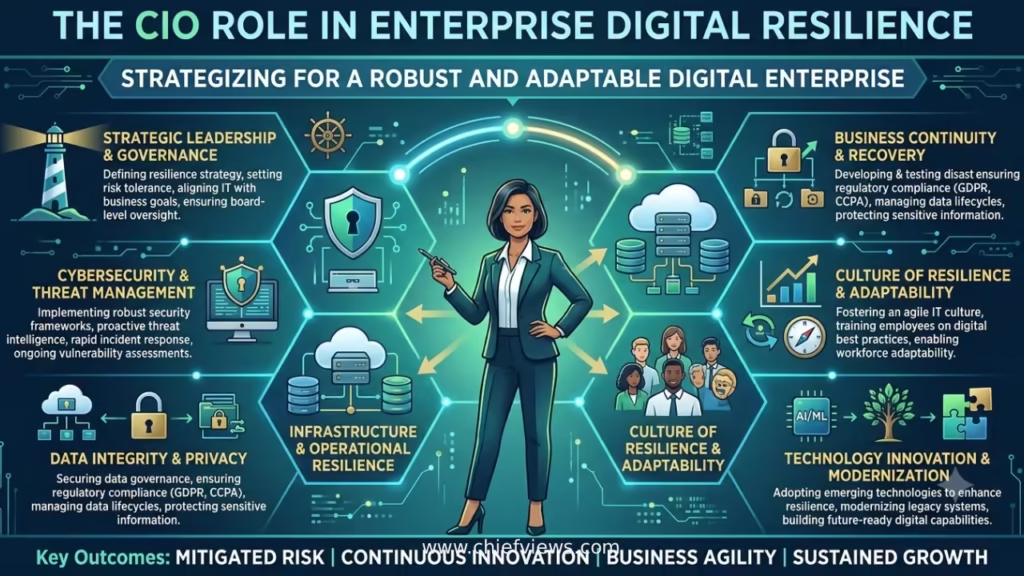
Think of digital resilience as four connected disciplines the CIO must drive:
- Anticipate – Map critical business services to the technology, identities, data, and third parties they depend on. Know the minimum viable company.
- Withstand – Design for graceful degradation. Redundancy, isolation, and real-time visibility matter more than perfect prevention.
- Recover – Restore trusted state, not just availability. That requires continuous understanding of what “good” looks like for systems, identities, and data.
- Adapt – Turn every incident into stronger architecture and clearer decision rights.
The kicker is ownership. In most U.S. organizations the CIO owns digital and technology resilience while the CISO owns cyber risk management. Shared execution, clear decision rights. When that line is fuzzy, response slows.
Comparison of Traditional IT Continuity vs. Modern Digital Resilience
| Aspect | Traditional IT Continuity | 2026 Digital Resilience Approach |
|---|---|---|
| Primary Goal | Restore systems after outage | Keep critical business services running through disruption |
| Focus | Infrastructure and data recovery | Live operational state + trusted recovery |
| Success Metric | Recovery Time Objective (RTO) | Business impact minimized + verified clean state |
| Key Partner | Operations teams | CISO + business owners + legal |
| Testing Cadence | Annual DR drills | Continuous dependency mapping + frequent game days |
| AI Consideration | Limited | Explicit defense against AI-driven attacks and AI system failures |
CIO Role in Enterprise Digital Resilience This table reflects the practical shift I see across enterprises that have moved past checkbox compliance.
Step-by-Step Action Plan for Building Digital Resilience
If I were walking into a new CIO seat tomorrow, here is exactly what I would do in the first 90 days.
Step 1: Identify the minimum viable company.
Sit with business leaders and name the five to seven services that must stay alive or recover first. Map every technology dependency, identity, data set, and third party behind those services. Document single points of failure without sugarcoating.
Step 2: Establish clear decision rights.
Write a simple RASCI for major disruption scenarios. Who declares an incident? Who decides to isolate a region or kill a compromised identity? Who signs off that a restored environment is trusted enough for production? Get the CEO and board aligned on this before the next tabletop.
Step 3: Make “what good looks like” continuous.
Invest in configuration integrity, identity hygiene, and dependency visibility that runs every day, not just during recovery. You cannot verify a restored state if you never defined the trusted baseline.
Step 4: Test under realistic pressure.
Run game-day exercises that include compromised management planes, AI-generated phishing at scale, and third-party outages. Measure time to trusted recovery, not just time to restore.
Step 5: Close the CIO-CISO operating gap.
Joint risk prioritization. Shared metrics. Security recommendations that translate directly into infrastructure and application changes with clear owners and timelines.
Step 6: Tie spending to business outcomes.
When you ask for budget, show the board the services protected and the residual risk reduced. Speak in revenue impact and customer trust language.
Common Mistakes & How to Fix Them
Mistake 1: Treating resilience as a CISO-only problem.
Fix: Own the technology recovery and operational continuity side explicitly. Partner tightly. Joint ownership of outcomes.
Mistake 2: Recovering systems without verifying integrity.
Fix: Build continuous baselines for critical configurations, identities, and data. Practice the verification step until it is muscle memory.
Mistake 3: Annual tabletop exercises that feel like theater.
Fix: Move to frequent, scenario-based game days that include real technical teams and decision makers under time pressure.
Mistake 4: Ignoring third-party and supply-chain dependencies.
Fix: Include key vendors in your dependency maps and recovery playbooks. Contract for resilience expectations where possible.
Mistake 5: Measuring only technical metrics.
Fix: Add business service impact and time-to-trusted-state to every post-incident review.
Practical Advice from the Trenches
CIO Role in Enterprise Digital Resilience In my experience, the organizations that handle real incidents best already know their critical service map cold. They have practiced isolation decisions. They have pre-agreed communication language for customers and regulators. They treat resilience as an operating discipline, not a project with an end date.
What I’d do if I saw a board asking only for “cybersecurity maturity scores” is gently reframe the conversation around business continuity outcomes. Scores are useful. They are not the point.
For deeper reading on structured approaches, review the Gartner guidance on cybersecurity for CIOs and Deloitte’s perspective on proactive technology resilience. The NIST Cybersecurity Framework remains a solid foundational reference for mapping controls to outcomes.
Key Takeaways
- The CIO role in enterprise digital resilience centers on keeping critical business services functional through disruption.
- Trusted recovery matters more than fast recovery when environments can be corrupted.
- Clear decision rights and continuous dependency visibility separate prepared teams from reactive ones.
- CIO-CISO collaboration is non-negotiable in the AI era.
- Test like the real thing will happen, because it will.
- Speak to the board in business impact language, not technical jargon.
- Resilience is an ongoing operating model, not a one-time project.
CIO Role in Enterprise Digital Resilience The organizations that treat digital resilience as a core CIO accountability will protect customer trust and competitive position when others are still restoring servers and hoping for the best. Start with the critical service map. Get the decision rights on paper. Then test until the team can move with confidence under pressure. That is the practical path most U.S. enterprises still need in 2026.
FAQs
What is the primary difference in the CIO role in enterprise digital resilience versus traditional IT recovery?
Traditional recovery focuses on restoring infrastructure and data. Modern digital resilience prioritizes keeping critical business services operational and verifying that the recovered environment is trusted and free of compromise.
How should a CIO measure success in the CIO role in enterprise digital resilience?
Track time to trusted recovery for priority services, residual business impact during incidents, and the percentage of critical dependencies that have been mapped and tested within the last 90 days.
Does the CIO own cyber risk or does the CISO?
In most effective U.S. models the CISO owns cyber risk management and threat response. The CIO owns technology continuity, recovery of digital operations, and ensuring systems support business resilience. Shared outcomes and clear decision rights make the partnership work.

