









CIO strategies for sovereign AI and data control start with one hard truth: if you can’t walk away from a model, a cloud region, or a vendor tomorrow, you don’t own the intelligence that runs your business.
CIO strategies for sovereign AI and data control start with one hard truth: if you can’t walk away from a model, a cloud region, or a vendor tomorrow, you don’t own the intelligence that runs your business.
Here’s the quick view of what matters right now:
- Sovereign AI means architectural control over data location, model weights, inference paths, keys, and governance—not just “data stays in the US.”
- CIOs who treat it as selective and workload-based keep innovation speed while cutting lock-in risk.
- The payoff shows up in faster agentic deployments, cleaner audits, and the ability to swap providers without rewriting half the stack.
- Beginners win by classifying workloads first, then building portability into the data layer.
- The biggest failure mode is still treating sovereignty as a compliance checklist instead of a design constraint.
In my experience working with US enterprise teams through 2025 and into 2026, the conversation shifted from “where does the data live” to “who decides what the AI does with it, and can we prove it.” Geopolitics, state-level AI rules, and vendor pricing changes made pure public-cloud convenience look expensive. The winners built optionality on purpose.
Why CIO Strategies for Sovereign AI and Data Control Became Non-Negotiable
Data residency used to be enough. Not anymore. Agentic systems move data, call tools, and chain models. A single prompt can pull proprietary context into a third-party environment before anyone notices. Add California’s frontier model transparency rules, emerging state automated-decision laws, and federal procurement clauses that lock down government data use in LLMs, and the old “trust the contract” approach starts leaking.
What usually happens is this: a business unit spins up a high-value use case on the latest frontier model. Six months later the contract terms change, the model weights sit outside your legal reach, or an auditor asks for the full lineage of training signals and inference logs. Suddenly the CIO is explaining why the organization can’t move the workload without a multi-month rebuild.

Sovereign AI flips that script. It treats control as a property of the architecture: you keep the data foundation, the policy engine, and the exit ramps under your authority even when you consume best-of-breed models.
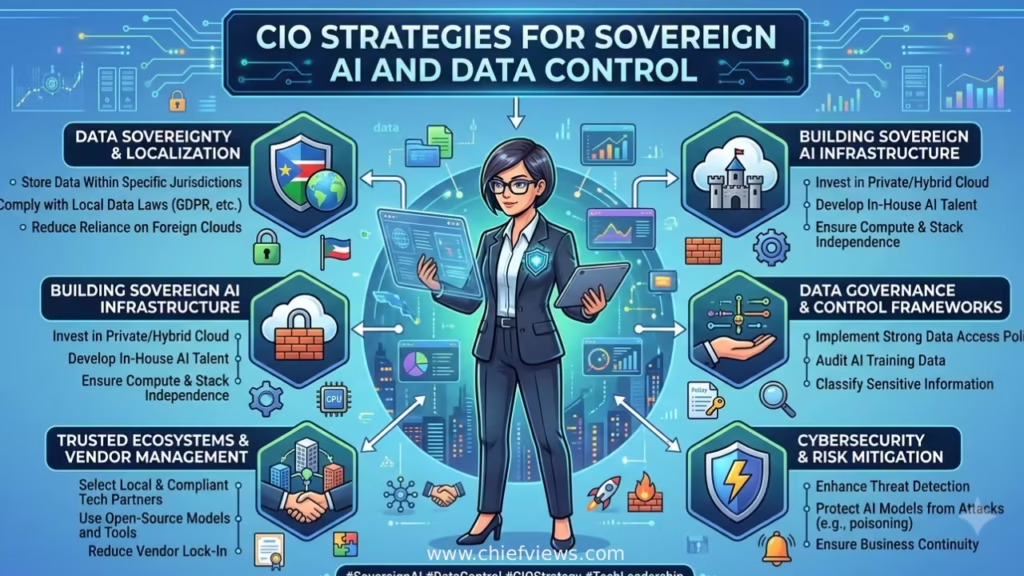
Core Pillars of Effective CIO Strategies for Sovereign AI and Data Control
Four layers keep showing up in solid programs:
- Data control – Classification, residency, encryption keys you hold, and pipelines that never force sensitive data into multi-tenant training sets.
- Model and inference control – Ability to run open-weight or private models where needed, swap providers, and keep fine-tunes and embeddings portable.
- Operational control – Identity for both humans and agents, audit trails that survive vendor changes, and the ability to pause or redirect workloads.
- Governance that travels – Policies enforced at runtime, not in a slide deck. Rules move with the data and the agents.
Think of it like owning the property line instead of renting every building on the lot. The tenant (model or cloud) can change. The ground rules stay yours.
Comparison of Deployment Approaches for Sovereign AI
| Approach | Data Residency Strength | Model Portability | Typical Cost Profile | Best Fit | Main Trade-off |
|---|---|---|---|---|---|
| Full on-prem / private AI factory | Highest | Highest (open weights) | High CapEx, predictable OpEx | Highly regulated or IP-heavy workloads | Slower access to frontier models |
| Hyperscaler sovereign / dedicated zones | High (contractual + technical isolation) | Medium | Medium-high OpEx | Most enterprise regulated data | Still some shared control plane risk |
| Hybrid with governed data layer | High for sensitive tiers | High if designed right | Balanced | Majority of US mid-to-large enterprises | Requires disciplined classification |
| Pure public multi-tenant | Lowest | Low without extra work | Lowest short-term | Non-sensitive experimentation | Highest lock-in and leakage risk |
Selective sovereignty beats absolute isolation for most organizations. Classify workloads by risk and strategic value, then apply the right tier.
Step-by-Step Action Plan for Beginners
If you’re starting from a typical hybrid cloud and scattered AI pilots, here’s the practical sequence I’d run:
- Inventory and classify in 30 days. Map every data set and AI workload. Tag by sensitivity, regulatory exposure (HIPAA, state privacy, IP), and business criticality. You cannot protect what you haven’t labeled.
- Anchor governance in the data layer. Put policy, access control, lineage, and masking where the data lives—not bolted onto each model. This is the single highest-leverage move.
- Establish portability requirements. Every new AI contract or internal platform must prove you can export embeddings, fine-tunes, and agent configs. Test the exit path once a year.
- Stand up a controlled inference path for crown-jewel data. Bring the model to the data for high-risk use cases. Open-weight models in a VPC or private environment work well here.
- Extend identity and logging to agents. Treat every agent as a non-human identity with scoped permissions. Log actions so you can answer “what happened” without scrambling.
- Review the stack quarterly. Technology moves fast. Re-check residency claims, key ownership, and whether a new model family broke your portability assumptions.
What I’d do if I walked into a mid-size US company tomorrow: freeze net-new ungoverned AI spend for two weeks, run the classification exercise with legal and the business owners in the room, then fund the data-layer controls first. Everything else becomes easier.
Common Mistakes & How to Fix Them
Mistake 1: Treating sovereignty as pure residency.
Fix: Expand the definition to include who holds the keys, who can change the model, and whether you can move the workload. Geography is table stakes.
Mistake 2: Building one-size-fits-all controls.
Fix: Use risk tiers. Not every chatbot needs the same isolation as clinical decision support or proprietary R&D models.
Mistake 3: Letting procurement own the contracts alone.
Fix: Put architecture and security at the table. Contracts that look fine on paper often hide operational dependencies.
Mistake 4: Ignoring agent behavior.
Fix: Agents act. Define explicit allow/deny lists for data movement, tool use, and model hand-offs before they go live.
Mistake 5: Waiting for perfect regulations.
Fix: US rules are still fragmented across states and federal procurement. Design for the strictest current requirements that apply to your data and update as new laws land.
Practical Reality Check for US CIOs in 2026
CIO strategies for sovereign AI and data control Boards now ask about AI dependency the same way they once asked about single-cloud risk. Organizations that already treat the data foundation as sovereign report higher production rates for agentic and generative workloads. The ones still treating AI as a collection of point solutions keep rediscovering the same control gaps.
You do not need to rebuild everything. You need clear ownership of the parts that matter most to your risk profile and competitive edge. Open-weight models, policy-as-code, and hybrid orchestration make selective sovereignty achievable without sacrificing speed.
Key Takeaways
- Sovereign AI is architectural control across data, models, operations, and governance—not just location.
- Start with workload classification; apply controls proportionally.
- Put governance and portability in the data layer so models can change without rewriting the foundation.
- Test exit paths the same way you test disaster recovery.
- Treat agents as identities with enforceable boundaries.
- Selective, risk-based sovereignty beats isolation for most US enterprises.
- Review the stack regularly—technology and regulation both move.
CIO strategies for sovereign AI and data control The organizations that treat CIO strategies for sovereign AI and data control as a permanent design constraint keep the ability to innovate on their own terms. The ones that treat it as a one-time project eventually discover they have outsourced the intelligence that differentiates them.
Start this quarter with the inventory and classification. Everything else builds from there. Once the data layer is under real control, the rest of the stack becomes a set of choices instead of a set of dependencies.
FAQs
What do effective CIO strategies for sovereign AI and data control actually require beyond data residency?
They require ownership of model portability, encryption keys, runtime policy enforcement, agent identity, and the ability to move or pause workloads without major re-architecture.
How should a mid-size US company prioritize CIO strategies for sovereign AI and data control with limited budget?
Classify workloads first. Apply full controls only to high-risk and high-value data. Use open-weight models and existing hybrid infrastructure for the rest while you strengthen the shared data foundation.
Are CIO strategies for sovereign AI and data control mainly a compliance exercise in 2026?
No. Compliance is the floor. The real value is strategic flexibility—being able to change models, providers, or regions when the market, the law, or the business requires it.
