





Agentic AI use cases by industry are exploding as these autonomous systems move from pilots to production. Unlike basic chatbots, agentic AI plans, reasons through options, takes action, and learns from outcomes—all while staying within defined guardrails.
In 2026, smart organizations aren’t asking if but where to deploy them for maximum impact. Finance, healthcare, retail, manufacturing, and supply chain lead the charge, delivering faster decisions, lower costs, and happier customers.
Here’s the no-BS breakdown of what’s actually working right now.
- Finance: Real-time fraud fighting and automated reconciliation that slashes manual work.
- Healthcare: Patient monitoring agents and streamlined administrative workflows.
- Retail & E-commerce: Dynamic pricing, personalized shopping agents, and inventory optimization.
- Manufacturing & Supply Chain: Predictive maintenance and autonomous logistics rerouting.
- IT & Operations: Ticket triage and self-healing systems that resolve issues before they escalate.
The link back? These use cases only deliver when you know how CIOs can implement agentic AI for business value in 2026. Execution beats experimentation every time.
Finance: Where Agentic AI Makes Money Move Faster
Financial services lead adoption for good reason. Agents handle high-volume, rule-heavy processes with speed and precision.
They monitor transactions in real time, spot anomalies, investigate patterns, and block threats or flag them for review. One agent pulls KYC data, another cross-checks against regulations, and a third updates records.


Contract review cycles drop by up to 50%. FP&A agents continuously forecast, flag variances, and draft reports. Underwriting and claims processing in insurance become semi-autonomous, with agents gathering docs, assessing risk, and routing exceptions.
What usually happens is compliance teams breathe easier while revenue teams chase bigger opportunities. Early movers report massive gains in processing speed and risk reduction.
Healthcare: Agents That Support Care, Not Replace It
Healthcare agents tackle the crushing administrative load so clinicians can focus on patients.
Continuous monitoring agents track vitals, lab results, and device data to predict risks like sepsis and alert teams early. Scheduling agents optimize staff and OR time. Claims agents verify eligibility, chase documentation, and reduce denials.
Drug discovery teams use multi-agent systems to parse literature, simulate compounds, and accelerate timelines. Hospitals deploy workflow agents for intake, documentation, and discharge coordination.
The human element stays central—agents augment expertise where lives are on the line. ROI shows up in lower burnout, fewer errors, and better resource use.
Retail and E-commerce: Personalization at Scale
Retail agents turn data into action.
Personalized shopping agents handle recommendations, answer questions, manage carts, and even complete purchases with customer approval. Inventory agents monitor stock across locations, predict demand shifts, and trigger reorders. Dynamic pricing agents adjust in real time based on competitor moves, demand, and inventory.
Supply chain agents in retail reroute shipments during disruptions. Customer service agents resolve issues end-to-end—refunds, exchanges, returns—without constant human escalation.
Result? Higher conversion rates, lower cart abandonment, and leaner operations during peak seasons.
Manufacturing and Supply Chain: Resilience in Motion
This sector loves agentic AI for its ability to handle complexity and uncertainty.
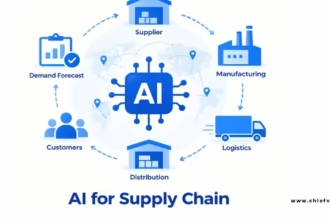
Predictive maintenance agents analyze sensor data, schedule repairs, order parts, and update production plans. Supply chain agents monitor global events, weather, geopolitics, and supplier performance—then autonomously adjust routes, book carriers, or source alternatives.
Production agents optimize workflows, manage quality checks, and coordinate with robotics. Toyota and others use them for better ETA visibility and issue resolution.
Downtime drops. Inventory turns faster. Resilience improves when disruptions hit.
Table: Agentic AI Impact by Industry (2026 Benchmarks)
| Industry | Top Use Case | Typical Gains | Key Challenge | ROI Timeline |
|---|---|---|---|---|
| Finance | Fraud & Reconciliation | 40-60% faster processing | Regulatory compliance | 3-6 months |
| Healthcare | Patient Monitoring & Admin | Reduced denials by 30-40% | Data privacy & integration | 6-9 months |
| Retail | Personalization & Inventory | 20-30% better conversion | Seasonality & competition | 2-4 months |
| Manufacturing | Predictive Maintenance | 15-30% less downtime | Legacy equipment | 4-8 months |
| Supply Chain | Autonomous Rerouting | Faster response to shocks | Multi-party coordination | 3-7 months |

IT Operations and Cross-Industry Wins
IT teams use agents for ticket triage, troubleshooting, patch management, and knowledge synthesis. One agent diagnoses, another executes fixes within policy, and a coordinator reports outcomes.
HR agents handle onboarding, benefits queries, and talent matching. Sales agents prospect, qualify, personalize outreach, and update CRMs. Legal and compliance agents review documents and track regulatory changes.
Common Pitfalls Across Industries
- Starting too big instead of narrow, high-pain processes.
- Weak governance leading to uncontrolled actions.
- Poor data foundations that starve agents of quality inputs.
- Underestimating change management—teams need training on collaboration.
Fix them by piloting tightly, measuring relentlessly, and scaling what works. Governance isn’t optional; it’s what lets you expand safely.
Why Industry-Specific Matters in 2026
General-purpose agents disappoint in specialized domains. Vertical agents trained on industry data, regulations, and workflows outperform every time. Finance agents understand SOX. Healthcare agents respect HIPAA. Manufacturing agents speak PLC and ERP languages.
Gartner notes 40% of enterprise apps will feature task-specific agents by end of 2026. The winners pick processes with clear goals, repeatable steps, and high volume.
Key Takeaways
- Finance leads with compliance and transaction agents.
- Healthcare gains from admin relief and monitoring.
- Retail wins on personalization and inventory agility.
- Manufacturing and supply chain build real resilience.
- Success requires strong data, governance, and human oversight.
- Start narrow, prove value, then orchestrate multi-agent teams.
- Industry context beats generic tools.
- Measure business outcomes—cost, speed, revenue—not just tech metrics.
Agentic AI use cases by industry prove one thing in 2026: the technology works when applied to the right problems with discipline. The gap between leaders and laggards is widening fast.
Ready to act? Review your top three operational headaches. Map them against these use cases. Then dive deeper into how CIOs can implement agentic AI for business value in 2026 for the full execution playbook.
FAQs
What industries are seeing the fastest ROI from agentic AI in 2026?
Finance, retail, and supply chain often see wins in 3-6 months on focused deployments like fraud detection, inventory optimization, and logistics rerouting. Healthcare follows closely once governance is solid.
How do agentic AI use cases differ between manufacturing and retail?
Manufacturing focuses on predictive maintenance, production coordination, and physical process optimization. Retail emphasizes customer-facing personalization, dynamic pricing, and demand-driven inventory—different data sources and decision speeds.
Can mid-sized companies compete with enterprise players on agentic AI use cases?
Absolutely. Cloud platforms and pre-built vertical agents lower the barrier. Start with one high-pain process like invoice processing or customer support. Many SMEs achieve strong results faster by avoiding legacy integration headaches.