



AI talent upskilling strategies for enterprises separate organizations that capture real ROI from those stuck in endless pilots. In 2026, the gap isn’t just about buying better models. It’s about turning your existing workforce into confident AI collaborators who drive measurable business impact.
Leaders who get this right see dramatic results. Companies with mature upskilling programs report twice the likelihood of strong AI returns. The ones that don’t? They watch talent walk or waste millions on tools nobody uses effectively.
- Targeted skill building: Focus on high-impact roles first instead of generic training.
- Learning in the flow of work: Embed practice into daily tasks, not just workshops.
- Human-AI hybrid teams: Redesign roles around augmentation, not replacement.
- Continuous measurement: Track productivity, retention, and business outcomes.
- Leadership alignment: Tie upskilling directly to CEO priorities on transformation.
These approaches work because they treat people as the multiplier, not the bottleneck.
Why AI Talent Upskilling Strategies Matter for Enterprises in 2026
AI adoption surged, yet only about 21% of leaders report significant positive ROI. The difference? Workforce capability.
BCG notes that 50-55% of US jobs will be reshaped by AI in the next few years. Upskilling isn’t optional—it’s how you protect institutional knowledge while unlocking new value.
AI Talent Upskilling Strategies for Enterprises Here’s the thing: Hiring external AI stars is expensive and slow. Internal development delivers faster results and higher retention. AI-skilled workers command wage premiums, but upskilling your current teams costs far less than competing in the talent market.
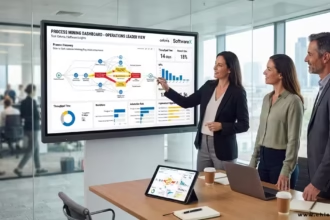
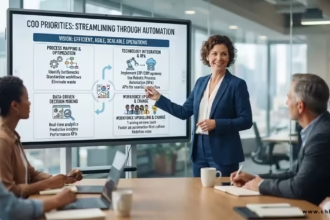
What would I do as a CHRO or L&D leader right now? Audit skill gaps tied to your top three AI use cases, then build programs that deliver wins within 60-90 days.
Proven AI Talent Upskilling Strategies for Enterprises
Start with Skills Assessment and Prioritization
Skip blanket training. Map current capabilities against business priorities. Focus first on roles with the highest volume of AI-augmentable tasks—like operations, customer service, marketing, and sales.
Use AI-powered tools for real-time skills intelligence. Move beyond annual reviews to dynamic gap analysis.
Build Personalized, Always-On Learning Pathways
One-size-fits-all programs fail. Top performers use AI to personalize learning—adapting content, pace, and difficulty to each employee.
Embed learning into workflows. Short, practical modules. Immediate application on real projects. This beats passive videos every time.
| Strategy | Key Features | Best For | Typical Impact |
|---|---|---|---|
| Personalized AI Learning | Adaptive paths, real-time feedback | All levels | 2-3x higher completion & adoption |
| Hands-On Project-Based | Sandbox environments, job-specific challenges | Intermediate users | Faster skill application |
| Mentoring & Peer Networks | AI-fluent paired with learners | Culture building | Improved retention |
| Role Redesign Programs | Hybrid human-AI team structures | Enterprise scale | 30-80% productivity gains in workflows |
| Certification + Badging | Recognized credentials | Talent attraction & mobility | Clear career pathways |
Leverage “Build, Buy, Borrow, Bot” Models
Don’t rely on one approach. Combine internal upskilling with strategic hiring, partnerships, and AI agents handling routine work.
Rhetorical question: Why fight for scarce AI engineers when you can multiply the effectiveness of your existing 500-person team?
Integrate with CEO Leadership Skills for AI Transformation and Talent Development 2026
Strong upskilling programs don’t live in HR isolation. They connect directly to executive vision. CEOs who treat talent development as a core leadership skill see better alignment, faster scaling, and sustained competitive edge. Link every initiative back to business outcomes your CEO cares about—revenue, efficiency, innovation speed.
Measure What Matters
Track leading indicators (adoption, confidence scores) and lagging ones (productivity lifts, cycle time reduction, retention). Organizations with strong programs often see ROI in the thousands of percent on time savings alone.

Step-by-Step Action Plan for Enterprises
- Audit and Align (Weeks 1-4): Assess current AI readiness. Prioritize 2-3 high-ROI use cases. Get executive buy-in.
- Design Targeted Programs (Months 1-2): Create role-specific pathways. Mix mandatory basics with advanced tracks.
- Launch Pilots (Months 2-4): Start with enthusiastic departments. Use real projects. Gather feedback fast.
- Scale with Support (Months 4-9): Roll out enterprise-wide. Add mentoring, communities of practice, and incentives.
- Embed and Iterate (Ongoing): Make learning continuous. Redesign roles. Update programs quarterly as AI evolves.
- Celebrate and Certify: Recognize achievements. Create internal mobility paths for newly skilled talent.
Common Mistakes & How to Fix Them
- Treating upskilling as one-off events. Fix: Build always-on systems embedded in daily work.
- Focusing only on technical skills. Fix: Balance with human strengths—creativity, judgment, ethics.
- No clear measurement. Fix: Define success metrics upfront and review monthly.
- Top-down only. Fix: Involve employees in designing their learning journeys.
- Ignoring change fatigue. Fix: Communicate wins early and often. Tie to career growth.
Making It Stick
Check the World Economic Forum’s resources on workforce transformation for global benchmarks. Review Deloitte’s latest human capital trends for orchestration ideas. For practical ROI frameworks, explore DataCamp’s insights on AI capability building.
Key Takeaways
- AI talent upskilling strategies deliver the highest returns when tied to specific business outcomes.
- Personalization and hands-on practice beat traditional training.
- Role redesign amplifies impact far more than tool access alone.
- Measure relentlessly—productivity and retention tell the real story.
- Leadership commitment from the top accelerates everything.
- Balance technical fluency with irreplaceable human skills.
- Start now with focused pilots rather than waiting for perfect plans.
- Connect upskilling to broader transformation efforts for maximum effect.
Enterprises that master these strategies don’t just adopt AI. They become organizations where people and technology compound each other’s strengths daily.
Your next move? Pick one department and one workflow. Launch a small, measurable upskilling sprint this quarter. Momentum builds fast when results show up.
FAQs
How long does it take to see results from AI talent upskilling strategies for enterprises?
Most organizations notice productivity gains within 60-90 days on targeted pilots, with broader ROI emerging in 6-12 months when scaled properly.
What skills should enterprises prioritize in 2026 AI upskilling programs?
Focus on prompt engineering, AI tool fluency, critical evaluation of outputs, data literacy, and hybrid skills combining domain expertise with AI collaboration.
How do AI talent upskilling strategies connect to CEO Leadership Skills for AI Transformation and Talent Development 2026?
They form the practical execution layer. CEOs who master transformation leadership ensure upskilling delivers enterprise-wide impact rather than isolated HR efforts.