



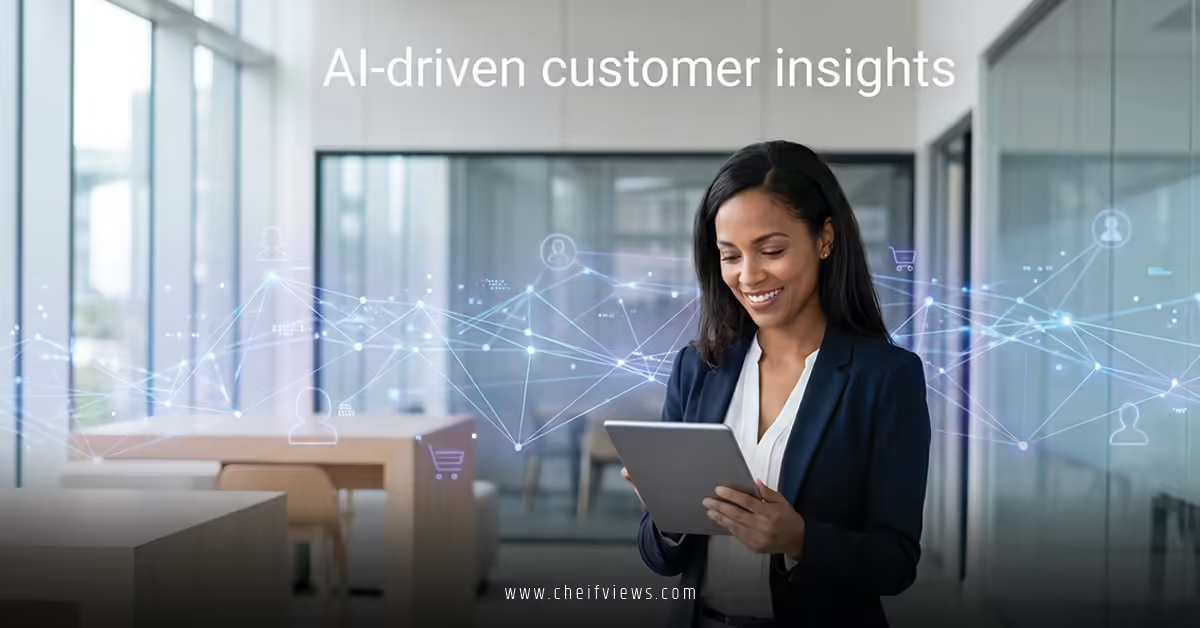
AI-driven customer insights are quietly rewriting how growth teams decide what to build, who to target, and how to speak to buyers. Not next decade. Right now.
Instead of gut feel and a few dashboard snapshots, you can have a constantly updated understanding of what customers want, what they hate, and what actually drives revenue. When you plug that into campaigns, product, and sales plays, things start compounding fast.
Here’s the short version before we go deeper:
- AI-driven customer insights use machine learning and large language models (LLMs) to analyze huge volumes of structured and unstructured customer data.
- They help you uncover patterns in behavior, preferences, and intent that humans alone would miss or take months to find.
- Done right, they sharpen ICP definition, messaging, churn prevention, and personalization across the funnel.
- The strongest setups combine quantitative data (usage, CRM, conversions) with qualitative inputs (calls, chats, reviews) for a full picture.
- They become a growth engine when they feed directly into GTM strategy, product roadmaps, and sales enablement – not just dashboards.
What are AI-driven customer insights, really?
Forget buzzwords for a second.
AI-driven customer insights means using algorithms and models to:
- Collect signals from customer behavior and conversations
- Clean and organize those signals at scale
- Surface patterns, clusters, and anomalies
- Translate them into decisions your teams can act on
That might look like:

- An LLM mining weeks of sales calls to highlight the top objections and desired outcomes.
- A recommendation model predicting which accounts are about to churn based on feature usage trends.
- A clustering algorithm grouping customers by jobs-to-be-done instead of just company size or industry.
- A natural language model summarizing thousands of NPS comments into the five themes leadership should care about.
In my experience, the companies that win don’t just “use AI.” They design an operating model where AI-driven customer insights fuel every big GTM move—and where humans stay firmly in charge of judgment.
Why AI-driven customer insights matter now
A few reasons this isn’t optional anymore:
- Data volume exploded. Between product analytics, CRM, support platforms, and call recordings, most businesses now sit on more customer data than they can reasonably process manually.
- Buyer journeys fragmented. A typical B2B purchase involves multiple stakeholders, channels, and touchpoints. You’ll miss half the story if you only look at form fills and MQLs.
- Expectations changed. Buyers now expect personalization by default—relevant messaging, offers, and timing. Generic blasts don’t cut it.
- Competitive pressure is real. When competitors use AI-driven customer insights to refine their ICP, tighten messaging, and optimize pricing, their acquisition cost drops while yours stays bloated.
Research from firms like McKinsey, BCG, and major cloud providers consistently shows that organizations using advanced analytics and AI in sales and marketing outperform peers on revenue growth and profitability. You don’t need their exact numbers to see the pattern: data-savvy teams win more.
Data sources that power AI-driven customer insights
You don’t need every possible input. You need the right mix of structured and unstructured data that tells a clear story.
High-value structured data
- Product usage and feature adoption
- Billing, renewals, and contract data
- CRM opportunities, stages, and win/loss reasons
- Marketing engagement (email, onsite behavior, ads, webinars)
High-value unstructured data
- Sales and success call transcripts
- Live chat, support tickets, and email threads
- Reviews and community conversations
- Open-text survey and NPS responses
- Social mentions and analyst commentary
The big unlock of AI—especially LLMs—is making sense of the unstructured side. That’s where the real “voice of the customer” lives.
How AI-driven customer insights actually work (without the jargon)
Under the hood, you’ll see a mix of:
- Classification models – tagging conversations with topics, intents, or sentiment.
- Clustering models – grouping customers or behaviors without pre-defined segments.
- Predictive models – estimating churn risk, upsell likelihood, or lead-to-opportunity conversion chances.
- Recommendation systems – suggesting next-best actions, content, or offers based on patterns.
- LLMs and natural language processing (NLP) – summarizing, extracting, and transforming human language at scale.
You don’t have to become a data scientist. Your job as a marketing or revenue leader is to:
- Define the questions.
- Ensure the data is trustworthy and representative.
- Decide how insights translate into GTM, product, and CX changes.
The models are the engine. You still own the steering wheel.
AI-driven customer insights and GTM: the tight connection
Here’s the important link a lot of teams miss.
AI-driven customer insights become exponentially more valuable when they feed a strategic GTM engine, not just reporting. That’s where turning LLM insights into GTM strategy for CMOs comes in: when your LLM-derived patterns become the backbone of ICP shifts, narrative changes, segment plays, and enablement.
Think of the flow like this:
- AI ingests customer data and surfaces patterns.
- LLMs translate those patterns into human-readable insights.
- GTM leaders turn those insights into positioning, campaigns, and sales plays.
- Results from those plays feed back into the models as labeled data.
That loop is where the compounding effect happens.
Core use cases for AI-driven customer insights
Let’s break this into the big impact zones.
1. Sharpening your ICP and segmentation
What usually happens is this: someone makes personas based on a planning offsite and a few customer calls. Then those personas sit in a deck.
With AI-driven customer insights, you can:
- Cluster customers by real outcomes, usage patterns, and deal dynamics.
- Identify which segments close faster, expand more, and churn less.
- Understand the jobs-to-be-done and language that define each segment.
That gives you a sharper ICP, smarter targeting, and more honest “who we’re not for” boundaries.
2. Refining positioning and messaging
Here’s the thing: the best copy often comes from your customers’ mouths, not your brand board.
With AI-driven customer insights:
- LLMs can scan thousands of conversations and highlight the exact phrases buyers use to describe pains and outcomes.
- You can see which messages actually get repeated back in late-stage calls and customer referrals.
- You can spot which claims fall flat, confuse people, or invite skepticism.
Those insights are gold when you’re rewriting your website, sales decks, and product marketing narratives. And when you want to go deeper on translating LLM learnings into GTM moves, that’s where turning LLM insights into GTM strategy for CMOs becomes your playbook.
3. Predicting churn and expansion
AI-driven customer insights aren’t just for new logo growth.
You can:
- Flag accounts showing early signs of churn (usage drop-offs, negative support sentiment, disengaged champions).
- Identify customers who behave like your best expanders (feature adoption, seat growth, multi-product usage).
- Recommend proactive outreach, offers, or playbooks to CSMs, based on patterns learned from past accounts.
The result: higher net revenue retention and less fire-drill churn response.
4. Personalizing journeys at scale
With AI-driven customer insights, you can move from generic nurture tracks to dynamic journeys based on real behavior and intent:
- Dynamic email and ad messaging based on jobs-to-be-done, not just industry.
- Content recommendations tailored to where the account actually is in their evaluation, not just MQL status.
- Onsite experiences personalized to the pain points and segments surfaced by models.
The trick is not to overdo it with creepy micro-personalization. Aim for “relevant and helpful,” not “we know your dog’s name.”

Building an AI-driven customer insights stack: a simple blueprint
No need to boil the ocean. Start with a practical setup that can grow with you.
1. Data foundation
- Connect product analytics, CRM, support, and call recording tools.
- Ensure you have clean identifiers (account, contact, segment) across systems.
- Set up a basic data pipeline or integrations into a central warehouse or customer data platform (CDP).
2. Insight layer
This is where the AI lives:
- Use analytics and ML tools from your existing stack, CDP, or cloud provider.
- Layer in LLM capabilities to process unstructured data.
- Set up pre-built models (churn, propensity) before rushing to build custom ones.
Resources from large cloud vendors and industry leaders often include reference architectures and best practices for AI-based customer analytics—worth leaning on to avoid reinventing the wheel.
3. Activation layer
Insights only matter if they hit the front lines:
- Pipe outputs into CRM (risk scores, opportunity scores, segment tags).
- Feed into marketing automation for targeting and personalization rules.
- Embed into sales enablement tools as “insight cards” and recommended plays.
And again, for marketing and GTM leaders, connecting this to turning LLM insights into GTM strategy for CMOs is how you ensure insights don’t get stuck in dashboards.
4. Governance and ethics
You’re working with real people’s data. Treat it that way.
- Set clear rules on data access, retention, and anonymization.
- Align with privacy regulations and guidance from reputable bodies (for example, regulators and standards organizations focused on AI and data use).
- Regularly review models for bias and unintended consequences.
Trust is a growth asset. Don’t burn it for short-term optimization.
Step-by-step: how to get started in 60–90 days
If you’re early on the journey, here’s a realistic entry path.
Step 1: Pick one business problem
Not “do AI.” One problem. Examples:
- Reduce churn in a specific segment.
- Improve win rate in a core ICP.
- Increase conversion from high-intent leads to opportunities.
Step 2: Map the relevant data
For that one problem:
- Identify which systems hold the most relevant data (product, CRM, support, calls).
- Pull a manageable time window (e.g., last 6–12 months).
- Work with RevOps or data partners to ensure basic cleanliness.
Step 3: Run initial AI analyses
Focus on 2–3 analyses:
- Predictive: which accounts look like past churn/expansion stories?
- Descriptive: what patterns show up in behavior and outcomes?
- Language-based: what do customers say at key moments (buying, churning, renewing)?
This is where LLMs shine—summarizing and clustering thousands of qualitative signals humans don’t have time to read.
Step 4: Translate to action
For each insight, ask:
- What do we change—messaging, plays, offers, onboarding, outreach?
- Who owns the change?
- How do we measure impact over the next 30–60 days?
If you want a framework for connecting those insights to full-funnel GTM, plug into a strategy like turning LLM insights into GTM strategy for CMOs so your actions aren’t random one-offs.
Step 5: Build a repeatable cadence
- Monthly: review new patterns and model performance.
- Quarterly: bake insights into GTM plans, roadmap, and budget decisions.
- Ongoing: refine datasets, prompts, and models based on what actually works.
Common pitfalls with AI-driven customer insights (and how to avoid them)
Pitfall 1: “Shiny dashboard” syndrome
Everything looks fancy, nothing changes.
Fix: Tie each insight project to one KPI and one owner. No insight without an attached decision and next step.
Pitfall 2: Over-trusting the outputs
Models are smart but not omniscient. They mirror your data, with all its biases and gaps.
Fix: Combine AI-driven customer insights with human judgment. Have sales, CS, and product leaders review patterns before you bet big.
Pitfall 3: Privacy and compliance shortcuts
Rushing ahead with data access and retention can backfire hard.
Fix: Bake in privacy and security from day one. Work with legal and security, follow standard guidance on responsible AI and data use, and limit sensitive data until your controls are mature.
Pitfall 4: Focusing only on acquisition
AI-driven customer insights can absolutely improve lead gen, but stopping there leaves money on the table.
Fix: Apply the same muscle to onboarding, adoption, expansion, and renewal. Often, ROI is faster and higher on the post-sale side.
How AI-driven customer insights change the marketing and revenue org
Once this becomes part of your operating system:
- Campaign ideas come from real behavior and language, not just brainstorms.
- Personas evolve continuously instead of once a year.
- Reps get smarter guidance on where to spend their time and how to talk to each account.
- Product teams see which features actually drive value in the wild.
- Leadership discussions shift from “I feel” to “the data shows” without losing nuance.
It feels less like guessing in the dark and more like having night-vision goggles for your customer base.
Key takeaways
- AI-driven customer insights turn scattered data points into a living, evolving understanding of your customers’ behavior, intent, and language.
- The real leverage comes from combining structured data (usage, CRM) with unstructured data (calls, tickets, reviews) using LLMs and other ML models.
- Insights only matter if they drive specific actions in GTM, product, and CX—tie every initiative to one business problem and one metric.
- Governance, privacy, and bias checks aren’t “nice to have”; they’re foundational for long-term trust and scalability.
- For marketing and revenue leaders, the next level is linking AI-driven customer insights directly to a GTM system—exactly what turning LLM insights into GTM strategy for CMOs is built to do.
- Start narrow, learn fast, and build a cadence where insights and GTM decisions feed each other in a continuous loop.
When AI-driven customer insights stop being an experiment and become part of your operating rhythm, you don’t just run more campaigns—you become a company that actually listens, learns, and adapts faster than the competition.
FAQs on AI-driven customer insights
1. What are AI-driven customer insights in simple terms?
AI-driven customer insights are patterns and findings about your customers’ behavior, preferences, and intent that come from algorithms analyzing data such as product usage, CRM records, support tickets, and call transcripts. Instead of relying only on manual analysis or gut feel, you use AI and LLMs to surface what actually drives buying decisions, churn, and expansion—so you can adjust your GTM, product, and CX strategies with confidence.
2. How do AI-driven customer insights connect to turning LLM insights into GTM strategy for CMOs?
AI-driven customer insights provide the raw signal—what customers say, do, and respond to—while turning LLM insights into GTM strategy for CMOs focuses on converting those signals into concrete moves like refined ICP, sharper messaging, targeted campaigns, and sales plays. Think of it this way: AI-driven customer insights tell you what’s really happening, and turning LLM insights into GTM strategy for CMOs tells you what to do about it across your entire go-to-market engine.
3. How can a team get started with AI-driven customer insights without heavy data science resources?
Most teams can begin by connecting existing tools—like call recording platforms, CRM, and support systems—to an LLM or analytics platform that supports unstructured data. Start with one clear problem (e.g., improve win rates in a key segment), run focused analyses on recent calls and deals, and then align those findings with a GTM framework such as turning LLM insights into GTM strategy for CMOs. You can expand into more models and automation once there’s clear proof that AI-driven customer insights are improving real KPIs.