




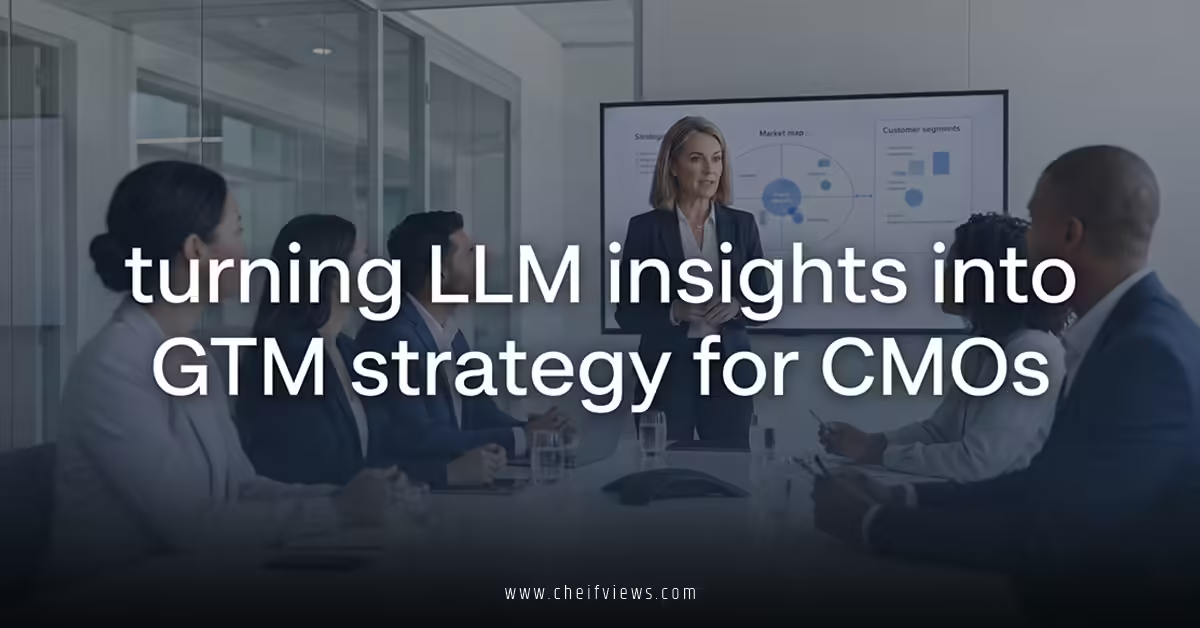
turning LLM insights into GTM strategy for CMOs is no longer a “nice to have experiment.” It’s the difference between guessing your way into market and orchestrating a GTM engine that’s listening to the customer 24/7 at scale. The tech is ready. The question is whether your strategy is.
Here’s the quick, answer-ready version before we go deeper:
- turning LLM insights into GTM strategy for CMOs means using large language models to mine customer, market, and internal data and translate that into concrete GTM decisions across positioning, messaging, channels, and plays.
- It matters because LLMs can process unstructured data (calls, chats, reviews, social, RFPs) at a scale your team never will – and surface patterns your GTM team can actually act on.
- Done right, it tightens ICP focus, sharpens value props, and aligns product, marketing, and sales around the same insight backbone.
- The payoff: faster iteration cycles, better message–market fit, and more efficient pipeline and revenue growth.
- The risk: random “AI experiments” with no operating model, no governance, and no path from cool dashboard to actual GTM decisions.
What turning LLM insights into GTM strategy for CMOs actually means
Most CMOs hear “LLM insights” and think dashboards, summaries, maybe a clever chatbot. That’s table stakes.
When people talk about turning LLM insights into GTM strategy for CMOs, what they should mean is this:
- You feed LLMs real data from your world: Gong/Zoom transcripts, CRM notes, NPS comments, win/loss interviews, support tickets, social mentions, competitive intel, analyst reports.
- You ask targeted, structured questions tied directly to GTM outcomes:
- Which segments show the highest intent and fastest payback?
- What buying triggers and jobs-to-be-done show up in language customers actually use?
- What objections block deals and which proof points resolve them?
- You turn those patterns into decisions:
- ICP definition and prioritization.
- Messaging and narrative.
- Campaign themes, content angles, and offers.
- Sales plays, talk tracks, and enablement.
In my experience, the CMOs who win here don’t obsess over “AI features.” They obsess over the operating rhythm that turns messy input → modeled insight → GTM moves → learning loop.


Why this matters now (not “sometime this year”)
A few grounding facts:
- Generative AI and LLM adoption in marketing is now mainstream. Surveys from firms like McKinsey and Deloitte show a sharp uptick since 2023 in AI use across marketing, sales, and product, especially in larger organizations.
- Search is shifting hard toward AI Overviews and answer-first interfaces, which means your content and messaging need to be structurally “answer-ready” and consistent across channels if you want to show up.
- Buyers leave a huge trail of unstructured signals: calls, emails, chats, social posts, reviews. Historically, most of that never makes it into GTM planning.
So the competitive question is simple: do you continue to rely on slide decks built from a handful of anecdotes and a quarterly win/loss report—or do you turn your entire “voice of customer exhaust” into a living GTM nervous system?
The core building blocks: LLM insights → GTM motion
To make turning LLM insights into GTM strategy for CMOs practical, break it into five building blocks:
- Data foundation – What you feed the model.
- Insight recipes – The prompts and workflows that extract signal.
- Decision frameworks – How GTM leaders turn patterns into choices.
- Execution hooks – Where the outputs plug into your GTM systems.
- Governance & guardrails – How you keep it compliant, accurate, and aligned.
Think of it like wiring a new analytics layer into an existing revenue engine, not bolting on a toy.
Quick comparison: old way vs LLM-powered GTM
Here’s an at-a-glance view to anchor expectations.
| Dimension | Traditional GTM Insight Process | LLM-Driven GTM Insight Process |
|---|---|---|
| Data types | Structured data (CRM fields, survey scores, basic web analytics) | Structured + unstructured (calls, emails, chats, reviews, RFPs, social) |
| Insight speed | Quarterly or campaign-based reviews | Near real-time themes and trends |
| Depth of customer language | Summarized by analysts or product marketing | Direct buyer phrases, intents, jobs-to-be-done surfaced at scale |
| Personalization | Segment-level, broad personas | Micro-segmented, context-aware messaging & plays |
| Who uses it | Strategy & analytics teams | Strategy + in-the-trenches sellers, marketers, CS reps |
| Change velocity | GTM plan updated 1–2 times/year | Continuous iteration on messaging, content, and plays |
turning LLM insights into GTM strategy for CMOs: a simple maturity model
Before building anything big, figure out where you are:
- Level 1: Experimenting
- One-off prompts, maybe an assistant summarizing calls.
- No defined process, no connection to GTM plans.
- Level 2: Insight-aware
- LLMs mining specific datasets (e.g., support tickets, reviews).
- Insights shared as one-pagers or dashboards, sometimes used in planning.
- Level 3: Operating model
- turning LLM insights into GTM strategy for CMOs becomes a ritual: monthly “AI insight sprints” feeding roadmap, campaigns, and enablement.
- Prompts and workflows standardized. Ownership clear.
- Level 4: Embedded
- LLM-driven insights wired directly into tools: CRM, marketing automation, enablement platforms, content systems.
- Sales and marketing consume insights inside their daily workflows.
The goal isn’t to jump to Level 4 in a quarter. It’s to climb deliberately without creating AI chaos.

Step-by-step action plan: from zero to operating rhythm
This is the “what I’d do if I were parachuted in as your interim CMO” section.
Step 1: Define the GTM questions before the tech
Ask blunt questions first; tools come later:
- Which segments actually drive efficient growth?
- Where are we losing deals, and why?
- Which pain points resonate across top customers?
- What objections consistently stall or kill deals?
- Where do buyers get stuck in our journey?
In my experience, CMOs skip this and go straight to “what can the LLM do?” That’s backwards. Strategy questions first, prompts second.
Step 2: Map and prioritize data sources
You don’t need everything at once. Start with “high signal per unit pain” sources:
- Call recordings and transcripts (sales, CS, onboarding).
- Win/loss notes and opportunity fields in CRM.
- Support tickets and chat logs.
- Review sites and community forums.
- Existing VOC surveys and open-text NPS comments.
Then ask:
- What’s easy to access without a six-month data engineering project?
- What’s rich in actual customer language, not internal jargon?
- What has clear GTM linkage (e.g., mapped to opportunity outcomes)?
From there, prioritize a first cohort of 2–3 sources to pull into your LLM workflow.
Step 3: Set up a basic LLM insight workspace
Whether you use a commercial platform, a cloud provider’s LLM, or an internal setup, the pattern is similar:
- Centralize your chosen data (or connect to where it already lives).
- Use retrieval-augmented generation (RAG) or similar to ground the model in your actual data, not just general web training.
- Lock down roles and permissions—especially around call recordings, PII, and anything that touches customer contracts or health data.
If you’re in a regulated industry, align this step with your legal, compliance, and data security stakeholders up front. Guidance from sources like the U.S. Federal Trade Commission and NIST on AI risk and data use is worth building into your policies from day one.
Step 4: Build “insight recipes” for core GTM areas
Think of “insight recipes” as reusable prompt templates tied to GTM outcomes. For example:
- ICP & segmentation recipe
- Input: Closed-won opp notes, top customer transcripts, usage data summaries.
- Output: Segmented profiles with common triggers, use cases, and decision criteria.
- Messaging and positioning recipe
- Input: Call transcripts, reviews, competitive mentions, analyst language.
- Output: Ranked list of pain points, value themes, and phrases customers use—plus what they don’t respond to.
- Objection handling recipe
- Input: Discovery and late-stage call transcripts, lost-deal notes.
- Output: Objection clusters and associated responses that correlated with wins.
- Content strategy recipe
- Input: Top-performing content, SERP analysis, chat logs, and search queries from your own site.
- Output: Topic clusters, content gaps, and specific content briefs.
You don’t need a hundred recipes. Start with 5–10 that map directly to your GTM levers.
Step 5: Turn insights into concrete GTM moves
Here’s where most programs stall. They stop at “interesting insights.”
To avoid that, create an explicit path from insight → decision → action:
- Monthly GTM Insight Review
- 60–90 minutes with marketing, product marketing, sales leadership, and RevOps.
- Review LLM-generated patterns and “spikes” in customer language or objections.
- Agree on 2–3 “bets” to act on for the next cycle.
- Translate into specific plays
Examples:- Update narrative and homepage hero copy to reflect the top 2 jobs-to-be-done surfaced by LLMs.
- Launch a targeted sequence for a micro-segment where the LLM found a spike in urgency and clear use case.
- Refresh sales talk tracks and objection-handling guides based on patterns from the last 60 days of calls.
- Instrument the change
- Tag new campaigns, sequences, and scripts so you can see performance deltas.
- Feed those results back into the LLM workspace as labelled data.
This is the flywheel: LLM insights → GTM experiment → performance data → smarter LLM insights.
Step 6: Embed into systems and teams
Once you see real traction:
- Pipe summarized insights into your CRM as fields or notes visible on accounts and contacts.
- Feed prioritized themes into your marketing automation platform for segmentation, scoring, and dynamic content.
- Integrate into your enablement platform so reps see “insight cards” alongside content, scripts, and training.
At this point, turning LLM insights into GTM strategy for CMOs shifts from “initiative” to “infrastructure.”
Common mistakes & how to fix them
Every CMO I’ve seen wrestle with this hits at least a few of these.
Mistake 1: Treating LLMs as magic oracles
What happens: Teams ask vague questions like “What’s our ideal customer?” and get fluffy, generic answers. Execs roll their eyes and move on.
Fix: Anchor prompts to data and GTM questions. Context about your product, market, and historical performance is non-negotiable. Train teams to ask narrow questions with clear inputs.
Mistake 2: No owner, no operating cadence
What happens: A few pilots, some cool demos, then everything stalls. No one quite knows who’s on the hook for outcomes.
Fix: Give turning LLM insights into GTM strategy for CMOs a single accountable owner—usually a senior product marketing leader or a RevOps leader partnered with you. Define a recurring cadence: monthly insight review, quarterly roadmap tie-in.
Mistake 3: Insights that never leave PowerPoint
What happens: Beautiful decks, zero behavior change. Reps keep using old decks. Campaigns follow the same old calendar.
Fix: Hard rule: no insight without a corresponding decision and action. For each major insight, require:
- What GTM artifact will change?
- Who owns the change?
- How will we measure impact?
Mistake 4: Ignoring data quality and bias
What happens: The LLM confidently amplifies skewed or incomplete data, and leadership questions the whole initiative.
Fix:
- Audit which accounts, segments, and channels are overrepresented in your source data.
- Label data (e.g., by segment, win/loss, stage) so you can slice and verify patterns.
- Combine LLM findings with human review from sales, CS, and product for sanity checks.
Guidance from organizations like NIST on AI bias and risk management can help shape your internal standards and review practices.
Mistake 5: Over-automating customer language
What happens: Teams start pushing LLM-generated messaging into campaigns and sales scripts with minimal oversight. Brand voice fractures. Things feel… off.
Fix: Use LLMs to surface patterns and first drafts, not final copy. Product marketing and brand should still own narrative and signoff—LLMs just give them better raw material.
Practical use cases CMOs can ship in 90 days
If you need tangible wins fast, here’s what typically works within a quarter:
- Message-market fit check
- Use LLMs to compare your current messaging and website copy against customer and prospect transcripts.
- Identify phrases no one repeats back to you—and the phrases they do.
- Adjust narrative and top-of-funnel assets accordingly.
- Objection handling and sales enablement refresh
- Mine the last 60–90 days of sales calls for objection clusters.
- Build new objection guides and microcontent (slides, one-pagers, snippets) aligned to what actually works in winning calls.
- Content and SEO strategy upgrades
- Feed in your content library, search queries, and customer conversations.
- Have the LLM surface topic clusters, gaps, and “jobs” your content should address.
- Build briefs that are structurally ready for AI search overviews, with crisp summaries and clear answer blocks.
- Segment-level GTM plays
- Have the LLM cluster customers by use case, job title, or language patterns.
- Design 1–2 high-intent micro-segment plays (tailored offers, messages, and outreach sequences).
How turning LLM insights into GTM strategy for CMOs changes the CMO role
This shift isn’t just tactical. It rewires what being a CMO feels like.
- You spend less time arguing anecdotes and more time aligning on patterns from millions of words of customer dialogue.
- You can test and adapt narratives faster because insight cycles compress.
- Your GTM organization becomes more “market-listening” by default instead of relying on annual planning and static personas.
The kicker is this: you stop being the “brand and campaigns person” and become the executive who runs a continuously learning revenue system.
FAQs on turning LLM insights into GTM strategy for CMOs
1. How do I start small with turning LLM insights into GTM strategy for CMOs without a huge AI budget?
Start with what you already have: call recordings, CRM notes, and support tickets. Use an existing LLM provider or a trusted SaaS that supports retrieval over your data, define 3–5 core GTM questions, and run a 60-day pilot focused on one area like messaging or objection handling. The goal is to prove that turning LLM insights into GTM strategy for CMOs drives one clear outcome—better close rates, higher response rates, or tighter ICP—before you scale.
2. How do I keep turning LLM insights into GTM strategy for CMOs compliant and secure?
Work closely with legal, security, and data protection teams from day one. Use providers that offer clear data handling commitments, strong access controls, and configurable retention settings. Align with reputable guidance on AI risk and privacy (for example, resources from the U.S. Federal Trade Commission and NIST) and limit which datasets feed the LLM until controls are battle-tested.
3. How do I measure the ROI of turning LLM insights into GTM strategy for CMOs?
Tie each LLM insight initiative to a specific GTM metric: win rate for targeted segments, sales cycle length, campaign conversion rates, or pipeline efficiency. Label GTM changes driven by LLM insights (new narratives, plays, content) and compare performance against historical baselines or control groups. Over time, you’ll see where turning LLM insights into GTM strategy for CMOs consistently moves the needle and where you need to refine your approach.