



AI-driven employee retention and skills gap analysis is the practical way to spot who might leave, why they might leave, and what skills your team is missing before the business feels the pain. Done right, it gives HR and managers a cleaner view of turnover risk, internal mobility, and future hiring needs. It matters because U.S. labor churn is still real, openings remain elevated, and skills shortages are hitting hiring managers hard.hrdive+2
- It combines retention signals with workforce capability data, so you can see risk and readiness in the same place.aihr+1
- It helps you move from reactive firefighting to proactive coaching, training, and succession planning.hr+1
- It works best when it is fed with clean, job-relevant data and paired with human judgment, not used as a black box.bls+1
- For beginner teams, the win is simple: fewer surprises, smarter upskilling, and better manager conversations.
- For intermediate teams, the payoff is tighter workforce planning and faster moves into hard-to-fill roles.
Why this matters now
The labor market keeps sending the same message: hiring is not just about filling seats; it is about filling the right seats with people who can grow into the work. The U.S. Bureau of Labor Statistics reported 6.9 million job openings in March 2026, while hires and separations continued to move around enough to keep workforce planning from feeling sleepy. At the same time, BLS skills data uses O*NET-backed occupation skill information, which makes it a strong foundation for mapping what jobs actually require.bls+1
Here’s the kicker. Retention and skills are the same story wearing different hats. If employees do not see a path forward, they drift. If the company cannot close skill gaps, the pressure lands on the same people again and again.
What it really is
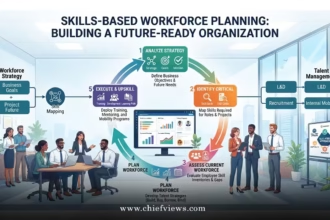
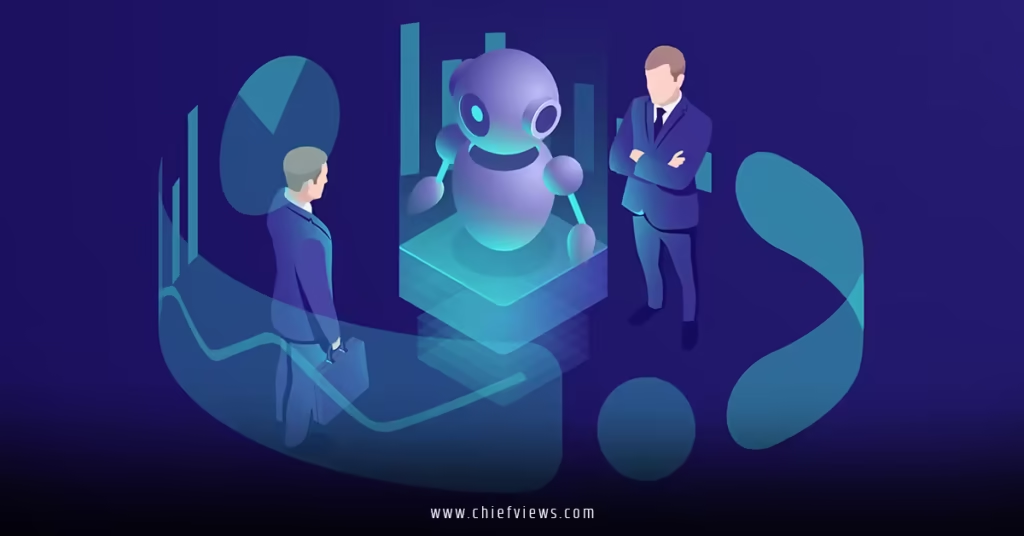
Think of AI-driven employee retention and skills gap analysis as a radar system for your workforce. One side watches for signals that someone may be headed out the door. The other side measures whether your current team can actually do the work coming next.
In practice, AI looks at patterns across engagement data, performance trends, attendance, manager feedback, internal moves, learning activity, and role requirements. AIHR notes that these systems are commonly used for turnover prediction, workforce planning, and skills gap analysis in HR. HR.com’s 2025-26 retention research also found that respondents expect AI to help most with identifying skills gaps and recommending targeted training.aihr+1
How the pieces fit
| Capability | What it answers | What HR does with it |
|---|---|---|
| Retention risk modeling | Who is likely to leave soon? | Target manager check-ins, workload fixes, and career pathing. |
| Skills gap analysis | Which roles lack critical skills? | Prioritize training, hiring, and internal mobility. |
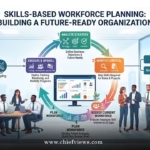
| Workforce planning | What skills will we need next quarter or next year? | Align learning budgets and headcount plans. |
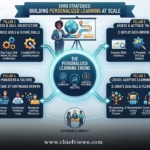
| Personalized development | What should each employee learn next? | Build tailored learning paths and stretch assignments. |
This is not crystal-ball magic. It is pattern recognition plus decent process. And when the process is sloppy, the model becomes a very expensive mirror.
AI-driven employee retention and skills gap analysis in plain English
The best way to use AI-driven employee retention and skills gap analysis is to treat it like a triage tool, not a verdict machine. It tells you where to look first. It does not tell you who deserves trust, who is lazy, or who should be pushed out.
A better question is this: which teams are showing friction, and which roles are becoming harder to staff because the skills are changing faster than the training plan? That is where the value lives. Georgetown’s Center on Education and the Workforce warns that the U.S. is facing growing skills shortages, with retirements expected to outpace younger workers entering the labor market in key credentialed roles from 2024 through 2032.cew.georgetown
AI-driven employee retention and skills gap analysis for beginners
Start small. Pick one business unit, one turnover problem, and one skills family. Do not try to boil the ocean on day one.
Use this sequence:
- Pull clean data from HRIS, performance reviews, learning records, engagement surveys, and job architecture.
- Define the outcome you care about, such as regrettable attrition or inability to fill frontline supervisor roles.
- Map required skills by role using a trusted framework like BLS skill data tied to occupations.bls
- Ask the model to surface patterns, not decisions.
- Validate the results with managers and HRBPs before taking action.
- Launch one fix, like targeted training or stay interviews, and measure the change.
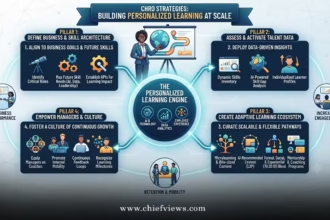
What I’d do if I were starting from scratch: I’d pick the five roles with the highest vacancy pain, then build a simple skills matrix and a turnover-risk dashboard. Clean, boring, useful. That’s the game.
AI-driven employee retention and skills gap analysis for intermediate teams
Once the basics are in place, move from reporting to intervention. Tie risk scores to manager actions, learning recommendations, internal gigs, and succession planning. The real upside shows up when employees see a path from “I’m stuck” to “I can move.”
At this stage, segment by job family, location, tenure, and skill adjacency. That makes the model smarter and the interventions less generic. It also keeps you from blasting the same training module to everyone and hoping for the best.
The action plan
Here’s the cleanest rollout path.
- Define the business problem.
Be specific. “Reduce attrition” is vague. “Cut first-year turnover in customer service by 15%” is usable. - Audit the data.
Check whether your HRIS, ATS, LMS, and survey data actually connect. Garbage in, garbage out is not a slogan. It is a bill. - Build the skills map.
Use role requirements, manager input, and external occupational data to define current and future skill needs.bls - Model retention risk.
Look for patterns in workload, tenure, internal movement, manager changes, promotion timing, and learning activity.aihr - Design interventions.
Match the insight to an action: coaching, pay review, schedule changes, role redesign, cross-training, or advancement paths. - Measure what changes.
Track attrition, internal transfers, learning completion, time-to-productivity, and vacancy duration. - Refresh the model.
Workforce data ages fast. Recheck it on a regular cadence so the system does not start speaking yesterday’s truth.
Common mistakes and fixes
The first mistake is treating AI like a replacement for management. It is not. If a team is burning out, the answer is not a prettier dashboard.
The second mistake is using broad, messy data. If titles are inconsistent and skills are vaguely described, your model will hallucinate confidence. Fix your job architecture before you chase fancy predictions.
The third mistake is ignoring compliance and bias risk. Employers using AI in hiring and employment decisions should stay alert to long-standing federal anti-discrimination principles, and the safest path is continuous monitoring, validation, and documentation. That means testing outcomes, checking for adverse impact, and keeping humans in the loop.employarmor
The fourth mistake is shipping insights with no follow-through. A retention flag without a manager action is just digital gossip. The model should trigger something concrete.
What good looks like
When AI-driven employee retention and skills gap analysis works, the business feels less chaotic. Managers get better conversations. Employees get clearer next steps. HR stops being the department of post-mortems and starts acting like a strategy team.
It also helps organizations build a more durable talent pipeline. Instead of waiting for a resignation email or a failed search, leaders can see the gap forming and close it earlier. That is the difference between patching leaks and designing a better pipe.
Key takeaways
- AI-driven employee retention and skills gap analysis connects turnover risk with workforce capability in one view.
- The strongest use case is not surveillance; it is earlier, smarter intervention.
- Clean job data and clear skill definitions matter more than fancy models.
- Start with one problem, one team, and one measurable outcome.
- Use AI to support manager judgment, not override it.
- Internal mobility and targeted upskilling usually beat generic training blasts.
- Keep an eye on bias, documentation, and ongoing validation.
- The real win is better decisions, faster.
The main benefit is simple: you stop guessing and start managing the workforce you actually have, not the one you wish you had. Build the system, keep it human, and use the insights to move people forward before they move on.
FAQs
What is AI-driven employee retention and skills gap analysis used for?
It is used to identify employees at risk of leaving and to show which skills your workforce lacks for current and future roles. That helps HR focus on coaching, training, internal mobility, and hiring where it matters most.hr+1
How accurate is AI-driven employee retention and skills gap analysis?
It can be very useful, but only if the inputs are clean and the model is validated regularly. It should guide decisions, not make them alone, because workforce data changes and human context still matters.employarmor+1
What is the fastest way to start with AI-driven employee retention and skills gap analysis?
Start with one business unit, define one retention problem, map the role skills, and connect the analysis to one action such as stay interviews or targeted upskilling. That keeps the rollout practical and measurable.hr+1