





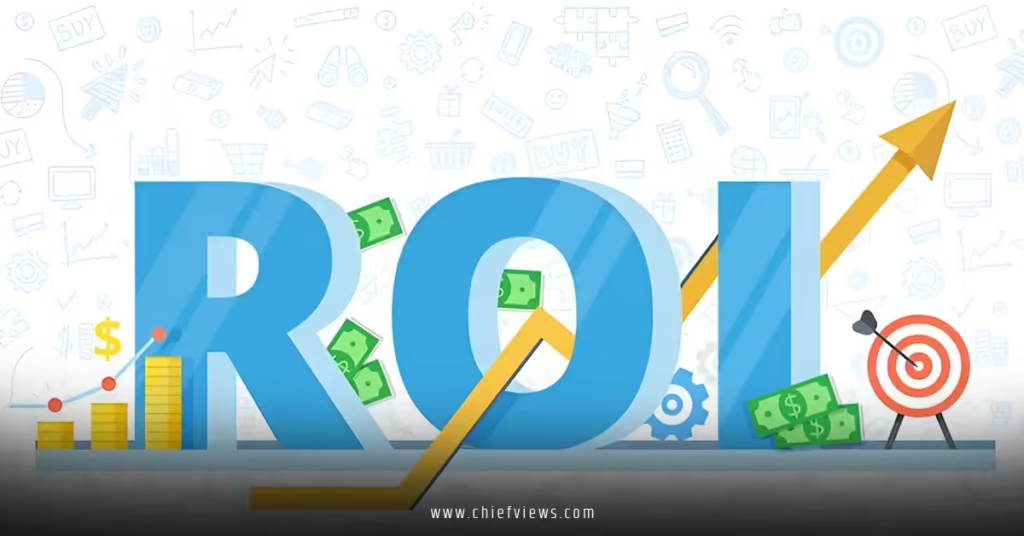
How CMOs can measure marketing ROI in the age of generative AI comes down to blending old-school revenue tracking with new tools that handle AI’s messy, multiplier effects. Forget simple last-click attribution. AI content, personalization engines, and agentic campaigns create value across the entire funnel in ways traditional dashboards miss.
The pressure is real. Budgets stay flat while boards demand proof that AI spend delivers more than faster content slop. Smart CMOs build hybrid systems that track efficiency, incrementality, and pipeline impact. Those who nail it turn AI from a cost center into a predictable growth lever.
- Hybrid attribution models that credit AI touchpoints without double-counting.
- Incrementality testing to isolate AI-driven lift from baseline performance.
- Efficiency + outcome metrics linking time/cost savings to actual revenue.
- Unified dashboards connecting MarTech, CRM, and AI tool usage data.
- Governance frameworks to ensure quality and compliance don’t erode gains.
This approach matters because generative AI scrambles traditional measurement. One prompt can spawn 50 variants that feed into personalized journeys. Without updated playbooks, you fly blind.
Why Traditional ROI Falls Apart with Generative AI
Classic ROI formulas break when AI enters the picture. You generate 10x more assets. Personalization hits new levels. But linking that output to closed-won deals gets fuzzy fast.
What usually happens is teams celebrate vanity metrics—pieces produced, engagement rates—while finance asks the hard question: “Where’s the money?” AI amplifies both good and bad campaigns. A weak strategy with AI just fails faster and at scale.
The kicker is this creates a false choice: efficiency or effectiveness. Winners measure both. They track how AI compresses campaign cycles and whether those faster campaigns actually move revenue needles.

Core Metrics That Actually Matter in 2026
Focus on layers. Efficiency metrics show input improvements. Performance metrics show output quality. Business metrics tie it to the P&L.
| Metric Category | Key Examples | Why It Matters | Benchmark (2025-2026) |
|---|---|---|---|
| Efficiency | Time saved per asset, Cost per output, Campaign launch speed | Proves productivity gains | 49% of CMOs cite time efficiency as primary ROI (Gartner) |
| Performance Lift | Conversion rate delta, Engagement quality, Personalization uplift | Shows AI improves effectiveness | 15-40% lift in targeted campaigns |
| Revenue Impact | Incremental revenue, Pipeline contribution, CAC reduction | Connects to business outcomes | Revenue-linked attribution improvements of 18-22% |
| Quality & Risk | Hallucination rate, Brand compliance score, Customer sentiment | Prevents value erosion | Critical for long-term trust |
Data from sources like Gartner CMO Spend Survey highlight time and cost efficiency as top reported wins, but revenue connection remains the real test.
How CMOs Can Measure Marketing ROI in the Age of Generative AI: A Step-by-Step Action Plan
How CMOs Can Measure Marketing ROI in the Age of Generative AI:Start simple if you’re earlier in the journey. Scale to sophisticated models as data matures.
Step 1: Baseline everything. Before layering more AI, lock in current performance across channels. Run control campaigns.
Step 2: Implement multi-touch attribution. Move beyond last-click. Use data-driven models in Google Analytics 4 or advanced platforms that incorporate AI signals.
Step 3: Run incrementality tests. Geo-holdouts, synthetic controls, or A/B tests with AI on/off. This isolates true lift. BCG emphasizes strong measurement as the foundation for scaling GenAI.
Step 4: Build a unified dashboard. Connect your CDP, CRM, ad platforms, and AI tools. Track AI-specific spend and usage.
Step 5: Calculate blended ROI. Formula gets practical: (Incremental Revenue + Efficiency Savings – AI Investment Costs) / AI Investment Costs. Factor in both hard dollars and time value.
Step 6: Review weekly, act monthly. AI moves fast. Set thresholds for killing underperformers.
What I’d do if stepping into a new CMO role tomorrow? Audit the top three AI use cases (content, ads, personalization) and tie each to a revenue proxy within 30 days.
Common Mistakes & How to Fix Them
Teams still chase volume over value. They measure outputs (assets created) instead of outcomes (revenue influenced).
Mistake 1: Ignoring quality decay. AI content floods channels but tanks trust if not governed. Fix: Add human review loops and brand safety scores. Track downstream metrics like bounce rate or sentiment.
Mistake 2: Siloed data. Marketing AI lives separate from sales systems. Fix: Invest in clean first-party data pipelines. Explore Google’s guidance on privacy-safe measurement for compliant tracking.
Mistake 3: Short measurement windows. AI benefits compound. Fix: Use longer horizons for brand and upper-funnel efforts. McKinsey research on attribution shows proper models unlock 18-22% better budget allocation.
Mistake 4: No incrementality. Claiming all gains from AI when the market lifted everything. Fix: Consistent testing protocols.
The fresh analogy here? Think of generative AI like adding rocket fuel to your marketing engine. It accelerates hard, but without a solid navigation system, you burn cash and miss the target.
Advanced Tactics for Intermediate CMOs
How CMOs Can Measure Marketing ROI in the Age of Generative AI:Layer in predictive analytics. Use AI to forecast campaign ROI before full launch. Experiment with agentic systems that optimize in real-time based on performance signals.
Tie marketing to share of voice or brand consideration metrics that correlate with pipeline. Run experiments linking upper-funnel AI content to downstream sales velocity.
Forbes councils and industry leaders stress tracking decision speed, workflow automation depth, and capacity expansion alongside traditional ROAS.
Key Takeaways
- Blend efficiency, performance, and revenue metrics for a complete picture.
- Incrementality testing beats attribution alone for proving AI value.
- Data quality and governance determine whether AI delivers or destroys ROI.
- Unified dashboards and cross-team alignment turn measurement into action.
- Start with baselines and quick wins, then scale to predictive models.
- Measure quality alongside quantity—bad AI scales failure.
- Review frequently because the tech and customer behavior shift constantly.
- Connect everything back to business outcomes that finance understands.
Marketing leaders who master how CMOs can measure marketing ROI in the age of generative AI gain more than credibility with the C-suite. They unlock bigger budgets and faster iteration cycles. The next step? Pick one under-measured AI use case in your stack and build a mini incrementality test this quarter. Run it, learn, then expand.
FAQs
How do beginners start measuring AI marketing ROI without complex tools?
Focus on before-and-after comparisons for specific campaigns. Track time saved, basic conversion lifts, and manual cost calculations. Use free tiers of analytics platforms and build from there. How CMOs can measure marketing ROI in the age of generative AI starts with disciplined experimentation, not perfect tech.
Can you rely solely on multi-touch attribution for generative AI campaigns?
No. Combine it with incrementality testing. Attribution shows distribution; incrementality proves causation. This hybrid approach handles AI’s indirect influences better than any single model.
What role does data privacy play in measuring marketing ROI with AI?
Huge. Stricter regulations force first-party data strategies. Check FTC guidelines on AI and marketing to stay compliant while building accurate attribution. Clean, consented data beats volume every time.
How often should CMOs reassess their AI ROI frameworks?
Quarterly at minimum. The technology evolves monthly. Set recurring audits that include finance stakeholders to keep everyone aligned on definitions and success thresholds.
Does generative AI always improve marketing ROI?
Only when paired with strategy and measurement. Many teams see efficiency gains but miss revenue impact due to poor integration. Strong frameworks separate the winners.