



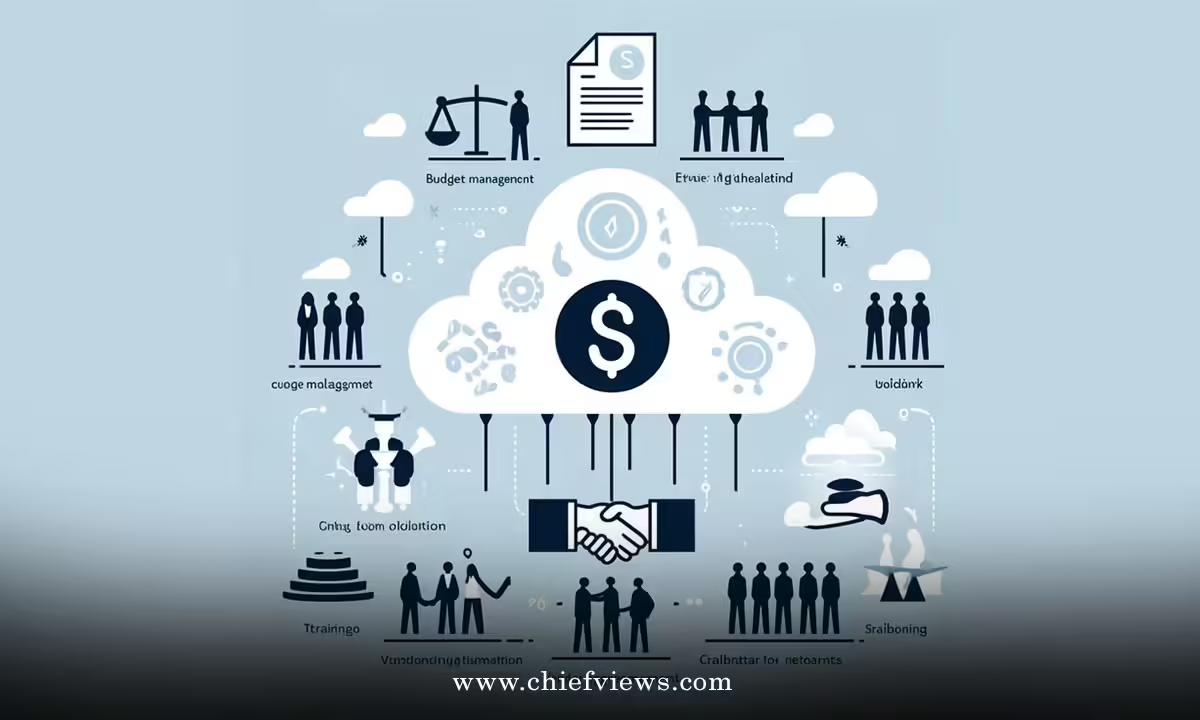
AI FinOps and cloud cost governance frameworks turn uncontrolled AI spend into a managed economic system. Token bills swing wildly. Agentic loops multiply costs overnight. Traditional cloud FinOps tools were never built for this volatility.
Here’s the quick overview of what matters and why CFOs and platform leaders are rewriting the playbook in 2026:
- AI FinOps extends classic cloud cost management into tokenomics, model routing, and outcome-linked spend.
- 98% of FinOps teams now track AI costs, up from 31% two years earlier, according to the FinOps Foundation.
- Visibility alone is not enough. Real control requires hard budgets, attribution by agent or team, and continuous unit-economics measurement.
- Mature practices link every dollar of inference or orchestration cost back to a completed business outcome.
- Without governance, organizations routinely exceed AI forecasts by 2–3x and face the same cancellation pressure that has already hit many agentic pilots.
The old model of monthly cloud invoices and reserved-instance shopping does not survive agentic workloads. A single multi-step agent can burn tokens at rates that make last quarter’s forecast look quaint.
Why Classic Cloud FinOps Falls Short on AI
Cloud FinOps mastered compute hours, storage tiers, and commitment discounts. AI introduces a different unit of cost: the token. Input tokens, cached tokens, output tokens, and the loops that generate them behave nothing like a steady EC2 instance.
Agentic systems compound the problem. Long-lived context, tool calls, retries, and multi-agent handoffs can drive token volume 100 to 1,000 times higher than a simple chat query. McKinsey’s work on agentic economics shows that token costs themselves often represent only 20–25% of variable run costs in many workflows; human oversight and orchestration take the rest.
What usually happens is teams bolt AI spend onto existing cloud cost tools, get a lagging invoice view, and discover the overrun only after the board asks hard questions. By then the damage is done.


AI FinOps and cloud cost governance frameworks close that gap by treating tokens as a real-time economic signal rather than a delayed line item.
The Four Pillars of Effective AI FinOps
Most successful programs in 2026 rest on four practical pillars adapted from the FinOps Foundation domains and extended for AI.
Visibility
You cannot govern what you cannot see. Unify LLM API spend, GPU inference, orchestration platforms, and traditional cloud into one view. Attribute costs by team, product, agent, or customer. Tagging discipline remains the foundation. Without clean tags, allocation collapses.
Optimization
Rightsizing moves from instance type to model selection. Route routine classification to cheap models. Cache stable prompts. Compress context. Batch non-real-time work. These levers routinely deliver 30–60% reductions once visibility is in place.
Governance
Soft alerts are not enough. Set hard spend caps that can pause traffic at the gateway or wallet level. Enforce budgets per agent, per business unit, or per environment. Real-time circuit breakers stop runaway loops before they become six-figure surprises.
Operating Model
Treat AI FinOps as a permanent capability, not a project. Cross-functional ownership between finance, platform engineering, and business domain owners. Monthly reviews that examine both cost and value. This is where the practice connects directly to the broader CFO guide to agentic AI ROI measurement and token economics 2026.
Core Framework Comparison
| Element | Traditional Cloud FinOps | AI FinOps & Cloud Cost Governance | Practical Impact |
|---|---|---|---|
| Primary cost unit | Compute-hour, GB-month | Token (input/output/cached) + orchestration | Requires new metering and attribution |
| Volatility | Predictable within a few percent | Order-of-magnitude swings on agent loops | Hard caps and real-time controls become mandatory |
| Attribution | Account, tag, service | Team, agent, prompt, model, customer | Chargeback and showback need finer grain |
| Optimization levers | Reserved instances, rightsizing, idle cleanup | Model routing, caching, prompt efficiency, workflow redesign | Engineering decisions directly affect the bill |
| Governance style | Monthly reports and alerts | Real-time budgets, circuit breakers, policy-as-code | Prevents overruns instead of explaining them |
| Success metric | Cost reduction percentage | Cost per completed business outcome | Links spend to ROI, not just savings |
Sources include FinOps Foundation State of FinOps reporting and observed enterprise patterns in 2026.
Step-by-Step Action Plan
Start simple. Do not try to boil the ocean.
- Assign a single accountable owner for AI cost before adding more models or providers.
- Inventory every AI spend source: direct LLM APIs, managed platforms, self-hosted inference, and orchestration layers.
- Implement consistent tagging and virtual tags so every dollar can be attributed to a team or product.
- Stand up a unified dashboard that shows both traditional cloud and AI token spend in the same currency.
- Set initial hard budgets or spend caps at the project or agent level. Start conservative.
- Instrument cost-per-outcome metrics for the highest-volume workflows.
- Introduce model routing and caching policies at the gateway layer.
- Run monthly cross-functional reviews that examine both spend trends and business value delivered.
- Expand to chargeback or showback once attribution is trusted.
- Continuously refine based on actual unit economics.
In my experience, the organizations that name the owner first and build the single view second move fastest. Everything else follows.

Common Mistakes and How to Fix Them
Mistake 1: Treating AI spend as just another cloud line item.
Fix: Create dedicated visibility and governance for tokens and agents.
Mistake 2: Policies without enforcement.
Fix: Move from email alerts to hard caps that can pause traffic.
Mistake 3: Optimizing before attributing.
Fix: Clean tags and a single source of truth come before rightsizing.
Mistake 4: Ignoring the link to business outcomes.
Fix: Pair every major AI cost center with a cost-per-completed-process metric. This is the bridge to the CFO guide to agentic AI ROI measurement and token economics 2026.
Mistake 5: Leaving ownership fuzzy across finance, engineering, and product.
Fix: Name one person accountable and give them the data and authority.
Building Governance That Scales
Mature AI FinOps and cloud cost governance frameworks embed cost awareness into the development lifecycle. Engineers see projected token cost at the point of model selection. Platform teams enforce routing policies through gateways. Finance sees real-time burn against budget.
Tools that sit in the request path—gateways, proxies, and wallets—make enforcement practical. Policy-as-code turns rules into automated controls rather than after-the-fact reports.
The goal is not the lowest possible spend. It is the highest value per dollar spent. That requires continuous feedback between cost data and business results.
Key Takeaways
- AI FinOps is now a core FinOps priority for nearly every enterprise team managing significant model spend.
- Tokens introduce volatility that classic cloud tools cannot handle alone.
- Visibility, optimization, real-time governance, and a clear operating model form the practical foundation.
- Attribution by team, agent, and outcome turns cost data into decision data.
- Hard spend controls prevent overruns; soft alerts only explain them.
- Link AI cost governance directly to unit economics and ROI measurement for board-level credibility.
- Start with ownership and a unified view. Expand from there.
- Organizations that treat AI spend as an economic system rather than a technology bill keep control as agentic usage grows.
AI FinOps and cloud cost governance frameworks give finance and platform leaders the same discipline they already apply to cloud, only tuned for the speed and unpredictability of tokens and agents. Get the measurement and controls right, and the ROI conversation becomes straightforward instead of defensive.
Next step: name the AI cost owner this week and inventory every source of model and orchestration spend. That single action starts the real work.
FAQs
How does AI FinOps differ from traditional cloud cost management?
Traditional FinOps focuses on predictable compute and storage. AI FinOps adds token-level metering, model routing, real-time caps, and outcome-based unit economics because agentic workloads are far more variable.
What is the first practical step in building AI FinOps and cloud cost governance frameworks?
Assign clear ownership and create a single view that combines traditional cloud spend with AI token and inference costs. Without attribution, every other control is guesswork.
How do AI FinOps practices support the CFO guide to agentic AI ROI measurement and token economics 2026?
They supply the real-time cost data, attribution, and governance needed to calculate reliable cost-per-completed-process metrics and keep agentic programs accountable to business outcomes.